
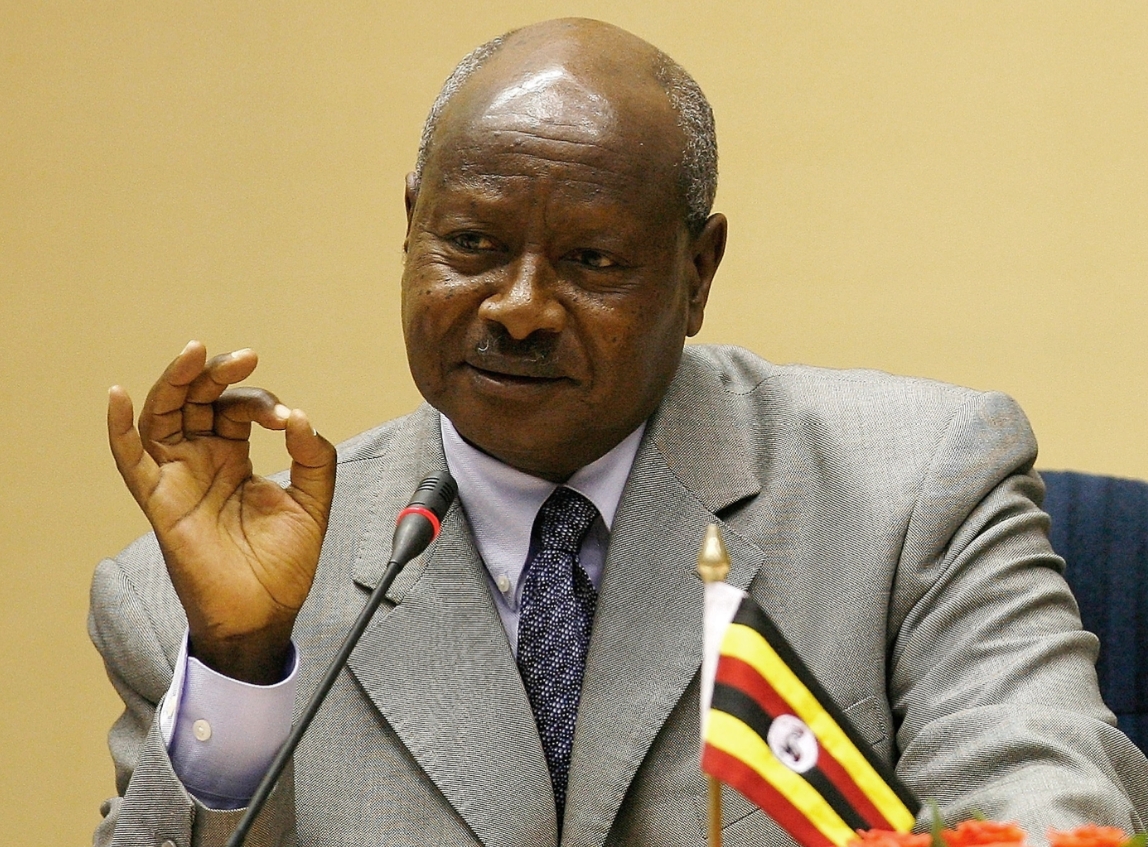
President Yoweri Kaguta Museveni has been in power since 29 January 1986, for a good 26 unbroken years. Under him, Uganda has achieved political, economic and social stability, three vital elements that eluded the country for the first 25 years of independence. Now Museveni says the East African nation “is on the verge of a take-off to become a middle-income, and then a modern, country”. As part of the 50 years of independence celebrations, he granted New African’s editor, Baffour Ankomah, a wide-ranging interview in State House Entebbe, in which he talked about almost everything – from cattle to roads, to politics and economics.
Q: From your book, Sowing the Mustard Seed, and from what you have done practically since coming to power in January 1986, we learn that you love cattle, you are a man of cattle. It is unusual, isn’t it, to find a man of your standing who has a great passion for cattle like you do?
A: Well, it is my life. I am a cattle keeper; I just came to town to help these people because they were stuck. But my base is in the village. I am just a visitor in town. I came because these townspeople could not manage their affairs. They couldn’t run their government. So I just came to help them. But in reality I am a cattle keeper. So you should ask me why I am not with the cattle all the time [laughs heartily].
Q: I was going to ask you that, Mr President. I was going to ask you … for example, it is said that Prince Charles of Britain, a lover of nature, talks to his plants. Do you talk to your cattle? How much time do you get, from your tight schedule as president, to spend with your cattle?
A: Yes, we speak to our cows. You know English is a poor language, it doesn’t have enough words to express what we do, but let’s use the word “grooming”. Yes, we groom our cows, so we are very close to them. It is our way of life.
Q: Has your passion for cattle infected your ministers or citizens in general? Have you become an example to the nation? Have they followed your footsteps?
A: Some few people have learnt that maintaining contact with our roots is good. I think some of them have learnt so. Certainly my children have. So I am very happy that my children are following my footsteps.
Q: So how large is your herd of cattle?
A: We don’t say exactly how many cows we have because that can bring some bad luck; but they are a few thousand.
Q: A few thousand, and yet you don’t eat meat, not even chicken? So, what is the end product of your cattle? Do you sell them for meat here in Uganda or abroad?
A: No, I eat beef.
Q: Oh, you eat beef, but not chicken?
A: Yes, I eat beef, but not chicken, not fish, not pigs, not any meat other than cows; because fish I call it snake, and chicken is a bird so I am worried that I may be unstable if I eat it. These are traditional beliefs which I decided to maintain because I didn’t see anything wrong with them. They are traditional beliefs of some of the communities in the savannah. You see the savannah culture is different from the forest culture. Africa is divided into forest, savannah, and sometimes lake-shores. I am of the savannah culture, we just concentrate on cows, and dismiss everything else.
Q: On 9 October 2012, Uganda will be 50 years old as an independent nation. Looking back on those 50 years, would you say it has been worthwhile to have been an independent country?
A: Well, at independence there was a lot of optimism, although I think it was misplaced. This was because there were so many things that were not yet done. So I don’t know how they thought they would get by without doing some of those things, such as building a nationalist party – a party which believed in nationalism not sectarianism. We didn’t have nationalist parties at the time of independence, we only had sectarian parties.
Then there was the issue of a strong and patriotic army, and also of technology. All these had not been done at the time of independence. Therefore, the optimism was a bit unrealistic. So I think the journey we’ve travelled as a country was unavoidable; and even profitable in a way because we’ve been able to build from zero almost.
In the last 26 years for example, we’ve been able to build the base of the government, to build the armed forces which are an important pillar of the state, the civil service was already there but it has been enriched to develop our human resources, to educate Ugandans; Ugandans are now much more educated; the rate of literacy is now between 74% and 80%; and now finally we do have our own little money from the taxes imposed on the Indian factories based here, and because of that we are now able to fund our own programmes. So we are really on the verge of a take-off to become a middle-income, and then a modern, country.
Q: The British, Uganda’s former colonial masters, called the country “The Pearl of Africa”. What was the state of this pearl in 1962? Did they leave Uganda in rude health – economically, socially, and politically?
A: When Winston Churchill called Uganda the pearl of Africa, it was not at independence, it was in 1908 when he came here. At independence, Uganda was not prosperous, and though they called it “The pearl of Africa”, it was misleading. I mean how many educated people were there, you can go to the statistics; how many people were in university, how many in secondary school, how many in primary school? Uganda was not prosperous, it was still very backward.
Q: But you had Makerere University, very famous for its educational standards at the time.
A: But how many students were at Makerere? Even by the time we came into government [in January 1986], there were only 5,000 students at Makerere. That was the whole idea of the colonialists, to have a small elite; what they were talking about was a small elite, what we used to call in the 1960s “an enclave economy”, a small island of prosperity surrounded by a sea of backwardness.
Yes, the enclave was prosperous, but it was a small island of prosperity surrounded by a sea of backwardness. The prosperity they talked about was of that enclave, those few 5,000 students in the university! But what was that? Of course the enclave was prosperous, yes when we were at university we were being paid for being at university, because it was just a few of us. If you can that prosperity, then you are not a realist.
Q: But you did go to university in Tanzania?
A: Yes, but I was still paid by the government of Uganda for being at university. We did not only get free education, we were also paid for being at school. But it was just a few of us, very, very few of us, compared to the total population. So we better don’t call that prosperity at all. It was prosperity for a small enclave of occupants, but not for the country.
Q: But let’s stay with prosperity for a while. Out of the 50 years of independence, you and your government have been in power for 26 of those years. What are some of the successes achieved by your government, or what is the size of the prosperity you have brought, in those 26 years?
A: First of all, we’ve built the institutions of the state, especially the pillars of the state. For example, we’ve built the armed forces from zero. We literally destroyed the old colonial army that the British left behind here. It was made up of illiterate soldiers; we’ve destroyed that and built in its place a new army.
Then we set off on the journey of development, sending everybody to school. Right now the enrolment in primary school is 117% of children of school-going age. In fact they are oversubscribed, which means both the under-aged and over-aged children are enrolled in primary school. We’ve got more than one million students in secondary school, and about 20,000 at university.
We are now beginning to deal with infrastructural development, especially electricity, roads, and railway. So, having put the basics in place, we are now on a journey which has “development” as the destination.
Q: Talking about putting the basics in place reminds one of your State of the Nation Address 2012, in which you told the country’s 300,000 public service workers to stop asking for more pay because they already consume too much of the national budget. You want them to be patriotic and wait till you build the roads and other infrastructure before they get salary increments. Isn’t it too much, Mr President, to ask people who live in an economy that has seen inflation going up to 30% though it is now down to 16.8%, to wait till the roads are fixed before they get a pay rise?
A: But what can we do? What sort of alternative do they have? If this is their only country, and the country is underdeveloped precisely because one of the reasons is that they don’t have adequate infrastructure, and adequate infrastructure is a prerequisite for any growth, what do you do?
If you hanker after a good life when you don’t have the basics for having that good life, how will you get it and how will you sustain it? This is part of the problem of illusions in Africa.
Q: But are you sure they will be able to survive till you put the basics in place?
A: Yes, the way to survive is to live a simple life. Fortunately, our economy is good in the sense that we don’t just depend on our salaries. All of us have some land at home, in the village, which people in the West don’t have. So even if I have a small salary, I can go home and produce something on my land to supplement my income. So there are cushioning mechanisms which our people can rely on, so that they don’t interfere with creating the basics, because it is the basics that will give us the base to do the rest.
Q: Another interesting idea of yours is that you want Ugandans to treat investors like they would treat brides?
A: Yes, because there are some people here who don’t know who is useful to Uganda. Sometimes they look at you and if you are as black as coal, they think you are the most useful person. And yet a white man may be more useful to Uganda than some of our own black people.
Why? Because if you’ve made savings as a white investor, and you come and invest it here, say in a factory, that factory will provide much help to the people of Uganda. You will create jobs, you will pay taxes, you will buy raw materials, and you will use our electricity and pay for it. So de facto you are a much more useful citizen of Uganda than some of our black people.
Q: Or at least on equal footing.
A: Not on equal footing; more, more, more, not equal footing! In that context, the foreign investor is more useful to the country than some of our own people.
Q: So, why should foreign investors choose Uganda, the world is a much bigger place?
A: Uganda is in the middle of this continent, and you may have heard a rumour that there are human beings here, on this continent. Now these human beings are consumers. And there are many of them, and their consumption is going up, while in Europe consumption is going down. Now these human beings who are consumers, some of them are in Uganda, tens of millions of them are here; and some are in the neighbouring countries, in fact hundreds of millions of them.
So by investing in Uganda, you are accessing these consumers and their neighbours. And not only that, there are also raw materials specific to Uganda that you may need, especially agro-products. We produce agricultural products very easily, much more easily than in many places. So when you invest here you have access to those raw materials near the source.
And then, you also have to have good electricity supply, and because of the River Nile whose source is in Uganda and on which we have put some dams, we now have a good supply of electricity. Besides, we have also now found some hydrocarbons. So we have the market and the inputs for the products to feed the market. That’s why it is a good idea to invest here.
Q: And you also want more value addition done here in Uganda than exporting raw materials?
A: Yes, because when we export raw materials, we get cheated. That’s why I call myself a donor. And I have been donating to the UK for the last 100 years. Because when I produce raw coffee beans, normally I am paid $1 per kilo. Now when Nestle roast and grind the coffee in London, the same kilo of beans for which I was paid $1, goes for $13. So in each kilo of coffee, I am donating to the UK about $12. And I have been doing it for the past 100 years.
And I don’t only donate $12 to the UK for every kilo of coffee, I also donate jobs – the roasting job is done by somebody there; the grinding job is done by somebody there; the packaging job is done by somebody there.
So now I want to reduce my donations to the UK. This is the whole plan of value addition, to process the coffee here so it goes straight into our supermarkets. This is the struggle I have been engaged in for years now.
We’ve succeeded in doing this in milk production and in some other products also. So I hope to succeed also in coffee, cotton and minerals’ production. The size of African economies can go up 10 times just by adding value to our raw materials before export.
Q: Value addition brings to mind a curious thing happening in Uganda today, which you spoke about in your State of the Nation Address 2012. Some Ugandans are resentful of the Indian factory owners here. Why?
A: Because they don’t understand the issues involved; they are just ignorant. They think that if a factory is here but owned by foreigners, then it is not their factory, it is not a Ugandan factory, it is an Indian factory! But it’s not. Indian factories are in India, they are not here.
These Ugandans do not understand that GDP or Gross Domestic Product means all production in Uganda by whomever. So they need to understand basic economics.
Q: But don’t you think that they think that the Indians are dominating, or have total dominance of, the Ugandan economy. And that is why they resent them?
A: Dominating what? The size of the Ugandan economy is still very small, Uganda should be more than a trillion-dollar economy, but we are now just a few dozen billion dollars in size or growth. So if the Indians have added $500m to the size of the economy, you, the African Ugandan, should add some more.
And who is stopping you from doing that? Has the Indian finished all the opportunities? What do you mean by domination? If the Indian has invested in cotton, you invest in fruits, or minerals, or even in cotton itself because there is more room for investments in cotton. How is the Indian dominating?
Q: It is the same feelings that led to the expulsion of the Asians in 1972 by Idi Amin?
A: Yes, yes! And it is very wrong, very wrong! Our people are just confused. Dominating what? We are growing the economy, and there is room for everybody. If the Indian has built one building, you build two. Who has stopped you from doing it?
But it needs discipline. In order to invest, you must first of all earn something. And what are you going to earn from? Are you going to earn from agriculture, or from setting up a factory? Or from services? Now once you earn something, then you save. You consume part of what you earn, and you save the rest. And when you save cumulatively, then you invest. So it is a discipline. To invest is a discipline. If you just consume what you earn, what will you invest?
So when they say the Indians are dominating, what are they dominating? The Indians are just in a small area. What about all this bush, why don’t you go and invest there?
Q: Perhaps the Africans don’t have the money the Indians have to invest, and it is the responsibility of the government to help them in that regard. Is your government helping?
A: First, they should have the discipline to earn the money. The government gets money from the people. If the people have no money, where will the government get money from? The government taxes the people, so they should be the ones to work.
Q: Uganda achieved high economic growth in the past decade or two, but in the last few years the growth has decelerated. What are reasons for the dip?
A: The deceleration was mainly internal; because we had not invested in the basics – for example, in electricity, we did not have our own money in the beginning to invest; we had to borrow or beg from foreign sources, particularly from the World Bank.
Yes, the economy was growing, but it was growing in sectors that did not require electricity, like in real estate where you did not need too much electricity, or in services and transport. But what you call deceleration is just temporary. The economy will rebounce, it will grow even more robustly than in the past. Why, because now we have dealt with the basics, we’ve dealt with security and electricity supply, so we are going to get a lot of growth, even in double digits like in China.
Q: But critics say electricity supply will not be enough to power faster economic growth, even with the recent addition to the national grid?
A: That’s true. But we are not going to stop there. We are going to build more and more dams. We are going to build mini dams, small dams, and big dams. Of course Bujagali [a recent addition] is a big dam, so we’ve planned for both big dams and small dams.
Then we’ve also got oil now, so we can also use crude oil to generate electricity. We’ve also got gas, so the plan is not to be in energy deficit. We should always be ahead of the demand.
In the past, we didn’t have our own money, so we had to depend on the World Bank and others to give us the money, and that caused a lot of delays. But now we have our own money, so there won’t be any more delays in putting the basics in place. Even the Bujagali Dam [over the Nile River] was built because we had our own money. Private investors came in only because we said “if you don’t come, we are going to do it ourselves”. So they came in, and we even lent them the money initially. We lent them $75m because their funding was delayed, and they paid us back when their funding came through.
But in the future, we are going to use our own money to construct the dams. We won’t depend on foreign money. The main problem we had in the past was not having our own money to use as we wished, but that phase is now over. Yes, we still need some money from foreign sources, but not for the basics. For very important projects like energy, we shall always find our own money.
Q: So where is all this money, your own money that you are talking about, coming from?
A: From taxing Ugandans. We tax them. And also the Indian companies pay taxes.
Q: Now, Mr President, let’s move to politics. Do you have a problem with opposition politics in the country?
A: Many of the opposition politicians here are criminals. They are criminals dressed up as opposition. There are some responsible ones though, but many of the others are just criminals. It is just a matter of not having enough evidence to bring them to court, to try them for treason and other offences.
Q: Would you put Dr Kizza Besigye, the main opposition politician who was once your personal doctor, in this group of criminals?
A: Well, he has been taken to court many, many times.
Q: And he has been arrested many times?
A: He has been charged, not arrested, charged with so many offences.
Q: Don’t you think the country, for its own sake, needs an insurance policy in the form of allowing opposition parties to flourish and become a government in waiting, for them to step in when the time comes for you to step down?
A: Yes, that should be the best for the country if they were responsible and criticising the government with the aim of providing options and alternatives. If they say this option you’ve taken is not the right one but this is the right one, that will be alright. But they don’t do that. They don’t have any programme other than saying the government has failed, or try to be subversive, or to cause riots, it is their nature. Otherwise opposition parties would not be a problem.
Q: In the UK and elsewhere, for example, the opposition is allowed to behave like a government in waiting. Why doesn’t Uganda have a deliberate policy like that, to encourage the opposition to prepare themselves in the wings to rule, in effect to become a government in waiting?
A: I would like to have that type of opposition, but it is not there. The mentality of our opposition is different. They think they should undermine the government, not provide an alternative but undermine what the government in power is doing.
Q: Presidential term limits, or the lack of them, is now a major concern the world over… Why did you change the presidential term limits in Uganda?
A: Is that the issue in the West? How can it be the issue in the West where the majority of countries do not have presidential term limits? The UK does not have one, neither is France.
Q: But you changed from a fixed presidential term to an unlimited term?
A: That is just a red herring, it’s just a diversion. Let’s take a country like Israel, a small country in a very turbulent part of the world. They don’t have term limits. They have been able to grow and become a technological superpower in that very turbulent region precisely because they don’t have term limits, and as such they need, and employ, all their leadership resources.
From independence in 1948 up till now, some Israeli leaders have been active in politics, and are still active. They are voted in and voted out, but they are available. So what is the problem? A man like Shimon Peres who is the president of Israel today was active in politics before I was born.
So where is the magic of term limits? I don’t see it. It is just wasting people’s time. The problem of Africa is not who, it’s what, what should be done. But some of our wonderful fellows spend so much of their time on the who, on the who, on the who! They never discuss the what.
Q: But Mr President you remember, don’t you, that on 29 January 1986, at your first swearing in as president, you made the famous statement: “The main problem in Africa is of leaders who do not want to leave power.” Do you still stand by these words?
A: I still insist on that; on the leaders who don’t want to leave power by not following democracy. Democracy depends on the people. In Israel that I have told you about, a man like Shimon Peres has been voted out of power for I don’t know how many times? So the people have the power to vote you in and vote you out. Therefore, you better not clinch to power because the people can vote you out or vote you in, if they want.
Q: But if Shimon Peres were in Africa, they would say he was a dictator who does not want to leave power because he goes out and comes in, again and again?
A: But how can he be a dictator when he is voted in and voted out? Or how can I be a dictator when I am voted in and voted out? How? How? It is only when you don’t submit yourself to the vote that you are a dictator.
Q: Well, I am trying to reconcile your 1986 statement, “the main problem in Africa is of leaders who do not want to leave power”, with your current situation. But as you’ve explained using the Israeli example where Shimon Peres have been voted in and out, again and again; and even in traditional Africa where our kings can stay for life if they are good kings and kicked out if they are bad kings, where then is the “problem” you talked about in 1986?
A: Because our leaders were not encouraging democracy. There were no elections. For instance, here in Uganda we had elections in 1962, we were supposed to have the next elections in 1967, but that did not take place. That was the problem.
And we never had any elections until 1980. That was 18 years after independence. That was what I was talking about. If there had been elections in 1967, maybe the government in power may have been voted out or retained, and we would never have had all the problems we went through thereafter.
Q: So you are saying it is left to the Ugandan people to vote you out if they are not happy with your performance?
A: Yes, absolutely, absolutely.
Q: Is it true that the former chief prosecutor of the International Criminal Court (ICC), Luis Moreno-Ocampo, put pressure on your government to refer the Joseph Kony and LRA problem to the ICC?
A: No, no. Nobody can put pressure on us, no way! We are the ones who … because Kony [the LRA, or Lord’s Resistance Army, leader] was not in Uganda, he was out of our jurisdiction, we were the ones who said OK since you are somewhere else, an international court should step in. But nobody put pressure on us.
Q: But at some point, you wanted to withdraw the case for local arbitration and the ICC said, no you can’t do that?
A: Yes, our people were talking about it. Yes, at one time we were thinking of that. If Kony had come, we would have withdrawn the case.
Q: Last year, the Americans sent a group of their Special Forces here to assist Uganda to hunt down the LRA. Has there been any progress on that front?
A: The US sent a few soldiers, not many. But their main assistance has been in reconnaissance, to use some aircraft to survey the terrain. That has been their main interest.
Q: You said last year that Kony has been defeated. Has he really?
A: Oh yes, he is not a problem for us. Not anymore! We are now hunting him down in northern Sudan, in Darfur.
Q: Are you willing to follow him anywhere?
A: With the cooperation of others, not alone.
Q: Would you hunt him down in all the neighbouring countries?
A: With their permission. With their permission!








