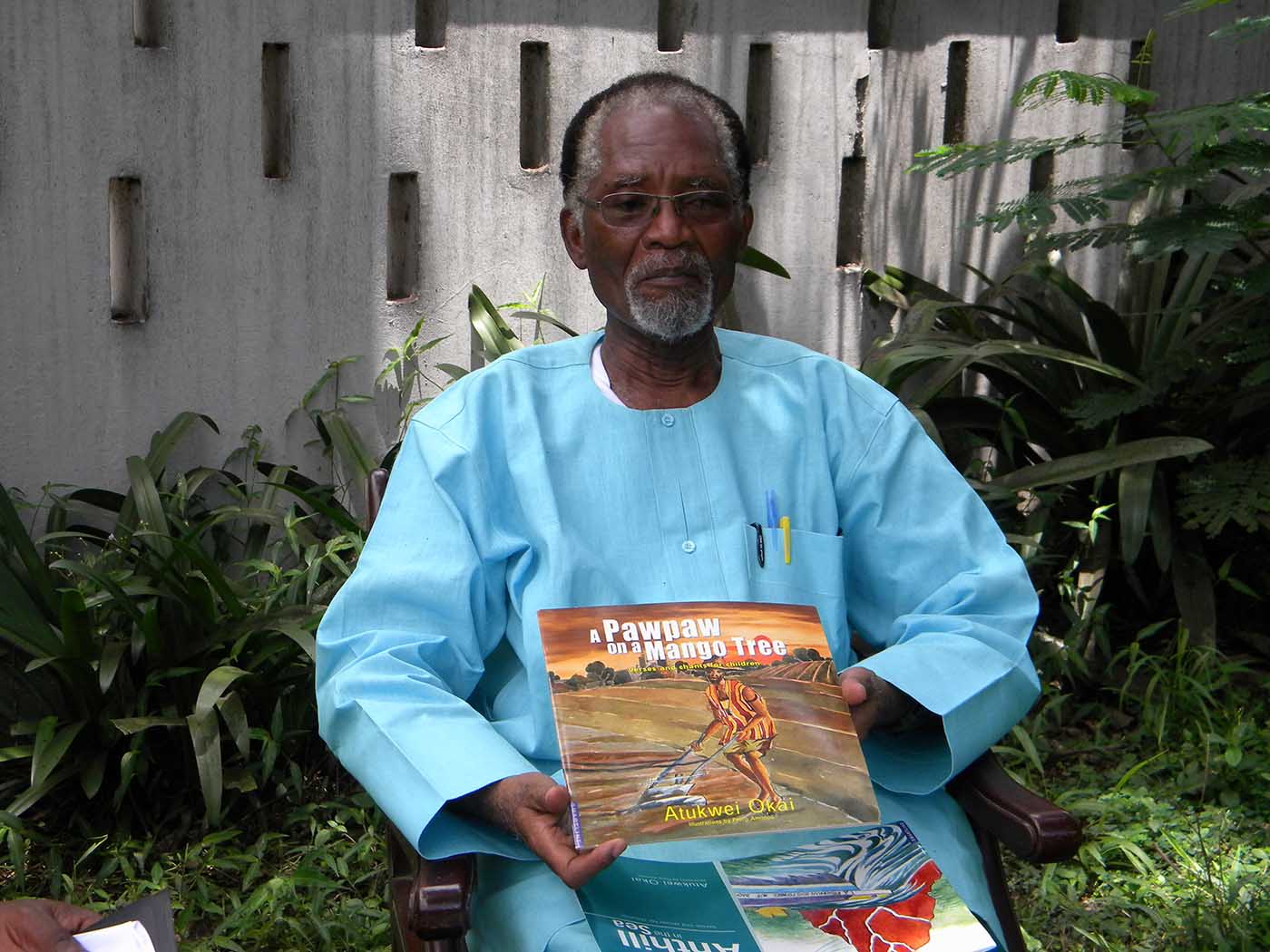
Did you know that for 13 years now, 7 November has been celebrated across Africa as International African Writers’ Day? In this interview with Femi Akomolafe, Ghanaian Professor Atukwei Okai , who is the Secretary-General of the Pan African Writers Association (PAWA) discusses the power of literature as well as sharing his personal triumphs and tribulations as one of Africa’s literary giants. He says: “A re-education of our minds with regards to the necessity of reading, needs to happen.”
New African: You are the Secretary-General of the Pan African Writers Association (PAWA); can you tell us more about the organisation?
Professor Atukwei Okai: The PAWA is the umbrella organisation for all African national writers’ associations. The idea was born of the fact that in unity lies true power. On their own, the national associations have little power or influence, but as a continental body, we carry more leverage. Through PAWA, we aim to bring African writers together, and fight for the rights and the interests of writers on the African continent.
It started around 1985 when we (various national associations) set up an international preparatory committee (IPC), charged to establish PAWA. We then made a tour of African countries and went to the OAU headquarters where we met officials and put our case across. We were advised to attend a meeting of African Ministers of Culture that was to take place that year in Ouagadougou, the capital of Burkina Faso. We went there, addressed the conference of ministers and informed them of our plans. They gave us enthusiastic support and PAWA was founded in 1989.
In 1991, the Conference of African Ministers of Education and Culture meeting in Coutonou, Benin, acting on a proposal by PAWA, resolved to establish 7 November, the day PAWA was founded, as International African Writers’ Day, which is now celebrated throughout the continent. This allows African people a moment to pause and reflect on, as well as celebrate the contribution of African writers in the development of the continent.
In 1992, the government of Ghana granted full diplomatic status to the PAWA Secretariat. The highlight of our calendar is the PAWA Annual Lecture where noted African writers come to give lectures.
Q: Sadly, reading is a dying hobby in most parts of Africa today. What do you think can be done to revive it?
Yes, it is sad. Reading is crucial, in fact even critical to national development. How do you develop a country without an educated mass of people? The impressive achievements we see in other societies reflect the investment they have made in education. The lack of interest in reading needs to be seriously addressed and tackled at the highest levels; a re-education of our minds with regards to the necessity of reading, needs to happen. We need to establish libraries and stock them with books so that we can revive the culture of reading in our people.
Government should encourage local publishers to publish more books by providing them with incentives that will make them stay in business. Parents should make sure their children balance the use of technological devices with the reading of books. Literature should be made compulsory and every school must set up a Literary Club.
Q: You are one of Africa’s towering literary icons. Kindly tell us what sparked your interest in literature.
I was lucky to have grown up in a literary home. My father was a school headmaster in Gambaga in the Northern Region, and he loved books. I grew up and had my formative years in Gambaga. I attended the school where my father was the head. It was a unique school where the 500 pupils were encouraged to recite the Lord’s Prayer in their own languages. And we all participated in whatever language was chosen. You can imagine the pride I enjoyed when fifty or so years later, I chanted parts of the Lord’s Prayer in Yoruba to an amazed audience in Lagos, during the presentation of my poem, Fanfare for Oduduwa. The northern Ghana of those days was a paradise. It was a pristine, natural environment where people led a natural life. The people got all their needs from nature – from the food they ate, to the drinks, to the clothes they wore, to the materials they used to build their houses. It was for them a life of total self-sufficiency. Nothing was imported. My school had a great library with many books, this allowed me to read to my heart’s content. That type of environment not only nurtured but also inspired me to be creative. I was lucky and blessed indeed.
Q: You were a member of the Ghana Society of Writers (precursor to the current Ghana Association of Writers), you even became an official at a very early age. Can you tell us the story? What was the literary scene in Ghana like in those days?
The literary scene was blossoming in those days; it was vibrant. I was a member of three libraries – the British Council Library, the American USIS Library and the Accra Central Library, in addition to my secondary school library. I wanted to find out as much as possible about poetry. I read widely and I wrote prodigiously. I became a member at age sixteen, when it was founded in 1957 – I was the youngest member and then at the Accra High School. It was quite an exciting time in my life. Imagine as a young boy, being surrounded by so many books, and being in the company of literary giants like Michael Dei-Anang, J.H. Kwabena Nketia, Efua Sutherland, Kofi Awonoor, Crakye Denteh, Kwesi Brew, Geombeeyi Adali-Mortty, Cameron Duodu and many others.
Another kind mentor was Madam Dorothy Padmore, the wife of George Padmore, whom I visited at their home. On some evenings, I would sit by her under the skies as she critiqued some of my published poems while her husband, Dr Kwame Nkrumah’s famous friend and colleague, sat by reading foreign newspapers.
Q: You went to study in the former Soviet Union, what informed that decision?
I was on a mission to research and fashion a new kind of poetry that my people would be able to relate to. I discovered Russian poetry, which answered my needs.
Therefore, when the then President Kwame Nkrumah, came back from his tour of the Eastern Bloc in 1961 and announced that he had secured one thousand scholarships for Ghanaians in various disciplines, I applied for a scholarship to Moscow and was successful.
Q: Can you share with us your experience as a student in the Soviet Union?
Russians love books and they adore literary people. The people read voraciously. They believe that money should not be a barrier between man and enlightenment, and that the development of the individual is the development of the nation. They see education as good investment. There were writers’ cottages all over the country. There were great publishing houses that churned out books in voluminous quantities. Vast resources were put at the disposal of the artists and the writers so that they could concentrate on their literary creations. The facilities, owned by the Soviet Writer’s Union, were paid for by a percentage deducted from every literary material sold in the country. As a student with published works (from which percentages had been deducted) I was entitled to free tickets for flights to and from the writers’ cottages. I took full advantage.
While studying there, we were also introduced to the works of great writers like Pushkin, Lermontov, Dostoevsky, Leo Tolstoy, Anton Chekhov, Nikolai Gogol and Mayakovsky. I got to meet giants such as Konstantin Simonov, Mikhail Sholokhov, Pavel Antakolsky, Evgeniy Dolmatosky and Olga Berlgolts. I also met in 1964 the legendary African artist from Ethiopia, Afewerk Tekle, as well as the Mozambican poet, Marcelino Dos Santos, Ngugi wa Thiong’o, and Okot p’Bitek, all major African writers and poets.
Q: You must have many memorable moments in your illustrious career. Could you pick one?
In 1967 the Gorky Literary Institute was honoured with a visit from Stanley Kunitz, the US Poet Laureate and the Consultant in Poetry to the Library of Congress. He came into our class and I had the privilege of reciting one of my poems for him. We became friends. Besides giving a reading of, and a seminar on, my poetry at his Literature Graduate Class at Columbia University, New York, I had the honour of recording two hours of my poetry for the US Library of Congress.
Q: You were in the Soviet Union when Ghana’s first coup happened, that overthrew the government of Kwame Nkrumah. You were a beneficiary of a scholarship from that regime. Did the coup directly impact you?
Personally for me, it created uncertainty about my future. I was a beneficiary of a scholarship and had gone to acquire the knowledge I thought would enable me to also contribute my quota to nation-building. I had finished my studies and was preparing to go back home in 1967. Then the coup happened in 1966. My classmates from the Soviet Union were already given their employment letters, and some advised that I seek employment in the Soviet Union, which I could have done. They were very anxious about my going back to a country that had just experienced a military coup.
But I allayed their fears by saying that I was just a student, with no political tags whatsoever, and that the worst they could do to me was make me starve. So I returned to Ghana.
Q: On returning home, Ghanaians who had studied in the Soviet Union were ostracised by the new regime. There were some persecutions. What was your own experience?
It was a most despondent time in my life. It was indeed a very low period for me. I was already a writer and broadcaster of some note before I went to the Soviet Union. It galled greatly that those of us that went to study in the former Eastern Bloc were tarred by the general suspicion attached to socialism in those days. We were not politicians and we did not get our scholarships on our political affiliations. We were young Ghanaians with a passion to help build the country. I wrote application upon application for employment – not a single organisation even bothered to reply to me. The situation was so scandalous that the late Jawa Apronti would write [about me] in the Evening News newspaper, in an article titled, “Can’t We Use This Man?”. At one point, the Ghana Broadcasting Corporation invited me for a job interview with several other people. I was the only person out of the lot that was denied employment. On enquiry, I was told that the CID (Criminal Investigations Department) had collected my file and had not returned it.
Q: Ghanaians would later learn that despite your qualifications and your huge talent in the arts, not only could you not get a job then, you had to depend on stipends from your mother. How did you cope with such experiences?
It was tough, very tough. Imagine a highly-qualified person like myself roaming the streets of Accra, while colleagues with whom I had studied, were gainfully employed. Imagine trekking around the city on your feet in the sun. It was sometimes friends and former colleagues driving their own cars who stopped by to offer you a lift. My situation was dire, and I don’t know how I would have survived were it not for the generosity of my mother. And by the grace of God, every morning she gave me two shillings, which was just something to have in the pocket, just in case, as I went from office to office. At one point, I roamed Accra the whole day on an empty stomach. It was harrowing.
Q: Then your passport was seized and you almost lost the chance of a scholarship to a British university. How did you finally resolve matters?
I had a scholarship for the University of London. But on returning from the Soviet Union, my passport had been seized at Accra Airport and it had not been returned to me. Time was running out for me to leave and there was a chance I would lose the scholarship. I decided on direct confrontation. I went to the police headquarters and demanded to see the Inspector General of Police. I was ushered into his office. He smiled and asked: “How do you do, Mr. Okai?” I replied: “Sir, I am not fine.” When he asked me why, I narrated my story to him. Lo and behold, right there and then, he pressed a button, summoned an officer and asked him if he knew me. The officer answered: “Yes, sir!” And he asked him to go and get my passport for me. That was how that case was resolved. Just like that!
Q: Let us talk on what made you what you are today – your poetry. Many of your fans say reading your poems is like living a real story told by a master storyteller. What is the trick?
The trick is simply that an artist must first question why he wants to become an artist. That is fundamental. Artists are crucial to a people’s recollection of themselves. They are the custodians of a people’s collective memories. In the Soviet Union, the poets declaimed their poems. I thought, hey look, we also do the same in Africa. Our Griots and praise singers perform exactly the same roles. Then it clicked. People can be so in love with literature. For example, there was a time in the 60s, when thousands of people in Moscow filled a stadium for 4 hours, in the freezing cold listening to poetry recited by the hugely popular and revolutionary young poets, Yevgenyiy Yevtushenko and Andrei Voznessenky.
I am a great admirer of Kwame Nkrumah. I am astounded by his elaborate vision for Ghana, for Africa. Nkrumah believed that black people were capable of taking care of their own affairs. That lit a fire in me. My burning ambition was to do for African literature and for poetry, what the Osagyefo Kwame Nkrumah, did in the African realm of politics. I wanted to demystify poetry and make it accessible to the common people. I knew it was a monumental task I had set for myself but I set my sights on achieving it.
Q: You also have a collection of childrens’ poems, why the interest in children?
My interest was kindled when my wife, Beatrice, and I went to look for books for our children and we couldn’t find any written by a Ghanaian or African for African children. All we saw were foreign books written for children in other climes. I recognised this is an opportunity and a challenge! I said: You are a writer, do something about the gap. That was how it started and so far, I have published three volumes of verses and chants for children: “The Anthill in the Sea”, “A Slim Queen in a Palanquin” and “A Pawpaw on a Mango Tree”.
Q: What advice do you have for those of us with unwritten stories in our skulls?
Read, read and read. Then start to write your own story. As a beginner don’t worry too much about structures, plots or suchlike. Just put to paper the ideas that flow into your head. First, write the stories in their raw state; then let other writers or the editor guide you, putting them into shape. This practice becomes essential to the process, which becomes a habit, then a lifestyle; and finally your blueprint.