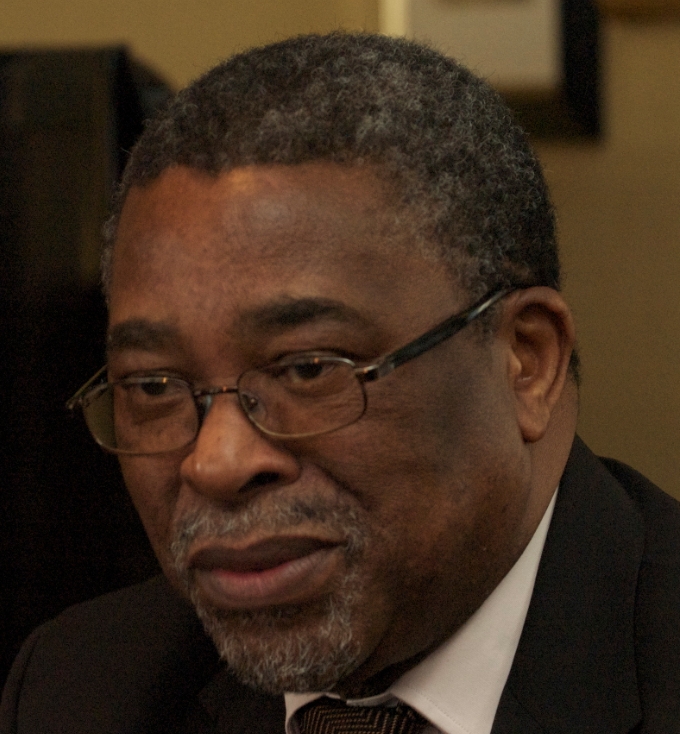
There has been a storm of criticism over South Africa’s leadership strategy that will likely culminate in heated debate at the ANC’s summit next month. Adding his voice to the debate has been Moeletsi Mbeki, whose well-known views attract significant attention given the venerable political family he belongs to, being the son of Govan Mbeki and brother of former president, Thabo Mbeki. Following a breakfast briefing, Stephen Williams interviewed him.
Some view Moeletsi Mbeki’s steadfast opposition to the African National Congress (ANC) policies as something close to a betrayal. Educated at Warwick University, a renowned political economist and now serving as the deputy chair of the South African Institute of International Affairs, many of Mbeki’s detractors thought he should have tempered his trenchant criticism of the ANC while his brother was president. But he is unbowed by such opinions.
Early in our conversation, we addressed this matter. When asked how he could have criticised his brother, he responded forcefully: “I’ve never criticised my brother. People say that, but it is not true. What is true is that I criticised the ruling ANC and it happened that Thabo was then the party president and the head of state.
“It was government policies that I was opposing, not him as an individual. We remain close. In fact, I helped organise a big party for his 70th birthday, just a few weeks ago, at his Johannesburg home.”
Having knocked that particular myth on its head, we then turned our attention to what he considers some of the most crucial issues facing South Africa. The first he chose to focus on was the ANC’s Black Economic Empowerment policy (BEE).
During an earlier breakfast briefing, Mbeki had said that many of those that had been involved in the battle against apartheid had, since, become absorbed into directorships of big companies in order to meet racial quotas (part of the BEE prescription).
Many of those co-optees, he suggested, do not even know how to read a balance sheet, but they are on the board of these companies and get paid very generous salaries.
The downside to this, Mbeki argued, is that the potential entrepreneur group in the black population is being “taken out” of the entrepreneurial class and being given this option whereby they are paid huge amount of money to be sleeping partners, in order for the companies to get government contracts.
In fact, Mbeki believes BEE is not an ANC policy at all, but a construct of the white business community who chose this policy as the means to retain its privileged position of economic power.
“What is wrong with BEE is that it buys off the politicians – I call it legalised corruption,” Mbeki said. “It is really designed to retain the status quo in terms of the ways our big corporations operate. We’ve all seen the ways that the large mining companies operate.”
As we were speaking in the days after the Marikana disaster, I interjected to ask Mbeki if he thought the police shootings of striking miners represented something of a watershed for the country. “Yes, it is definitely a watershed because the ANC has, for all its faults and shortcomings, always been a liberation movement, but now it is repeating Sharpeville,” he said.
The investment argument
Returning to the BEE issue, the devil’s advocate might argue that having politically well-connected figures on the boards of major corporation might give international investors a sense of comfort.
“Of course,” Mbeki retorted. “If I am the one who has got a politician in my pocket, I would feel a lot of comfort. But it does not help the overseas investor as two or three companies, in effect, dominate each sector of the South African economy, and they pose a monopoly barrier to you entering the market, if you want to participate in the real economy. It is different if you just want to put money into the Johannesburg Stock Exchange.
“I will give you an example of what happens. If you are a soft drinks company and you had disinvested during the apartheid era, and you now decide to come back into the market to set up your soft drinks plant, the large incumbents will block you from starting again and reopening. So it is actually an obstacle for foreign investors trying to get into the South African market. So I would abolish BEE.”
A number of Mbeki’s critics say that his questioning of ANC policies has had the effect of serving Western interests. Without being too subtle, these critics suggest he is “a sellout”. When this was put to him, he looked thoughtful for a moment before denying the accusations: “Serving Western interests? Oh my gosh! It is not just the ANC government, I criticise many other African governments,” he explained. “For example, I criticise Zimbabwe’s ZANU-PF. I have been a supporter of ZANU-PF since I was student, but since 2000 I have been opposing their programmes of rigging elections, expropriating farms and the violence and mayhem these policies have caused.
“There again, I don’t necessarily see the West as the enemies of the people of South Africa. In fact the West were great supporters of our struggle against apartheid. Sections of the Western population were important supporters of the struggle for independence in Ghana, and in Zimbabwe! So the West is not the enemy. Not today. Maybe in the past, that is a different argument, but today the West is not Africa’s enemy.”
It would perhaps be easier for Mbeki to go along with the “neo-colonialist” argument, but Mbeki refutes this argument. “No, I don’t think so,” he said, “For example, the USA’s Comprehensive Anti-apartheid Act forced the apartheid regime to abandon its racist policies. How can we say that the US is the enemy when they worked with us to get apartheid overturned? De Klerk would never have released Mandela and relinquished power without this kind of international pressure from the West.”
Leaders and leadership
Turning our discussion towards more contemporary issues, I asked Mbeki whether he thought Zuma would survive the ANC meeting, where there will almost inevitably be at least a debate if not a challenge to his leadership. He was confident that Zuma would survive as party president, and by extension, state president, partly because of his strong power base in Kwa-Zulu Natal, in Mpulanga and in the Free State. I think that is sufficient to allow him to retain the presidency of the ANC.”
Looking further afield, to the rest of Africa, did Mbeki saw the beginnings of a new African leadership era, with the passing of Atta Mills in Ghana, Meles Zenawi in Ethiopia and Bingu wa Mutharika in Malawi? “Not really,” was Mbeki’s answer, his voice carrying a tinge of weary regret about it.
“There was a lot of optimism about a new generation of leaders from Africa. Frankly, they just reproduced the old Africa with the big man syndrome, where the big man knows all the answers to everything. Take Meles, he believed he was the one man that knew everything in Ethiopia, nobody else did. He reproduced ethnic politics and ran a Tigrayan apartheid system.
I know a lot of good things have been said about him since he passed, but that is the truth. And Kagame is not running a democratic system in Rwanda. He is running a tilted, dominated system and then there is his interference in the Congo. So there is nothing new with these so-called new leaders. Maybe Atta Mills was more progressive.
“But those other guys … well Mutharika tried to be a dictator. He was opposed by Joyce Banda, but he tried. But these new imagined leaders in Africa are a ‘good idea’. [laughter] As Gandhi said, Western civilisation is a ‘good idea’.”
We also discussed the significance of having a new leader in South Africa’s Nkosazana Dlamini-Zuma chairing the African Union. “No. I don’t think it is relevant,” Mbeki said. “In the AU, and here I have to agree with my brother Thabo, the decisions are made by the council of ministers. The chairman of the committee is not really a decision-maker.
Achievements and failures
When asked what, over the last two decades, had been South Africa’s major failures, and its major achievements, Mbeki was more complimentary of the people of South Africa than its political class. “Up until now I think one could say that the abolishment of the police state has been a major achievement,” he replied. “But we can no longer say that. It is back, and the force has been re-militarised. Nor can you say that the ANC has overcome ethnicity as Zuma has been mobilising the Zulu population. So these are reversals of some of the things that were achieved in the Mandela era and, to some extent, Thabo Mbeki’s era. And the level of corruption has also been growing.
“Rather than examining what South Africa’s achievements have been, what the people of South Africa have achieved would be a more appropriate question,” Mbeki continued. “They have retained the independence of the media; they have retained independence of the judiciary. They have retained the calibre of our top universities – they are still top universities. And I could go on, but that is what the people of South Africa have achieved, I wouldn’t say they are the achievements of the ANC.”
It was perhaps inevitable that the question of Africa’s international and intra-Africa trade should arise. The “trade not aid” argument is well versed, but when asked how a more level playing field for Africa’s trade position in international markets might be achieved, Mbeki had a simple four-word reply. “Africa has to manufacture,” he averred.
“But the continent is some away from achieving this,” he elaborated. “It must process its raw materials and add more value, you will not be able to improve Africa’s trade profile otherwise.”
At the earlier business briefing, Mbeki had taken a question about the Niger Delta. He had described as “absolutely scandalous” the way in which oil companies had ravaged the environment in the Niger Delta, and had compared that to the many consequences of the way in which the mining industry operates in South Africa. Mine’s acid water, and noxious, if not toxic, dust blown up from waste tips in South Africa can be directly compared to the destruction of the environment in the Niger Delta.
He had also railed against the flaring of natural gas. He had witnessed this himself when he flew south from Lagos to Calabar and from Calabar to Angola, and seen the hundreds of off-shore oil rigs flaring gas. As he pointed out, the world is very concerned about global warming, but the oil companies that control the oil in the Gulf of Guinea are among the biggest carbon contributors.
Mbeki confesses that he is absolutely mystified and not a little angry that Nigeria still has to import refined gasoline. “They are Africa’s largest crude producer,” he observed, “but they can’t themselves even refine their own petrol.” In fact, this returned to a point that Mbeki had made regarding China and the ferrochrome market. Before going into the specifics of this sector, Mbeki had made it clear that he did not blame the Chinese, but the South African government. “It is actually the South African government that is the culprit, grovelling to the Chinese,” Mbeki had said in explaining why, after scrapping BEE, he believed that reforming South Africa’s relationship with China should be at the top of the agenda.
He then spelled out how the world market for ferrochrome had been cornered by the Chinese with South Africa selling chrome ore to China, resulting in South Africa’s equipment for beneficiating chrome remaining idle – because China is now able to undercut South Africa on world markets. The net result is huge South African job losses. “I would renegotiate the whole economic relationship between South Africa and China,” he reaffirmed. So I put it to Mbeki that, in much the same way that some in Nigeria are calling for a limit on crude exports to encourage the building of refineries in-country, South Africa should be encouraging the Chinese to build a ferrochrome refinery in South Africa.
“The problem is the lack of power,” Mbeki explained. “There is no electricity and the government won’t let them [the Chinese] build a power station. That is a major problem with building new industries in South Africa. There is an electricity shortfall, and the government is keeping the sector from receiving private investment because they milk the electricity company and then the ANC expects Eskom, the electricity parastatal, to finance itself. So this is what raises the cost of electricity.”
As the interview drew to a close I was asked to put to Mbeki, whether he believed that South Africa’s youth had become disinterested in the country’s political system; and secondly, whether Africa gets the leadership it deserves. He was quite clear in his answers. “I believe that the youth in South Africa are not interested in the colour of the skin which is still politics. That is ancient politics for young people. They don’t care what the colour of your skin is, what they are interested in is the content of your character and of course, your intellectual capability. And no, I don’t believe that Africa gets the leaders it deserves. Remember, most people in Africa are peasants, which means they are vulnerable to the State. And the state in Africa was created by the colonial system to terrorise the peasants. And the postcolonial masters who inherited the State use this system to terrorise the weak and fragmented rural communities. So I do not blame the people for the leaders we have now.”