The Mo Ibrahim Foundation (MIF) celebrates a decade of operations this year, operations that include compiling the annual Ibrahim Index of African Governance (IIAG) and the Ibrahim Prize for Achievement in African Leadership. Hichem Ben Yaïche, editor-in-chief of the French edition of New African, interviewed Mo Ibrahim for this special report. Additional reporting by Stephen Williams, who spoke to Nathalie Delapalme, the Director of Research and Policy at the MIF.
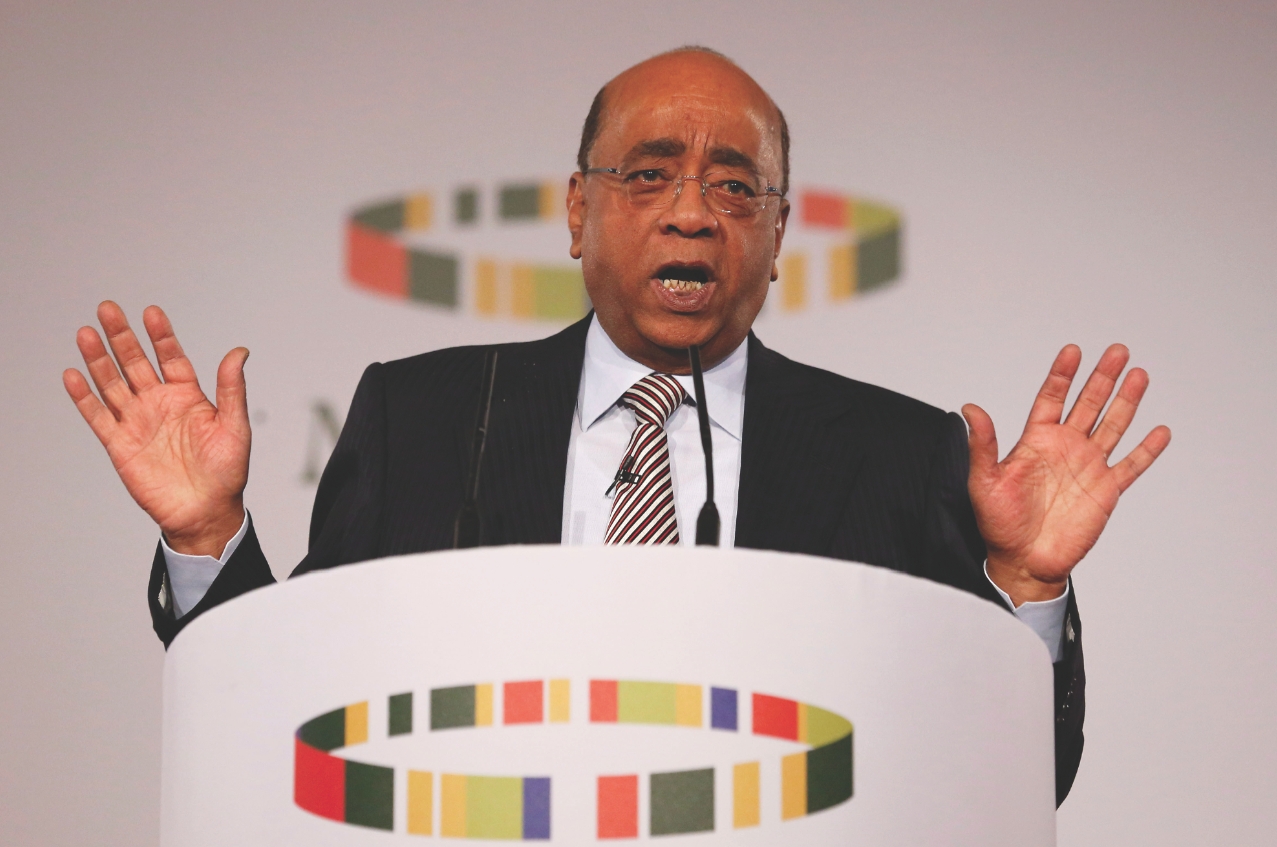
Shortly after the Mo Ibrahim Foundation announced that there would be no award made for Achievement in African Leadership in 2012, Mo Ibrahim, the Anglo-Sudanese former telecoms pioneer, faced a number of questions regarding this decision. To describe the questions as hostile would be an overstatement, but perhaps Business Events in Africa’s founder and chief executive, Christian Udewuchukwu’s invention summed up the mood of many at the post-announcement press conference in London.
Udewuchukwu described the decision not to award “a prize of this calibre” this year as “dispiriting”. Ibrahim responded by again reiterating the fact that the prize was for excellence, and the prize committee had a duty to the Foundation as well as past recipients that it was not devalued in any way. Ibrahim also had to fend off questions as to why the Prize could only be given to former leaders (the other criteria for winning this $5m prize is that the candidate must have assumed power democratically and also have stepped down voluntarily in the past three years). Ibrahim said that he was more than happy when others (such as our sister organisation IC Events), gave awards acknowledging the excellence of African central bank governors or ministers of finance – or indeed footballers – but the MIF had made a decision to award their prize only to Leaders or Heads of Government who have demonstrated excellence. “We are not a pension,” he insisted.
Furthermore, Ibrahim suggested that if other criteria needed to be judged, then the IIAG league table offered a wealth of data on progressive leadership and responsible governance. He is right.
As Ibrahim points out, worryingly, governance indicators in the regional giants of Egypt, Nigeria, South Africa and Kenya would seem to indicate that these countries “appear to be stuttering a bit”. That is disappointing for, as Ibrahim observed, these economic powerhouses, it had been hoped, would serve to lift their regional neighbours. But, on a more positive note, Ibrahim was able to report that, in general, indicators are improving across the continent – especially in the metrics of gender and health. Between 2000 and last year, there has been “a marked improvement in governance across Africa,” he said. “The economy has been moving forward relentlessly. However, this economic development does not give us any reason to be complacent about participation and human rights.” In fact, the MIF’s work goes beyond the Leadership prize and the IIAG. The annual Mo Ibrahim Forum is a case in point. Now in its fourth year, it will bring together a diverse number of stakeholders and delegates for what is promising to be a constructive debate. Discussion always focuses on the achievement of meaningful results on one particular issue, which this year is to be “youth and employment” and current challenges in this area.
The major economic challenge
Ibrahim was enthusiastic as he told New African about this year’s event. “We have decided that this will be the theme of our next forum, because we consider that young people constitute a major economic challenge for the African continent. We are convinced that they represent considerable potential, but we are also aware of the risks should there be a lack of suitable opportunities for them.”
The MIF Forum is to take place in Dakar, Senegal over the second weekend of November. Ibrahim confirmed that the MIF is currently working on collecting specific data to stimulate the discussions and to encourage, over and above the talking, concrete and pragmatic undertakings. “We will release a very detailed document about the characteristics of young Africans and the employment challenge,” he said.
Africa’s demographics are startling. Today there are 1bn people living in Africa – but by 2050 there are confidently expected to be 1.8bn – the majority of whom will be young people.
Commenting on these figures, Ibrahim said: “Yes, as of 2035, the largest population of working age people and, therefore, the principal potential workforce of the globalised world in which we live, will be African. This is a considerable challenge and also a major asset for the continent. These young people are, in a way, the greatest natural resource the continent has. It is therefore essential to help them realise their potential.”
So this is what the Mo Ibrahim Foundation’s Forum will be discussing. As Ibrahim says: “Our collective ability to offer them not only acceptable employment, but also encouraging and stimulating opportunities, is a major challenge. In this respect, there is no difference between a young African and a young European, between a young Greek and a young Senegalese. I would also add that young Portuguese jobseekers are currently leaving home to find work in Angola or Mozambique. This is a new trend that gives pause for thought.
“Furthermore, youth is a transient condition,” Ibrahim added. “You can’t stay young all your life. But you do stay African. So, what we are interested in is understanding the similarities and differences between African youth and the others and also measuring their comparative advantages and disadvantages: are they less well-educated, but more multilingual, more mobile, more connected? Less worried about the future, less disheartened, but more demanding, more responsible? It’s going to be a fascinating discussion.”
Linking education to employment
This sentiment was echoed by Nathalie Delapalme, the MIF’s director of research and policy. “Actually,” she told New African, “we are working closely with the African Development Bank. They will be holding a specific day on youth employment in West Africa. One of the things that has been tracked by discussions at the Organisation for Economic Cooperation and Development (OECD) was the necessity to find work for the massive numbers that will be joining Africa’s work force.
“As the OECD says, it will be difficult to create work, so we see the way forward as to link education and training to what the next working market is going to be.”
Could she identify areas where this growing demand for employment might be met? “Definitely, in Africa, agriculture is key. There is a huge agricultural potential in the continent while, at the same time demand for agro products is going to soar due to emerging markets’ demand and demography. And this is something we must work on. We must be sure of sufficient training and sufficient prospects in agro business, to bridge the gap between education and the employment market. This is definitely a very important issue.”
There is also a political challenge, as Delapalme made clear when questioned over how many young Africans would want to work on the land rather than to migrate to urban areas and live what is sometimes described as a 21st century lifestyle. “I would say policy makers from both sides, from African countries and their development partners, must make young people aware that there are financial rewards offered by agriculture in the rural areas, both in farming itself and the agro-business value chain.
“Agriculture is not simply about producing crops,” Delapalme insists. “It is about infrastructure, processing commodities, marketing these commodities – and the idea that a young person needs to migrate to the town or to the city to live a modern lifestyle is simply erroneous. The world is full of new technologies, and that means you can live a modern and fulfilling lifestyle almost anywhere.”
Taking a strategic approach
In Ibrahim’s opinion, there is a need to take a strategic approach by analysing and assessing the demand for jobs over the coming years. “In which industries, in which parts of the world will employment opportunities emerge. We then need to consider how competitive the supply from Africa is going to be … and fill in the gaps, reinforce the comparative advantages.”
Like Delapalme, Ibrahim identifies agriculture as being crucial. “In the years to come,” he says, “in view of the exponential growth in demand and the relative weakness of supply, the food industry will be one of the principal drivers of growth and wealth. At the moment, the leading economies of the world also figure among the biggest agricultural producers.”
“It is no accident that the world’s top 10 economies are the world’s top 10 agricultural producers,” Delapalme comments. “The potential of this continent, still very largely under-exploited, is highly significant – providing that we stop looking at the rural world as being synonymous with poverty and that young Africans stop believing that the future and modernity are to be found in the big capital cities,” Ibrahim says.
“But I am optimistic,” Ibrahim adds. “The IIAG shows that all the indicators, those regarding education and above all healthcare, have progressed. This is as a result of the real efforts made by African governments and their development partners. But here also we have to be strategic. Education is all very well, but what next? We now need to work on reinforcing the sort of growth that creates jobs, including in rural areas, and creates SME’s. We need to be sure that the training on offer truly corresponds to potential demand in the labour market and, therefore, to the natural expectations and hopes of young people who want to become independent and take on responsibilities … in other words, become adults.”
And the work continues at the MIF to invest in the continent’s governance and leadership to catalyse Africa’s transformation. It is a formidable yet exciting challenge.