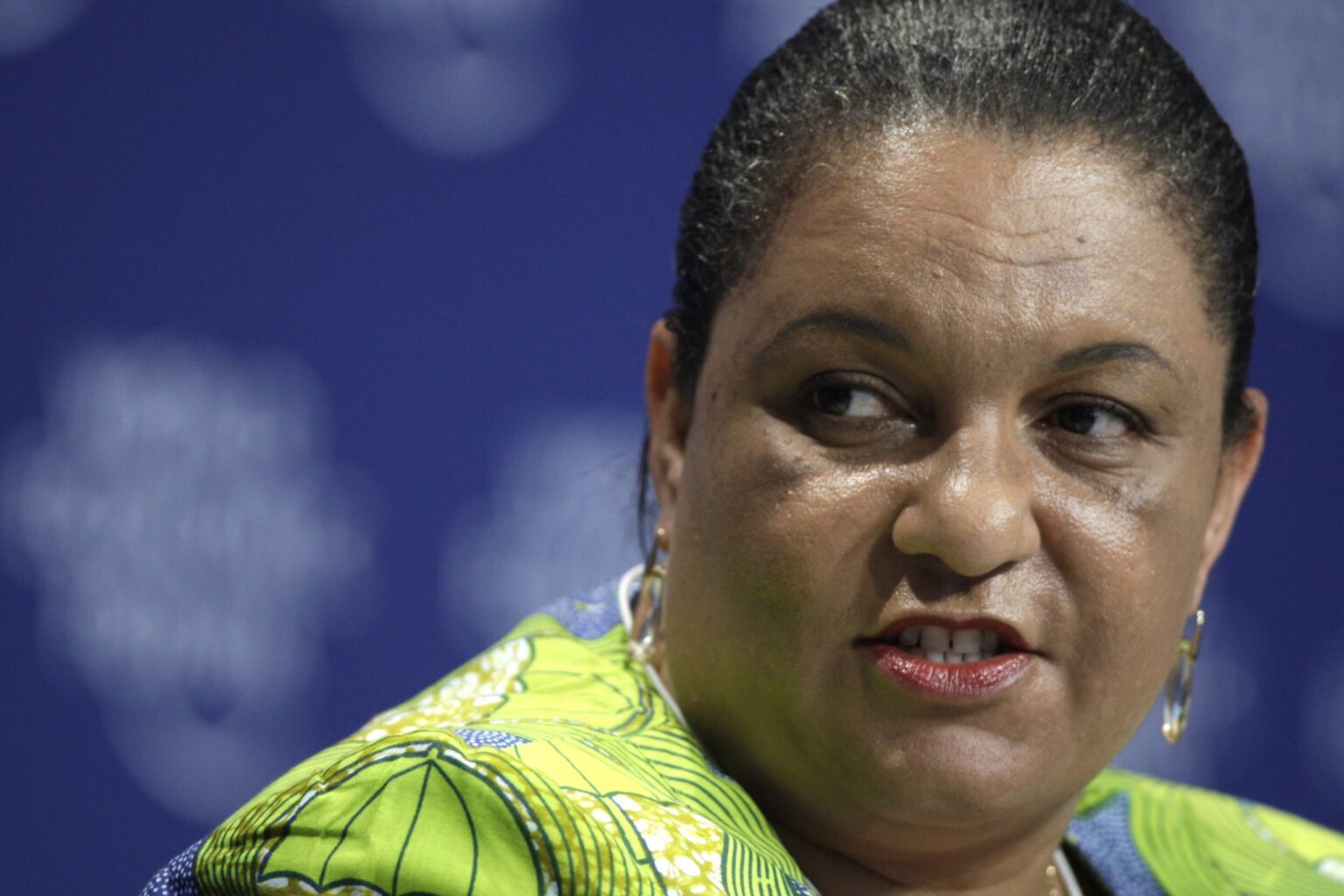
Among the brightest stars in Ghanaian politics is undoubtedlythe newly-appointed foreign minister, Hanna Tetteh. A woman of keen intellect and amazing communication skills, she has managed to rise to her current position after only 13 years in politics, and without attracting negative publicity. Femi Akomolafe interviewed her in Accra on a wide range of issues, including why Ecowas had to wait for French intervention in Mali, before the regional grouping acted.
Soft-spoken, articulate and very astute, Hanna Tetteh’s brilliant oratorical skills have endeared her to many who have listened to her bright, analytical, and almost dispassionate defence of some of the major policies of her government and party.
Never one to raise her voice or lose her composure in debates or arguments, she remains a rare gem in Ghanaian politics where political arguments can develop into shouting matches. Her incisive and sharp-witted ripostes make acrimonious abuses totally unnecessary.
Born on 31 May 1967 in Szged, Hungary, and a legal practitioner by profession, Hanna Tetteh is a relative newcomer to politics and has, thus, risen to the top with dizzying speed. She is a resident of Obrachire in the Awutu Senya West District of the Central Region.
She attended Wesley Girls High School, Cape Coast, from 1978 to 1985 and went on to obtain a Bachelor of Law (LLB) degree at the University of Ghana in 1989. She then went on to graduate from the Ghana Law School in 1992.
Her working experience included stints at the International Federation of Women Lawyers (FIDA), and at the Commission on Human Rights & Administrative Justice (CHRAJ) in Accra. She joined politics as a member of the now ruling National Democratic Congress (NDC), and was elected to parliament in December 2000.
She had previously worked at the Ghana Agro Food Company in Accra, and in 2005 she left politics and returned to the company until she was headhunted by the late President John Atta Mills who appointed her as head of the communication directorate of his election campaign in 2008.
Tetteh managed to successfully sell her candidate without recourse to negative campaign tactics. An apparently grateful President Mills appointed her as minister for trade and industry.
She contested and won back her Awutu Senya West parliamentary seat in the 2012 elections. Her appointment in January 2013 by the newly-elected President John Mahama as minister for foreign affairs and regional integration did not surprise many people, for she is a very capable woman. She scaled through the parliamentary vetting with ease.
Here are excerpts of her interview:
New African: Congratulations on your recent appointment. How do you intend to simultaneously represent your constituency in parliament while serving as foreign minister, which will entail frequent travels abroad?
Hanna Tetteh: I see no problem here as I have a very good structure in place to ensure that my constituents’ needs are properly catered for. Currently, my constituents visit me in my home in the village. But I intend, shortly, to set up an office in Awutu Beraku [the constituency/district capital] which will be more easily accessible and convenient.
However, we have a very active party structure through which I am able to get to know the concerns of my constituents and engage with them and address their needs. I make sure that I keep my appointments with my constituents, and honour the days assigned to my constituency affairs without fail. I hold regular meetings with them, I listen to their problems, and try to find ways to resolve them.
Of course, I am also accessible by phone calls, text and email. The important thing is to have a very good rapport and understanding with my people, and to make sure that they have access to me as often as possible. They know that I’m always available for them, and also that I do my utmost to promote their interests.My ministerial position will not in any way weaken my commitment to serve my constituency.
You were moved from the Ministry of Trade to Foreign Affairs, what are some of the qualifications you bring to the job?
What I bring to this job is what I always bring to any job to which I am assigned: complete dedication and total commitment. I try to do any assigned job to the best of my abilities. What I do is set myself clearly-defined goals and objectives and assemble competent support staff to help me achieve them.
What will be the major objectives of Ghana’s foreign policy and how do you intend to pursue them?
Our foreign policy objectives are spelt out clearly in our constitution. They include the promotion of political, economic and social interests of our country while seeking a conflict-free international environment. The objectives also include the implementation of our regional and international treaty obligations, and the protection of our citizens abroad.
Your counterpart in the US, Secretary of State John Kerry, recently said that foreign policy is essentially economic policy. Do you share this view, and if so how do you intend to pursue Ghana’s economic interests?
If by that he meant expecting economic benefits from every policy, then I don’t think I agree with him. It is not in every relationship that one should expect economic benefits. I think that foreign policy sometimes goes beyond the pursuance of parochial economic interests. There are situations where one does not, or should not, expect economic gains or benefits.
We live in an inter-connected world in which political and social policies
are pursued even when they are not in one’s economic interests. For example, we have had our troops in peace-keeping operations abroad where we have absolutely nothing to gain. Sometimes one has to look beyond economics in pursuing certain objectives.
Talking about economic interests, your portfolio includes regional integration. After 40 years of the formation of the Economic Community of West African States (Ecowas), West African citizens still face difficulties when they travel in the region. What do you think is responsible for the failure of Ecowas to live up to expectations?
It is true that Ecowas has not delivered as we all would like to see. But then we have to look at why that is. As we all know, we have all the protocols signed. But how many of the 16 Ecowas member countries have had their parliaments ratify the treaties and protocols in order to give it the force required for implementation? The agreements and protocols do not only have to be ratified, they also have to be incorporated into national laws to ensure implementation.
What Ecowas needs is a greater commitment on the part of member states to enforce all the protocols and not to pick and choose. What I can tell you is that Ghana has faithfully ratified all the Ecowas treaties we have signed, and we have codified them into our laws. For example, we don’t charge any tariff on goods manufactured in the Ecowas states. The trouble arises when the other states ratify the treaties, but fail to incorporate them into their laws so that they can start to implement them. While at the Ministry of Trade, I tried to convince my colleague ministers from the sub-region that it makes better sense to implement the already-agreed treaties than spend time talking about grandiose plans that will not see the light of day.
Maybe we in Ghana are lucky because we have vibrant and strong civil society advocacy groups that promote certain interests. We in government hold regular dialogues with stakeholders such as the Association of Ghana Industries, we listen to their concerns, and we try to address them.
The citizens of the other Ecowas states who want to take advantage of the provisions of the treaties should try and lobby their governments to have their parliaments ratify the treaties that they have signed. It is no use blaming leaders when citizens refuse to agitate and promote their own interests. It is time for our people to realise that good governance, like good services, are demand-driven. We all should try and contribute to the improvements we want to see.
Will you continue with Ghana’s African-centred foreign policy, which has been in place since independence in 1957?
Africa will always remain the centrepiece of our foreign policy if only because we know that we are one people. Since our interests are so closely interlinked in Africa, it is ultimately in Ghana’s interests to promote peace and security on the continent.
If we take the example of Mali, should the situation there escalate, we will have a serious refugee problem in Ghana, because the only place we can expect them to go is to the most stable country in the sub-region, which happens to be Ghana. Experience has taught us that Ghana is affected by any hiccup in the Ecowas sub-region. A good example was the crisis in Côte d’Ivoire, where many refugees simply trekked across the border to Ghana. We cannot afford to be complacent. We have to find solutions to the problems of insecurity and other challenges on the continent.
Regarding intra-African trade (which came under your former portfolio as minster of trade), it is said that it represents only 10% of the continent’s total trade. Why do you think we still have this rather embarrassing situation in Africa?
Again, it has to do with implementation of the treaties we’ve signed at the regional and continental levels to guarantee the free flow of people, goods and services. What happens when Ghana tries to keep faith with the provisions but the other states refuse to implement them? We have a situation where some countries have imposed duties on goods manufactured in Ghana because they did not believe that Ghana could manufacture such high quality goods.
There was another situation where a Ghanaian manufacturer shipped goods to an Ecowas country, and that country’s officials insisted on coming here to do an on-site inspection of the factory. In the meantime, the goods were attracting demurrage at the port. By the time the bureaucrats finished with the paper and legwork, the shipping costs had risen considerably.
We have had situations where local manufacturers who enjoy monopolies in some Ecowas states lobbied their home governments to ban competitors’ goods. Since they are local and have the political and economic clout to lobby their governments, they get their way to the detriment of all. These are some of the challenges we face. Lack of implementation of existing treaty obligations is what is crippling inter-African trade.
So, what do you think are the major impediments to removing the African borders, and what are you going to do to remove them?
It still all boils down to the absence of an implementation mechanism. There are enough treaties to guarantee the free movement of people, but they are yet to be passed into laws by national governments. Our citizens should put pressure on their home governments so that their parliaments can pass all the treaties they have signed into law.
There are French soldiers in Mali, there are Nato forces operating off the Somali coast, and the US, via AFRICOM, appears to be ringing the continent with bases. So there is talk about re-colonisation. How do you see these new developments on the continent?
I don’t share that assessment. We must remember that the French were invited by the government of Mali when it realised that it lacked the capacity to counter the existential threat posed by the rebels. The rebels breached the agreements brokered by Ecowas and directly threatened the capital, Bamako. That was when the French were called in. Ecowas has also contributed troops.
Ghana’s founding president, Kwame Nkrumah, pursued a vigorous foreign policy that gave the country global leverage totally out of proportion to its size. Should we expect a robust foreign policy from you also?
You have to recognise that the dynamics of those times are totally different from what we have today. The problem that Nkrumah grappled with was the total decolonisation of Africa. The continent was then under colonialism by European powers. He was successful in providing the platform for every African liberation movement to set up shop in Accra. That made Ghana the Mecca for every liberation fighter.
Today, the struggles we face in Africa are of a totally different dimension and they call for a totally different approach. We shall continue to pursue policies that best promote the interests of Ghana and Africa to the best of our abilities.
There have been complaints about ill-treatment of Ghanaians by some foreign embassies in Accra. This ranges from discourtesies, lack of sitting facilities at the embassies to the non-refund of money when visas are refused. Are you aware of these complaints, and how do you intend to address them?
Yes, I am aware of some of these complaints. What we intend to do is to let foreign diplomats in Ghana know that we expect our citizens to be treated with the same respect and dignity we accord their citizens at our embassies in their countries. On the non-refund of visa fees when visas are refused, there is little we can do as the fees are processing charges. Applicants are made aware that payment of fees do not necessarily guarantee the issuance of visas. We also charge non-refundable visa-processing fees.
Going back to the situation in Mali, why do you think that it took the intervention of the French to wake up African leaders! What should leaders do to forestall such interventions by outside powers?
It all boils down to capacity. It is not that we did not want to do anything about Mali, but you have to know that it takes time and money to build the capacity to intervene militarily in another country, especially one as big as Mali. For example, when Ghana decided alongside other Ecowas countries to send an intervention force to Mali, the soldiers had to be trained and equipped for desert warfare. The terrain in which our soldiers are trained is totally different from the desert terrain of northern Mali. The kits they required in Mali are different from what they normally wear here. The Ecowas military people were still organising their forces when the rebels moved south and threatened Bamako. That was when the government of Mali called for help from France.
Again, even though the UN Security Council sanctioned the Ecowas intervention, it did not address the question of funding. It takes money to send soldiers to battle.So, with the struggling economies in West Africa, we just cannot wake up in the morning and decide to go and intervene in another country without thinking about where the money will come from. As democratic states, we also cannot spend money outside what our parliaments have approved. And how do we get parliamentary approval without first convincing our people that it is a war worth fighting for with their money?
Shifting the financial resources allocated to one sector to another is not a very easy thing to do in a democracy. We first must convince our people why we do the things that we do, especially in foreign adventures where the policies don’t have direct bearing on them. Intervention is not as easy as it seems.
Kwame Nkrumah also advocated the setting up of an African High Command to take care of the security issues on the continent. Given the numbers of wars seen in Africa since then, do you think it is time for our leaders to revisit Nkrumah’s idea?
It is of course a very lofty idea. But the question remains: how do we fund it? There were costs involved and that does not only include their equipment.Even when such forces are formed within the national army structure, there will still be costs involved, and for developing countries that can be a challenge. For instance, those units will still have to train together periodically, and an institutional arrangement for co-ordination will have to be agreed and implemented.
The troops also need to be armed and supported with all the logistics an army needs to move – weapons, transport, engineering support, medical support, etc. Therefore, even if those soldiers remain part of the national army, there will still have to be dedicated resources set aside for such operations, and the costs of supporting any specific military activity are quite enormous.
Which is the reason why I am of the view that before we engage in any military intervention, we must define the reasons for our support or being part of such an intervention, and justify the need for the expenditure. Keeping a standby intervention force is a desirable goal, but with our present economic priorities, it is not at the top of the list of priorities at the present time.
Successive Ghanaian governments have paid what could be described as lip service to the question of the Ghanaian diaspora. This is a large group of highly educated men and women that the country could tap into to fast track its development. What are you going to do in this regard?
I honestly do not believe that Ghanaians in the diaspora are entitled to any special dispensation. What we shall try to do, as a government, is to create a viable environment for every Ghanaian, irrespective of where they reside, to realise their full potential.
I also have heard the diasporan clamour for certain entitlements because they say they have helped with remittances and other things. I don’t think that citizens are entitled to special treatment on the basis of remittances that were sent to mainly family members and for their personal expenses.
However, what is important is to engage with them to see how an appropriate means to contribute to national development could be arrived at. It is very important to engage with them, and have a structured dialogue to see how best this can be done.
There can be incentives for them in return for direct contributions to national development and progress. They could do this by contributing whatever skills they have acquired. I am not at all against incentives that make it interesting and worthwhile for diasporans to contribute more formally and directly to national growth and development. It will make a world of difference!
For instance, if some of our medical professionals abroad could be encouraged to come and work in our hospitals from time to time, to give specialist treatment to locals, it will greatly contribute to the provision of medical services in the country. This is what I mean by my ministry going to have an “engagement” with diasporan Ghanaians on this matter.
A former Ghanaian government adopted what it called the “Joseph Project” which was to aid diasporan Africans who want to come and settle in Ghana. Many of those who came praise the government, but complain about bureaucrats who frustrate their attempt to obtain Ghanaian nationality in order to fully integrate into Ghanaian society. How do you intend to address their concerns?
The “Joseph Project” is among numerous projects that former Ghanaian governments have used to promote better relations between and among diasporan Africans. Another one is the Pan-African Festival of Arts and Culture, the yearly cultural event that draws people of African descent from all over the world.
We recognise that we Africans are one people and try to promote all the things that will foster a sense of belonging among Africans. But it appears though that there are some highly unrealistic expectations by some of our disaporan brothers and sisters. For whatever reason, it appears that some of them harbour unrealistic expectations when they come here either as tourists or to seek residency.
We shouldn’t forget that about 500 years separate us, and a lot of things have happened in between. Africa has changed and they have also imbibed other cultures; so it is not very realistic to harbour romantic notions of an Africa that was caught in a time warp. Because of some of these unrealistic expectations, some of them have become disenchanted when the expectations failed to materialise. Many of them have chosen to stay in Ghana though, and they are very welcome to stay.
What we try to do is to hold regular dialogue with their representatives here and see how we can improve the relationship. We also try to talk to the Ghana Investment Promotion Council to see how to better facilitate things for those who stay and who want to invest in Ghana. I believe that the Ministry of Culture and Creative Arts is also helping in this area.
Africa remains the only continent without a permanent seat at the UN Security Council. Shouldn’t Africa do more to get a seat or seats on that Council?
I don’t think it should be limited to only a demand for a seat, however desirable that might be. The whole UN system needs a complete overhaul. The world has moved far beyond the situations that existed in the 1940s, and we cannot have institutions created to solve problems 50 or 60 years ago still being used to address contemporary problems as if nothing has changed. What we will like to see is a reformed United Nations that can democratically address today’s problems.
What type of Africa do you want to see in say 50 years time?
Like every African, I would like to see a politically stable and economically prosperous Africa that we all could be proud of. And it will take our collective efforts to realise it.
You formally joined politics in 2000, and 13 years later, you are the foreign minister. That is a meteoric rise by any standard. Do you have presidential ambitions?
The short and long answer is no.