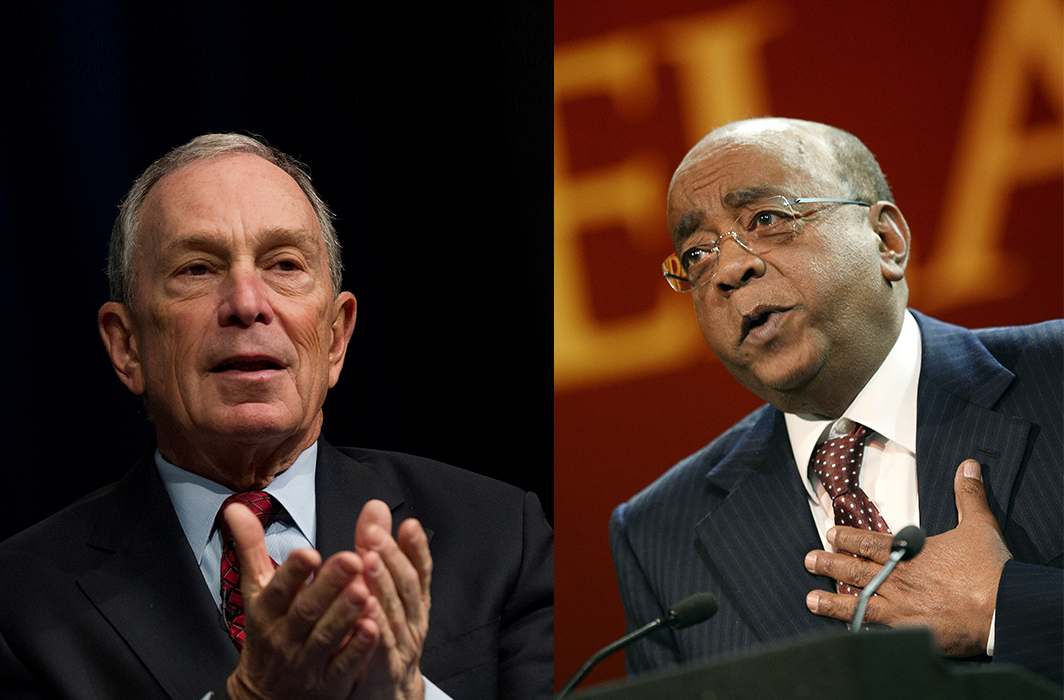
They are arguably two of the world’s most respected business minds and they are not afraid to speak out on many global issues. In the margins of the highly-touted US-Africa Leaders’ Summit last August, renowned former mayor of New York Michael Bloomberg and the unflappable Sudanese millionaire Mo Ibrahim jointly and exclusively spoke to New African on a wide range of issues. From money, politics and philanthropy to good governance and the summit itself, Mike and Mo do not hold back in this light-hearted, yet poignant interview with Omar Ben Yedder.
NA: Congratulations on what many people say was a successful event – the Business Forum that you spearheaded during the US-Africa Summit. What are you views on it?
NA: Michael, you are known as a problem-solver. You took the initiative to organise the successful Business Forum at this Summit. How did that evolve?
MB: In all fairness the idea came from the President and his Secretary of Commerce, Penny Pritzker. They had the idea and then they approached us and asked if we would be interested in participating. Bloomberg has a 20-year history in Africa. We have 8 offices, at least 160 people who work there. Our philanthropy side has projects in around 40 African countries. We were therefore a logical partner for the Summit. Besides, we also have the expertise on how to structure an event. It was therefore a good symbiotic relationship.
NA: Former President Clinton said that the US needed this Summit more than the Africans did, hinting that the Americans would have more to lose. Do you agree with this?
MB: I would never criticise a former American President. But how do you measure that? For Africa it is a unique opportunity to deal with individual American businesses as opposed to a government-sponsored trade programme, of the kind China does. By the way, there is nothing wrong with what China does. They just have a different approach to it and there are some benefits to that, as well some detriments. But that is what they do.
In America we have lots of alternatives. For example, if you don’t want General Electric jet engines, you can buy Pratt & Whitney jet engines. And you can have a different policy for jet engines than you have for locomotives, or turbines, or roads, or that kind of stuff. But at the end of the day you will create more American jobs, and you will create more African jobs as well.
NA: And Mo, what are your thoughts on that, do you think the US has more to lose and needs to make up ground?
MO: It is not a question of losing or winning. I think both sides needed to have an understanding of each other. The perception, for a long time now, has been that the American administration does not care much about Africa because it has its own battles in Afghanistan and Iraq. But actually, it has battles here in Washington itself, with the polarisation of politics right here.
Yes, there is not much attention being paid to Africa beyond the security issues, which are part of the global core strategic issues raised by the US administration, and that is why it was important for the two sides to really connect again at this Summit.
This Summit was important because Africa cannot afford to do without the United States. This great superpower has technology, innovation, still has the largest economy in the world and is also a big player on the issue of security and as Africans we have to accept it. For the US, it is also important for their business community to build a stronger association with Africa. There was so much going on at the Summit, but it was very intensive and focused.
NA: Michael, you have been described as someone who openly courts capitalism and free markets but at the same time you seem to have interventionist tendencies, such as limiting consumption of sweet drinks to reduce obesity, and gun and smoking controls. Would you say that you believe in an interventionist government?
MB: Well I think nobody suggests that unfettered capitalism would be appropriate for any society. You just have to have laws which protect all your people.
Mo: [interjecting] But the mayor was not able to stop guns in New York. I don’t know if he had the power to, but he did not do that. But I wish he had.
MB: Guns are a good example. The 2nd Amendment [in America] gives citizens the right to bear arms. The Supreme Court has said localities can pass reasonable restrictions. Some of the reasonable restrictions include selling guns to people with criminal records, psychiatric problems or minors. The problem is the Federal law says exactly that and requires dealers, of which there are 50,000 in the United States (to put that in perspective we only have 15,000 McDonald restaurants in the US) to run background checks. Every year 12,000 Americans get killed with illegal handguns, 19,000 Americans commit suicide with illegal handguns. So there is a problem with handguns in America.
NA: Sitting next to you Michael, is a great advocate of good governance, Mo Ibrahim. What are your thoughts in terms of governance? People say that you were quite lucky as mayor in that you funded your campaign yourself and were thus free to do as you pleased without having to bend to any interest groups. Political funding is an important issue in Africa, where elections are often about who spends the most, and thus political funding becomes a big issue. And some people, such as the Minister of Finance of Nigeria, are calling for campaign spending to be limited, like it is in the UK.
MB: I was a wise-ass when I was poor and 26 years old. Anybody who knew me then will tell you I haven’t changed.
Whether it be public funding, private funding, or time limits, there is a problem with every system. The real problem however comes when the public doesn’t stand up and demand accountability. When you have people who take campaign donations from companies and industries that they regulate, that is a problem and pure craziness!
NA: Mo, what is your opinion on the question of funding in terms of African politics?
MO: It’s a problem. Politics and elections cost money and we don’t have a system which provides public funding for political parties unfortunately, which makes elections prone to major influence by businessmen and money – and that is a problem.
I really don’t have the answer to this. However, I would favour a system where there was public assistance of some sort; but somehow with a set limit. That said, it can always be easy to circumvent rules and also, the incumbent leadership will always have a major advantage in terms of media exposure, travel and much more.
NA: Michael, earlier this year you launched an initiative to train African journalists in financial reporting. What prompted you to do that? Are you satisfied with the quality of journalism in Africa or not?
MB: It is not about that at all. Having a sophisticated capital market is a recent phenomenon in Africa. Therefore, Africa cannot be expected to have a large number of financial journalists as there wasn’t such a huge market for it previously. Today there is one and I think I have always believed that a better quality press informs the public better. And that way the public makes better decisions and can force their leaders to govern better.
NA: You are both philanthropists and I think you have a similar take on the issue of philanthropy, which is not about giving money, but about making money work. Would you consider working together on the philanthropic level?
MB: Yes, but you have got to be careful as there is room for both – giving money and making money work. I am all in favour of results-driven philanthropy but there is also room for Mo to say, “You know, I just have a feeling that this crazy kind of stuff painted on a canvas is going to be called modern art someday and it will be real art”, and he doesn’t have to have anybody agree with him, it’s his money. There is a place for that kind of innovation and there is also risk-taking in private philanthropy. But it should also be noted that even in philanthropy, you have to have accountability and make sure you don’t just keep pushing money through some programmes.
NA: But is there an argument for bringing people like you together and to make your philanthropic activities work more effectively?
MO: I don’t think of myself as a philanthropist to be honest because our situation is different in Africa. In America philanthropy has a huge tradition, I mean it’s so deep. Africa has unique problems.
We have political issues, economic issues, and health issues. And while I think it is okay that international development agencies, and people like Bill Gates, are doing really great work in many areas in Africa, there is one thing they cannot do – which is, take African leaders and governments to task, because they are not Africans. That is why I focus on governance and leadership – because the other guys cannot do that.
NA: On that issue of leadership, Michael, what do you think about term limits?
MB: Well, the New York Times would argue that if the public wants to keep electing a bozo, they get what they want. But that’s democracy.
NA: Because you fought hard to be allowed to run for a third term?
The City Council passed the law [to extend term limits, allowing Bloomberg to run for a third term in office] and they had the right to override a public referendum. Did I ask them to do it? Sure I did. They were very happy to do it because they wanted to stay in office as well. Some of the public didn’t like it but, you know, that’s democracy.
They didn’t have to vote for me or for them and they did so. You can however make the case that if you are in office too long, number one: you get corrupt; number two: you learn what can’t be done, and eventually you get to the point where you are immobilised. I don’t know when I thought changing term limits in my case was fine and I am not so sure I would vote for it.
Term limits can be abused and some people would argue it was abused in my case. However, it has to be remembered, I got re-elected.
Michael & Mo at a glance
Michael Bloomberg has lived many lives. And like many other savvy entrepreneurs, he has cast his business eye on Africa recently, expanding Bloomberg’s presence on the continent through his media enterprise and philanthropic work. Although still a small market for its terminals (the main revenue driver for media business), Bloomberg has recently begun working with a Nigerian production company to create localised content which airs on Bloomberg Television across the continent.
At the US-Africa Summit, Bloomberg Philanthropies – his Foundation – spearheaded the organisation of the Business Forum, which was hailed as one of the major successes of the Summit.
In America Bloomberg is renowned as an entrepreneur, a self-made billionaire, and a successful politician, who as mayor for New York, was often described as an opinionated yet unflinching reformer. After pulling out of the next US presidential elections, he has decided to go back to run the company he founded.
“What chance does a five foot seven, divorced Jew have of becoming President of the United States,” he has famously said.
He started his career as a banker, but left to set up one of the most successful business and finance information firms today.
Meanwhile Mo Ibrahim, the tirelessly resolute pan-Africanist and serial entrepreneur, needs little introduction in our pages and on the global landscape too. He is famed for setting up the Mo Ibrahim Foundation in 2006, which focuses on highlighting the importance of leadership and governance in Africa.
Its cornerstones are the Mo Ibrahim Prize for African Leadership which celebrates excellence in African leadership and is awarded to a former head of state or government; and the Ibrahim Index of African Governance (IIAG) which provides an annual assessment of the quality of governance in African countries.