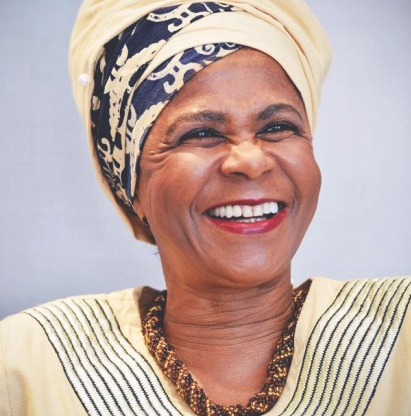
Memphela Ramphele: Unleashing potential. Memphela Ramphele, the founder and leader of the Agang party in South Africa, has some sharp criticisms of the way her country’s education sector has performed. She spoke to New African at the WISE conference in Doha, Qatar.
New African |What does education mean to you?
For me education is a process of freeing human potential, and so it is really about unleashing that genius that each one of us is born with, the unique talents that need to be made available to ourselves, so that we are conscious of who we are and what makes us tick. Then, in interaction with others, [it is about] being able to share that with others, to thereby shape the future of one’s own path, the future of the community that one is part of, the country, the continent and so forth. For me education is a very individual thing because it is the individual talent that must be unleashed, while it must also be done within the context of a supportive family, school and community.
NA | How do we make education appropriate to the individual and the circumstances that individual finds themselves in?
Education is not about teaching only the specifics. Oh yes, you must learn the basics, the literacy and numeracy, that was what my parents were very good at, But that enables you to be put on the path of learning how to learn. Of course the education system must pay attention to the appropriateness part, but if the teaching and learning process unleashes that capacity to learn, then people will have the ability to change their career paths throughout their lives.
NA| Are you happy with the relevance of today’s school curriculums?
We have to be so very careful about the quest for relevance that eats away at the general [curriculum] of the basic schools. We need, as a people, to become the best that we can be, in the understanding of ourselves, in being able to express ourselves, and the ability to apprehend one’s environment and analyse it in ways that enable one to find the best path.
You never find all the answers, but if you don’t have the ability to function in a rapidly changing environment, it does not matter what you have learnt, it does not matter how brilliant you are, you will not be able to function in a modern interconnected world. But, having said that, I am a very strong advocate of connecting with and learning from everyday life.
NA | But not everyone can become a professional, an entrepreneur, an inventor…
You know, in Africa in particular, manual work and artisanal work, because of the legacy of racial discrimination, is seen as being inferior. We need to regain respect for manual work, respect for artisanal work. So the revitalisation of vocational training is absolutely front and centre.
Right now, in South Africa, we have four million young people who are not in work, not in school, not in training. They are not employable. [The latest figures show that only four per cent of South Africa’s school leavers have any sort of qualification.] They need employment, they need on-the-job training opportunities. That is why we in Agang [the political party that Ramphele established and heads] are very clear that our first order of business would be to use the five to six billion rand (equivalent to $500-600m) that is currently absorbed by these completely ineffectual and ineffective Sectoral Education and Training Authorities and connect school leavers and school dropouts with the workplace.
NA | You have been at the sharp end of the tertiary education system in South Africa for a number of years. What are the main challenges that this sector faces?
The higher education sector in South Africa has been performing an ambulance service for an education system that is not working. The government’s own figures show that 80 per cent of schools are not working. We have got a big problem.
From the current statistics, the age cohorts studied in 2001, 1.1million people, only 33 per cent of them got to the point of writing metric [exams] and getting some kind of certificate, but only 10 per cent qualified for tertiary education. But when you take that 10 per cent, half of them drop out at the first year level. Now you could argue that universities should do more to receive children with different levels of preparation, but we have been doing that in anticipation of the advent of democracy. Why have we, after 20 years, failed to prepare young people not simply for tertiary education, but for the world of the future? Because of the growing inequality in South Africa, more and more young people cannot afford school fees, and our Tertiary Education Assistance Programme has not been adjusted to deal with unemployment, high dependency ratios etc. So we need a complete overhaul of the whole education system, from pre-primary all the way to tertiary, to prepare an agenda for our young people to be the movers and shakers of the 21st century. Right now, we are failing desperately.
NA| Were you to be elected the president of South Africa, how long do you think it would take to make this radical overhaul?
It would take as a minimum five years to get stability. But then in ten years we believe you could put South Africa in the top ten of education systems. We have the money, we have the innovations from civil society and the private schools and the best public schools. The knowledge is there and the international community is up with all the initiatives such as the example of the WISE laureate, Vicky Colbert and her Escuela Nueva system (see pages 68-71), and [we need to] apply this to our schools. We don’t need to invent the wheel, but we have to change the mindset – that of the government, the parents, the community and the teachers.
NA | Could you tell me what the mood of the teachers in South Africa is like?
There is not one cohort of teachers. The teachers who are professionals, the teachers that belong to the National Professional Teachers of South Africa would welcome the transformation of the system because they are frustrated by the current mediocrity. Some of the teachers in the South Africa Democratic Trade Union would also welcome change, but the majority in this union, which is aligned to the ANC, just see teaching as a way of earning money – thinking, it is not a calling, it is not a profession. I met a teacher recently in Uitenhage in the Eastern Cape who told me that when the outcomes-based education was introduced in the late 1990s, she stayed at home on full pay for six years with the full knowledge of her principal. At the end of the six years, she took early retirement. So the problem is not so much the teachers, it is with the management of the teachers, which has been bedevilled with this alliance relationship. This teacher’s union represents more than 200,000 teachers, and what the ANC is looking at is both the voting pool and also the mobilisers of voters, so they are not going to do anything to upset this teacher’s union.
Our constitution is very clear. Our children have the right to an education that is going to prepare them for their future life. But these children’s rights are being violated every day. Post-colonial governments, because of poor governance, and the lack of accountability towards the citizens and the inability of citizens to hold their governments to account – whether out of deference, because they are liberation movement heroes, or because citizens don’t understand that a respect for heroes does not mean that you must tolerate incompetence or nepotism or corruption, have been responsible.
So because we have consistently failed as a continent to have citizen education as an essential ingredient of transformation from a colonial to a post-colonial situation, we have ended up with this scenario where governments have failed in the provision of education, healthcare and social services. And they by themselves, out of that system, have private schools, private hospitals, private security – so that is where the issue of social justice comes in. If you believe that the 21st century is about innovation, innovation is about people. And therefore you must invest in the people’s education and healthcare.
NA | If you were granted three wishes for South Africa’s education system, what would you choose?
The first thing would be an audit of all the teachers, to see what skills they have, what attitudes they have, who wants to stay in, who wants out, then [we must] make sure we retrain those that want to stay not just technically but attitudinally, so they know that this is the most important profession, because this is about nurturing their talents, releasing the genius in our children. We only want the best, so we have to reciprocate with good pay and conditions.
The second thing would be to move from textbooks into tablets and have every school properly equipped with laboratories, recreation rooms for drama, painting, music etc, and sports facilities. And finally, we need to have an education system that really raises the bar, where there is open learning and openness to the possibilities – and excellence is the benchmark. Because, the poorer you are, the more education you need as there are no second chances.