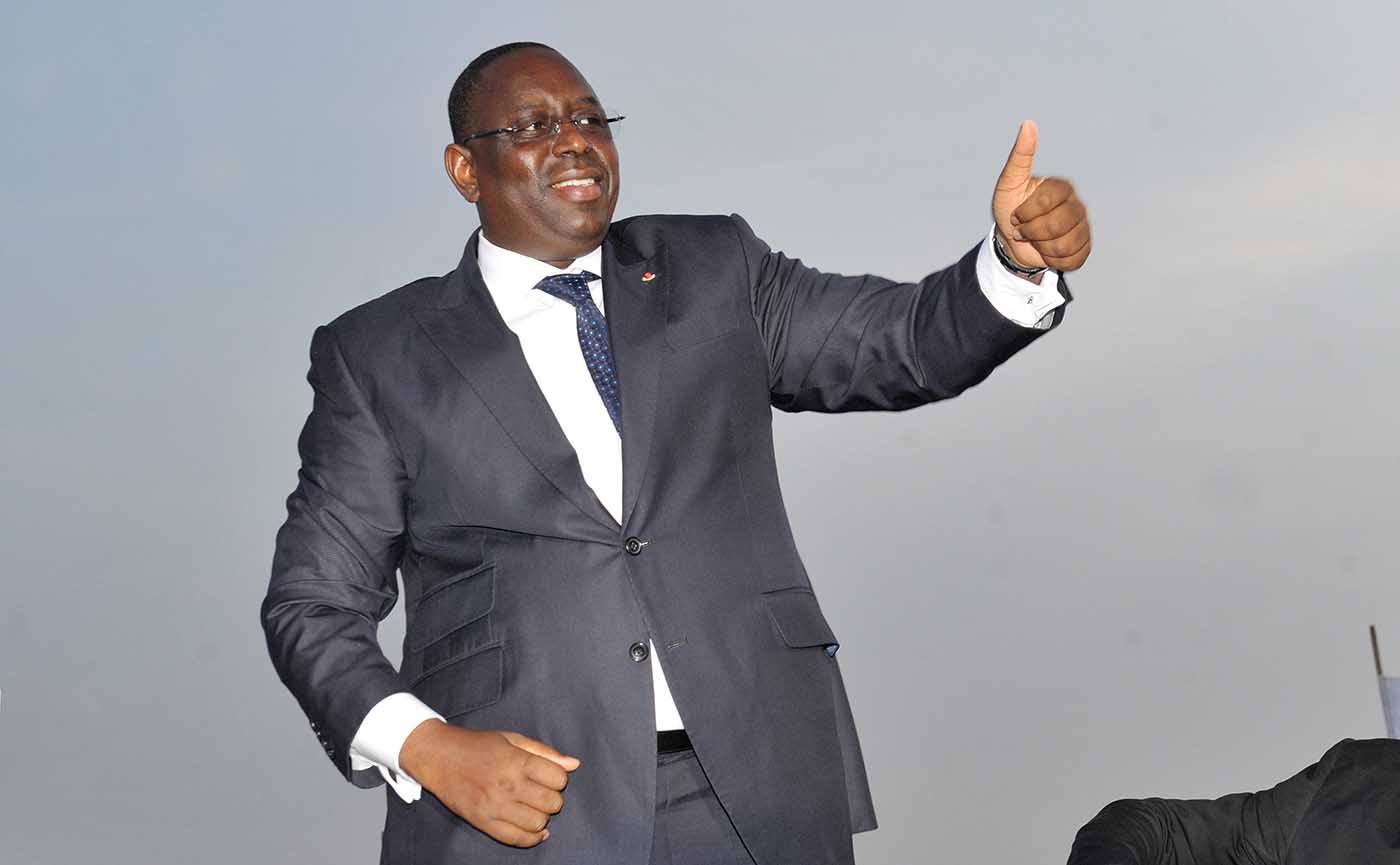
Hichem Ben Yaïche interviewed Macky Sall, President of Senegal.
Your Presidential election victory triggered a huge wave of hope. Today, impatience has transformed into disenchantment. How do you explain this state of affairs?
I would be much more positive in my judgement. Admittedly, impatience is a reality. It can be observed in all the countries around the world! Nations are going through difficult times. The economic situation is complicated everywhere, including in the big industrialised countries.
So you can imagine the situation is even tenser for a developing country with no natural resources. And yet, I can tell you that we work every day towards reducing the population’s difficulties. We act to alleviate the suffering, especially that of the most vulnerable. Our policy is materialising first and foremost in the protection of those people.
With this aim in mind, prices have not risen since 2 April 2012 [when he assumed office]. You, of course, are aware of inflation’s pressures on the economy. Yet, we contained it. We can even say that when it comes to consumer prices, essential goods’ prices have decreased, so we are effectively in deflation. This is absolutely concrete.
In addition to this, we also took action in favour of employees by lowering income tax. This initiative is another way to boost consumption. As such, this tax cut has been popular amongst the vast majority of trade unions and workers! What I am referring to are palpable and indisputable results. To get a fuller picture, we must also take into account the drop in rents as well as all the efforts made towards spreading out our social safety net.
And yet, the average Senegalese man or woman on the street doesn’t feel the benefit…
On the contrary, I think your impression absolutely does not reflect the reality in which the majority of Senegalese people are living. Of course, there are problems; everyone says so! It would not be helpful to pretend that all is well, that we’re living in some Eldorado… That is not the stance I’m taking here, but we must recognise there are some improvements.
A number of measures have been taken for [aiding] agriculturalists, pastoralists and peasants. We have also established universal health care. Free of charge treatments did not exist in Senegal before. We have also subsidised seed renewal. Naturally, everything cannot be successful in only one or two years, but we can’t say the situation has deteriorated.
Everyone knows Senegal needs profound reforms. Is the country truly reformable? Inertia seems strong…
There’s a paradox in this eagerness to call for reforms, when, at the same time, there’s a refusal to break away from the status quo.
When you decide to drive an austerity policy and reduce public spending in non-productive sectors, you’re threatening vested interests. Therefore, you’re creating friction!
We’re trying to determine what is the appropriate speed to unveil reforms, keeping in mind the necessity to preserve the social climate. We are moving towards what we agreed upon and now share with the majority of the Senegalese people the Plan Sénégal Emergent (PSE) [Senegal’s development framework], endorsed by the international community.
Evidently, the framework’s financing also depends on the implementation of those reforms; so we’ve embarked upon them! For example, we conducted a public sector audit and obtained concrete results. We recovered more than 6 billion CFA ($12 million) that had been fictitiously allocated. We’re also conducting an audit of grants. We have, today, control over the civil service.
In the industrial sector, we took over the payroll-monitoring unit to monitor and control spending, thereby increasing the return to capital.
Today, capital investment applications have substantially increased. And, for the first time, 62% of the entire investment budget is sourced from the consolidated revenue fund (budget consolidé d’investissements – “BCI”).
Why would an investor want to come to Senegal at a time when reform implementation remains slow and resistance to those reforms is strong?
No, reforms are not slow! I entirely refute this idea. The 2014 Ibrahim Index of African Governance (IIAG) has just ranked Senegal 9th out of 52 countries in Africa! It’s no small achievement! In terms of democracy, as a country reforming management systems and governance… We managed to climb one place higher in the Index: we were ranked 10th last year. Note our qualitative jump in terms of reforms for the business environment, cutting red tape, precisely to facilitate investors’ access to land, property and more generally.
In the food-processing industry, we took immeasurable steps, steps that no one else in the majority of African countries has dared to take.
Public officials’ asset disclosures have become a reality: the Bill has been passed, the decree will soon be finalised and published. I will say this: in terms of governance and optimal public spending, we have made undeniable progress.
There’s still a lot to do, I agree with you… We cannot fundamentally change a country in two years. Give it time!
In your two and a half years as president, you have changed the cabinet three times. Does your new team match your pace and desire when it comes to governmental action?
Yes. Cabinet reshuffles are part of institutional life… you shouldn’t judge a government’s overall actions against those episodes. I think that after two reshuffles, we have a more coherent, strong and more comprehensively satisfying cabinet makeup. So, I am absolutely satisfied with this new team. Those who left have done all they could, but somewhere along the line, for various reasons, the necessity to change one person or another arises. Since the President of the Republic conceives the cabinet’s policy, changes in personnel do not define policy.
You embody the vision you have long held and developed before your election, but in the domain of good governance and transparency, where are the improvements? For example, we’ve seen that in the fight against corruption, mistakes were made in the preparation of case files, in particular that of Karim Wade…
I’d be happier if you had picked a specific example where one such mistake had been acknowledged. We don’t want to be manipulated. I know I’m speaking with a journalist, so I’m assuming you have all the information… Saying that there has been hastiness is wrong, it’s very wrong! In actual fact, it’s quite the opposite.
The audits I ordered on those issues have not yet been published. All that’s currently being done and commented upon result from previous audits left to us by the former government. They are the result of work carried out when I was not yet President. Admittedly, legal proceedings have not always been followed through. We handed over the files to the justice system in due time.
There was no hastiness and no witch-hunt.
Today, what are your biggest concerns and challenges?
The most pressing issue is to drive Senegal towards development. And to do so, I defined an economic framework, the PSE, which relies on strategic and well-defined pillars. The first one is built on the transformation of systems of economic production and it revolves around growth-spurring sectors like agriculture – the main sector – infrastructure, [and] the development of public-private partnerships, the energy sector and transport infrastructure (roads, the railway network, etc.). That is the 1st pillar of the PSE, we could call it “transformation of the national production system”. But a framework, whatever the ambition behind it, is worthless if it does not include a human dimension.
Precisely how do you advance towards this “cultural revolution”, or rather, this “revolution of the mindset”, to impose this new vision?
We’re wholehearted there. It is no longer a matter of declarations or projections. We’re already there thanks to PSE. And I can tell you that in line with the 1st pillar, which concerns agriculture, we have made fundamental choices. Achieving self-sufficiency in rice as soon as 2017 is one of them.
Of course, I am aware this is very ambitious. Today, we are producing 400,000 tonnes of rice. We are forecasted to reach 1.6 million tonnes. And with this in mind, we allocate the appropriate resources in the budget. For the first time, the new budget for 2015, which has been scrutinised on 10 October [the day of this interview], has led to an extraordinary meeting of the council of ministers to enable all ministers to appreciate the philosophy that underpins budget scrutiny. First, it involves the realisation of growth-spurring projects representative of the choices we’ve settled on in the PSE and the shape we’d like to give our development plan.
Concretely, with regard to agriculture, we are setting up new land of up to 60,000 hectares. I will shortly head to the Senegal River valley to see for myself what has been achieved in 2014… Our cooperation with India will be at the heart of the “green revolution”. At my request, Senegal has already invested about 65 billion CFA ($127 million) over two years, to increase the productive areas, as well as modernise them. That is one example. I could say as much about energy.
Indeed, energy is an essential issue that weighs heavily on the functioning of the economy: how do you approach such a critical question?
Energy… I am in fact very happy to talk about it. It is a field I know well, as former Energy Minister and a geologist by training, having worked in this sector. It’s an issue across Africa; an issue Senegal hasn’t avoided. We had an old system sustained by engine generators using 25 to 30-year-old gas turbines or diesel fuel, and these generators, most of which used gas turbines – some others worked with fuel – were very expensive. The solution was to turn to hydropower.
We decided on an energy mix so as not to depend on a sole energy source. If we were dependent on petroleum products, with all their erratic variations, we would be at a great disadvantage. So, this energy mix allows for a greater diversification of products. Thus, we introduced coal, which better meets today’s environmental standards. We’ve worked with organisations responsible for the development of the Senegal River Basin in an attempt to increase its hydraulic capacity.
We’ve also worked on a regional project for solar energy with Mauritania. And it is the combination of all those sources that will ensure that by the end of 2015, we will put at least 500 megawatts on the market. When I was elected, I only found 490 megawatts. We will add 500 new megawatts! Several projects are being executed.
Here’s another tangible improvement: investments have been made in the private sector! This means there’s confidence in the country and its energy policy. They’re independent producers and we have got the regulatory and legislative framework for the energy sector. We’re on the right path, even if everything cannot be fixed immediately. It would be demagoguery to pretend otherwise.
The other priority in the eyes of Senegalese people is that of employment. Certainly, unemployment affects the planet as a whole. What are your flagship ideas?
As you said, unemployment is a global problem. That is especially true for our developing countries with very young populations. The most recent national census has just been made public and it reveals that out of 13.5 million Senegalese, half are less than 18 years old! You can appreciate the necessity for future jobs. Half! That is to say that about 7 million young Senegalese are under the age of 18. What does this mean?
In terms of forward planning, we already have educational learning centres, training, higher education, research… In terms of employment prospects… those jobs will not be given by the State. Public sector jobs represent the smallest share, a maximum of 6000 to 7000 new jobs a year. When 100,000 or 150,000 young people are entering the job market every year… We estimate our action should focus on levers of growth and employment. This is why we are putting an emphasis on agriculture: modernising it, strengthening it… So as to enable the youths who choose to take part in it, to earn their living through what will soon become one of the top employers in the country: agriculture and agribusiness.
From this viewpoint, we have a comprehensive vision for agriculture, with all its value chain, all the training it requires and its commercialisation. We’re also exploring other avenues to boost employment: the development of services, for example. Senegal is a country of services! Nowadays, with the service sector, you can generate a great deal of outsourcing jobs…
This raises the issue of training…
Yes, on training, you are right, we must change paradigm. Education, as it has been practised up until now in Senegal, has been all-purpose education.
We admit that we need to open the way to new viewpoints. At Higher Education level, we have created what we call Institutes of Professional Studies, to ensure professional trainings are in line with the job market. We created new professional colleges. They’re entirely new in the country. Up to now, Senegal had general colleges and vocational colleges; there were no professional, agricultural or tourism-focused colleges.
High school students now prepare for admission to the institutes, and you’ll see that at the same time as performing general education. We are strengthening professional and scientific training: the study of sciences, mathematics and other subjects. All this is to meet the needs of the market.
Terrorism is a subject of concern in the Sahel region, and elsewhere. The jihadism spreading out in West Africa is a major factor of instability. How do you understand it within Senegalese society?
Unfortunately, nowadays, no country is spared. Senegal has just lost a non-commissioned officer, who was killed in Northern Mali by terrorist forces. No country is safe from it…
How do you shape your doctrine to address this issue?
We stand against all forms of violence and we fight, reject and condemn violence in all its forms. Especially intolerance. No religion should give a man a pretext to commit what those jihadist gangs are doing. We are heavily committed, along with all the ECOWAS countries, and with all of the international community to protecting the population.
You’re right, the security and military approach are necessary. When we see that some factions are modelling their organisational structures on that of some armies, it compels us to act militarily. That’s a remedial method. But prevention entails tackling the root causes early.
And those causes are: unemployment, lack of education and training. We need to take action so that the youth is not vulnerable to those extremist groups that threaten to swallow them… You’ve seen that great powers cannot escape this threat, including the Western world. It is a societal problem that requires us to review it from top to bottom if we are to find a suitable way to address it.
Another urgent situation has emerged: Ebola. Do you fear the impact of the epidemic on the population and the economy?
In this globalised world, where trading and travelling are part of daily life, no country is shielded from such a virus. As the most recent examples in Spain and the United States remind us…
I congratulate myself on the management of the single Ebola case we had on Senegalese soil. The professionalism of our authorities has been exemplary and the young Guinean student who had been screened as carrying the virus is being treated and completely cured. The Francophonie Summit, which some thought might be threatened, will still take place [in Dakar] in November!
Senegal is no longer in the World Health Organisation “Red Zone”. The Ebola virus no longer exists in Senegal and we have all mobilised to keep it out.
The seriousness of our border control measures, the preparedness of our medical staff when faced with the sudden management and treatment of suspicious cases, as well as the important efforts made to raise awareness of and communicate the facts with the population are the best guarantors.
Despite this, we share the concerns of the countries affected and I’d like to reiterate my support to them. We’ve established humanitarian corridors in order that doctors, health workers, NGOs and members of the international community have access to the countries where the outbreak is ongoing. We will carry on our efforts to eradicate the virus.
More than ever, I am calling on solidarity and the rallying of all the international community to eradicate this epidemic, which is no longer just the African continent’s problem… Ebola is everyone’s business!
You just mentioned the Francophonie Summit. How should African countries use it to their advantage and to explain and transform a concept that remains abstract for people, apart from the language?
For a start, let’s note that this interview is taking place in French! This is testimony to the importance of the French language, which is a shared language.
Francophonie is also a community of shared destinies, who share a language that originates from France, of course, but that we now share with different people. It is an instrument of communication to exchange, study and connect… It is, therefore, important that this language be preserved and protected. Obviously, it needs to be protected as part of greater linguistic diversity. The French language coexists with other languages. We’re not always
born French. Francophonie is made of Africans, Senegalese, Ivorians, Moroccans, Vietnamese, and more. This is a community of destinies, with values we share as Francophones. First and foremost, peace and tolerance… In short, the values of universal democracy.
This year, we chose the theme “Women and Youths in the Francophonie: vectors for peace, actors for development”. Women must act in West Africa, and everywhere where there are conflicts; they can be a vector of peace. The woman – she’s the mother, she’s the spouse. Women have made substantial contributions, including in researching peace in Africa. We must fight to preserve their rights. And we must also act in favour of the youth and – as I also said earlier in this interview – tackle joblessness. The youth is entering the labour market in numbers. They are the majority.
How shall we address their concerns? Heads of state will discuss all this in Dakar in November.
Is Francophonie a tool that matters?
Francophonie is an important tool. Anyway, if we were to desert the French language, we would have to find another language, one that can be shared, that is somehow universal.
As President of Senegal, I am the heir of what our founding father Senghor, Abdou Diouf and later Abdoulaye Wade have done as heads of state…
Is Senegal’s organisation of this summit an opportunity to convey the viewpoint of a Southern country on this Francophone question?
Absolutely. We previously organised this summit in 1989. Therefore, it is with great honour and pleasure that Senegal will welcome the coming summit on 29 and 30 November.