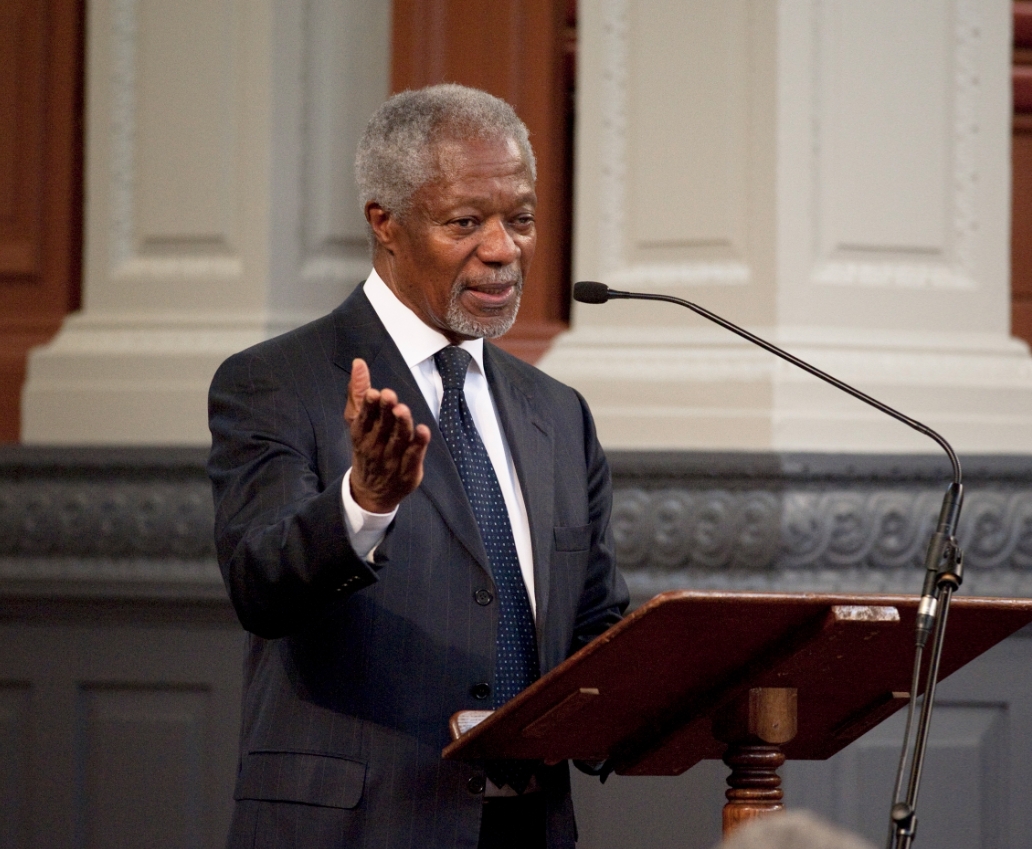
Kofi Annan posits that in 2012, it’s time that Africa looked beyond its colonial past to try and understand its current problems. In other words, Africa must look within itself to
prosper. It’s only then, Annan argues, that the continent can reach its full potential. This is something he believes is already beginning to happen, writes JP O’Malley, in this exclusive interview for New African with the former Ghanaian-born UN chief.
In conversation, Annan speaks with all the formality you would expect from a man who has given fifty years of his life to diplomacy. He looks considerably younger than his 74 years. Maybe it’s his smart attire. Or it could be his affable smile – which seems to give him enormous powers of persuasion in conversation.
It’s a balmy Saturday afternoon in October. We are sitting in a room on the ninth floor of the Dorchester Hotel, overlooking the trees that rise above the gates of Hyde Park in London. The autumnal sunshine even gives a semblance of placidity to the buses that jostle their way down Park Lane and into Mayfair.
I’m here to speak to Kofi Annan about his new book “Interventions: A Life in War and Peace”. The memoir speaks candidly about the peaks and troughs of a career spent trying to persuade governments around the globe to bring about peace. It also points out how the UN, on occasion, failed to protect the rights of “the peoples”, as laid out in the original charter of the organisation, written in 1945.
In one chapter in his book, which looks at the complexities of African politics, Annan describes a press conference in Gabon, just as his tenure began as Secretary Secretary-General in 1997. A journalist asked him why he often criticised African governments, to which he replied: “I work a lot for Africa and I recognise its hardships, but I reserve the right to criticise Africans.”
Annan still argues today that views which emphasise the culpability of colonialism in Africa, only serve those who desire the status quo. Furthermore, he says, the support for the Big Man system – Robert Mugabe in Zimbabwe being one example – creates a political culture that simply encourages autocrats and dictators.
“The struggle that led to independence in many African nations, sometimes led to the creation of national movements, and not necessarily political parties. When independence was achieved in some of these countries, they often found themselves in one big group. This led to a party-regime where the leaders did not tolerate differences, and stayed on,” says Annan.
“The sort of qualities that make dynamic, and revolutionary fighters, are not necessarily the same qualities you need to run a nation. This leads to difficulties,” he adds.
Annan believes that Africa must look beyond its colonial past to try and understand its current problems. In other words, Africa must look at itself, if it is to prosper, socially and economically. An optimist by nature, and a pragmatist who speaks his mind, Annan believes this is already happening.
“African governments are becoming more sensitive to democratic demands. This is because civil society is putting pressure on the politicians to do the right thing. We are now at the stage where we are seeing the generational change of leaders, who are better educated, and who know what they want from themselves, and their fellow citizens.”
Annan joined the United Nations in 1962, serving as secretary-general, from 1997 to 2006. It was in Ghana where his life as a pragmatist began. Born in Kumasi – the capital of the Ashanti region – in 1938, Annan was the son of a Ghanaian, who ran a European trading company. As a young man, he was a student in the “independence class” of 1957, at his boarding school, Mfantsipim, in the city of Cape Coast. It was an era where one could witness how politics had meaning above tribe, or ideology, says Annan.
“As a teenager, to see this struggle for independence taking place in Ghana was very powerful. I grew up with a sense that fundamental change was possible. For example, to watch the police commissioner-who was an Englishman – become a Ghanaian, or the Prime Minister become a Ghanaian, gave me great optimism and hope. I saw that things can change, and had a sense that I could help change things, because I had seen it happen at such an early age,” he says.
As the first sub-Saharan African secretary-general of the UN, Annan understands the prejudices of the outdated system in the Security Council. Currently, just five countries hold permanent seats: The United States, Britain, France, China and Russia.
Many African leaders recently – President Sata of Zambia being one – opine that Africa should hold a permanent seat on the Security Council.
Of the 193 member states that make up the UN, Africa has 54, making it the continent with the highest number of members. Annan says the current system reflects a geopolitical world-map 1945, not 2012. It’s an issue he believes needs reform.
“Change should come on this matter, when I cannot say. I tried hard to see if we could create a permanent seat for Africa on the Security Council, but we did not succeed. Three countries in Africa would see themselves as permanent members: South Africa, Nigeria and Egypt. These countries, and others, do expect to have a voice at the table. It will be in the interest of the organisation to have them there. These reforms cannot be resisted forever.”
The title of Annan’s new book, Interventions is aptly chosen, describing how interventionism was a practice that defined UN peacekeeping troops after 1989. Prior to this period, the organisation had been in deadlock for forty years, due to the paranoid cold-war rivalry of its two most powerful members: the United States, and the Soviet Union. However, as the politics of the post-cold war era thawed rapidly, the UN quickly found itself in a situation it was not equipped for, says Annan.
“Until the end of the 1980s, when the Soviet Union collapsed, the Security Council was divided. The cold war meant it wasn’t easy for the Council to agree on what conflicts they should intervene in.
“In most cases they had intervened in inter-country conflicts, where the parties came to agreements, and invited the UN to come and monitor. So they were fairly stable environments. After the early 1990s, we got involved in various internal situations, Somalia and Rwanda being two of them. That required a different type of skill – one that tested the organisation: to defend some of the civilian populations in the vicinity. That was really a qualitative and dramatic change to UN operations,” says Annan.
This unexpected transition meant Annan suddenly found himself in 1994, as head of UN peacekeeping, in a position where he could do nothing, as an ethnic conflict erupted in Rwanda, between the Tutsi and Hutu tribes. Over a three-month period, he pleaded with world leaders to intervene in the genocide, in which 800,000 people were massacred. This figure amounts to nearly three quarters of the entire Tutsi population, who were hacked to death with machetes, mostly by civilians on the Hutu side.
After the previous events of “Black Hawk Down” – where two helicopters were shot down, and eighteen US soldiers killed by a mob of rebels – a year earlier in Mogadishu, the Clinton Administration felt deploying more peacekeeping troops to a similar region would not benefit Americans’ national interest. Other countries steadily agreed. Annan describes this moment as devastating.
“It was a very painful experience for me, but we have to understand the context. We were trying to cope with Rwanda soon after the collapse of the UN operations in Somalia, where US troops had been killed, and dragged through the streets. These countries became so risk-averse that they wouldn’t jump into another situation like Somalia. Instead of increasing the numbers, we scaled back. In those situations, governments tend to look after their own. So the question of protecting the Rwandans was secondary.”
Nearly a decade later, Annan found himself again attempting to negotiate another ethnic conflict in Africa: this time in the Darfur region in western Sudan. In 2003, UN senior staff had begun to issue public warnings about an army of tribal fighters from the Arab Baggara tribes – known as the Janjaweed. These Arab militiamen – who were supplied with weapons by the Sudanese army – raped, killed, and burned down thousands of village homes, displacing hundreds of thousands of others.
Annan paid a personal visit to the president of Sudan, Omar al-Bashir, in July 2004, to ask him to intervene. The meeting ended with Bashir promising to disarm the Janjaweed, and to bring justice to those accused of human rights violations. Nothing happened. In a conflict where 300,000 had allegedly been massacred, many in the international community began to ask the same question: should Darfur be recognised as genocide?
In July 2004, the United States Congress voted that it was.
Annan maintains that he was given ample evidence which confirmed that however barbaric these crimes were, technically, they could not be classed as genocide.
“The UN sent in a commission to Darfur, headed by Antonio Cassese, who was a prominent Italian judge, and an expert on war crimes. They came up with a report confirming there was systematic abuse of human rights, and to some extent, crimes against humanity. However, they could not determine after their study, that it was genocide,” says Annan.
“That would entail judicial determination, and analysis, so the commission stopped short of calling it genocide. This was a report that went to the Security Council. On the basis of that report the Security Council referred the Bashir case to the International Criminal Court. Having accepted their report, I couldn’t then say it was genocide. I had to accept the judgment headed by Cassese.
“While the Americans called Darfur genocide, they didn’t change their policy. They declared it genocide and did nothing,” he adds.
After half a century of serving the UN, Annan has witnessed a plethora of tyrants – many of whom are guilty of practicing genocide, politicide and torture upon those they supposedly govern – pass through the gates of the UN’s headquarters in New York. Negotiating with these men, he says, is a fact of life in the world of realpolitik.
But how comfortable did he ever become, sipping tea in a room with Ben Ali, Hosni Mubarak, or Omar al-Bashir, when a diplomatic favour was needed from the UN? Did utilitarianism overcome contempt in such meetings? And were positive outcomes ever achieved?
“Whether we like it or not they exist. They often have power and influence over their people. They are also the ones we have to deal with in the situations we are trying to correct. How do you get them to change – or to do what the international community wants them to do – by not engaging them? One may go in with force, but you also have to make sure force will not cause more harm than already exists,” says Annan.
“Sometimes you need to talk with these people to save lives, to stop the killings, and the gross abuse of human rights. You need to try and find a way of getting them to understand, because you cannot go and blast your way in. I’m a diplomat, not an army general with a whole brigade behind me.”
Somalia – the failed state
Somalia, which became a failed state in 1991, has become a breeding ground for fundamentalist Islamic terrorists, in the absence of institutions that are normally paid to fight terrorism: such as a functioning police force, or a government-recognised judicial system. Al-Shabaab, Somalia’s Islamist insurgent group, which has joined al-Qaeda, has imposed a strict version of Sharia law in the areas that it holds control over in Somalia. Some punishments the organisation carries out include: the stoning to death of women accused of adultery, and amputating the hands of thieves. Publicly, most governments in the west maintain they will never negotiate beyond the barrel of a gun with such organisations. Privately however, often no alternative exists.
Asked why this strange charade is often played out in the media about never talking to terrorists, Annan responds:
“There are two reasons. You have to discourage people becoming terrorists. And secondly, you don’t want to give them the recognition, or the respectability in a civilised and stable society. However, you come to realise that they are a reality. So you have to deal with them to bring peace. In the end, you have to talk.”
What about the word terrorist? Does Annan believe it is loaded with connotations that might be reductive?
“It’s a word that has a meaning, but it also has political connotations. One man’s terrorist is another man’s freedom fighter. However, terrorism has a real meaning. Terror that strikes fear into the population, as a means of achieving one’s objectives, is not something you support and encourage in civilised society.”
The Global Fund to Fight AIDS
Annan has been a tireless advocate of campaigns that promote education and medical care for HIV/AIDS, and other diseases, around the globe. In 2002, he set up ‘The Global Fund to Fight AIDS, Tuberculosis and Malaria’. It has since approved funding worth $22.9 billion for 1,000 programmes in 151 countries. However, attempting to work with various African leaders on this issue has not been easy. In his book, Annan describes how in 2001, the then president of Kenya, Daniel arap Moi, when asked to speak publicly about the use of condoms, responded by saying: “I am [the] father of a nation. My duty is to keep people moral and upright. I can’t talk about being promiscuous!”
Annan says the irresponsibility and contemptuous attitude around this issue, from his fellow African leaders, was deeply shameful for him. Another culprit of AIDS denial was Thabo Mbeki, the former president of South Africa, who refused to recognise the scientific evidence which proved that AIDS is caused by the HIV virus and could be treated with antiretroviral drugs.
In South Africa, and in other countries in the region, this culture of AIDS denial – where health policy became corrupted by pseudo-science and misinformation – has resulted in an unprecedented number of senseless deaths. According to statistics from the website, unaidsrstesa.org, AIDS-related illnesses have claimed at least one million lives annually, in sub-Saharan Africa since 1998. I ask Annan if he ever felt, as secretary-general of the UN, that political leaders in Africa should have been held accountable for such deaths in an international court of law? He says to contemplate such a legal approach would have been impossible.
“There was no such effort; that would have been extremely difficult to get through any court. But what the UN did do, was to come up with measures to help and assist those living with the disease. We also negotiated with the pharmaceutical companies to reduce the price of medication for the poor, particularly in the African region. At one point they were even giving away the medication nevirapine: which prevents mother to child transmission, the cruellest [outcome] of all.”