African Natural Resources: ‘I don’t view Africa’s resources as a curse’. When it comes to the extractive industries, “local African communities have the right to expect respect for their environment. That’s the bottom line,” says Lord Boateng. “Respect for life, respect for water, respect for the patrimony, that’s the number one thing.” Stephen Williams interviewed him.
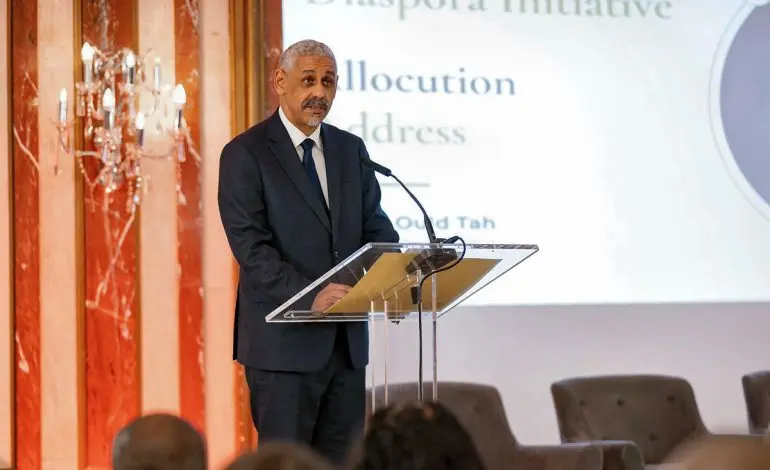
Lord Paul Boateng, the Ghanaian-born British politician ennobled after having served as chief secretary to the UK Treasury and high commissioner to South Africa under Tony Blair’s government, was one of the star speakers at the 2013 Africa Oil Week held in Cape Town, South Africa. Since stepping down from public office, Lord Boateng has taken up a number of private sector interests, acting in an advisory capacity and sitting on the boards of various charities, companies and institutions. As the UK’s first black cabinet minister, his opinions matter; even more so when these days he pays closer attention to Africa.
Lord Boateng spent much of his formative years in Ghana, but was brought to the UK as a boy following the arrest and jailing of his Ghanaian father after the coup against President Kwame Nkrumah’s government in February 1966.
Since leaving the world of politics and diplomacy, he has devoted quite a lot of time to the issue of commercial risk analysis, consulting for a number of companies that are contemplating investing in Africa. As generally known, the oil and gas industry – and the extractive industries in general – attracts a huge amount of inward investment to the continent. As such, Lord Boateng does not share the view, which is often repeated by analysts, that Africa’s mineral wealth constitutes a curse?
“No, I decline to view Africa’s resources as a curse,” Boateng responded. “What makes mineral wealth potentially so, of course, is what we human beings do with it. In itself it is not a curse and it is something that has the potential to contribute massively to the wealth of all the people of the continent if used wisely and sustainably.
“For me, Botswana’s 200 billion tons of coal indicates the potential of mining to contribute 80% of that country’s total economy by 2016. Namibia’s mining exports constitute 50% of its total export earnings, and that will be expanding at 12.5% each year between now and 2017. Zambia’s copper production makes up 10% of its GDP and 80% of its export earnings – all these facts illustrate my point. And that is mining alone, before you reckon with the hydrocarbons sector. “The question, is what do you do with this potential? That’s why I believe that the framework in the Extractive Industries Transparency Initiative (EITI) is such an important one.”
EITI is a global coalition of governments, companies, and civil society groups working together to improve openness and the accountable management of revenues from natural resources. EITI starts with the principle that natural resources, such as oil, gas, metals and minerals, belong to a country’s citizens and extraction of these resources can lead to economic growth and social development. But that is not to say that EITI is universally respected. Since its establishment in 2002, a number of critics of the initiative have stated that the EITI’s design assumes an EITI-friendly environment, and that is a naively optimistic viewpoint. However, this is not a view shared by Lord Boateng.
“I don’t believe that EITI is a hopelessly idealistic construct,” he said. “I have seen it work in potentially inauspicious circumstances and with some unlikely players. Its advantage is that it brings around the table the private sector, government, and civil society. The civil society element, I think, is enormously important, in terms of holding those government and the private sector parties to account.
“It stops that sort of cosy cabal that can exist between government and industry and asks questions about how resulting revenues are being utilised, where the revenue streams are going, and how they are being applied.”

The previous day Lord Boateng had spoken at a session sponsored by PGI, a risk analysis group that he consults for, where he both talked of his passion for Africa and the resources industry. He insisted that to look at Africa without recognising the contributions that its natural resources can play in its development is really to “lose the plot”.
In his conversation with New African, he turned to the example of Ghana, where recently discovered offshore oil is now being exploited, and the revenues from which are promising to change that country’s development trajectory in a very positive way. That is, if these resources and revenues are properly managed.
Lord Boateng agreed: “We have seen in Ghana a very healthy debate in parliament,” he said, “and I think that is the way Africa should go in the future. But what I have learnt from my own experience in the UK as far as North Sea oil is concerned – which has not been such an unalloyed success when you compare it to Norway’s experience – is that we took the easy way out. The UK used revenues as a means of reducing direct taxation at a time when other aspects of the country’s industrial base were in decline.”
The lesson is not simply about using resources revenues to reduce the burden of taxation or, as happens often in the African context, not to tax at all. Both these strategies tend to weaken the state, which in turn weakens the state’s capacity to support sectors such as agriculture and manufacturing. “That will inhibit the sort of diverse economies creating the jobs necessary,” said Lord Boateng. “We must utilise the other great resource of Africa, the human resource.
“I always say that it was a blessing to grow up in Africa. It is a blessing to spend a lot of one’s time in Africa. But Africa’s blessing is not just the numerous resources, not just its biodiversity and its topographical beauty; it is in its people who are both a spiritual and physical resource. If you are not growing the economy in a sustainable way, these human resources are not going to be utilised.”
One issue that arises time and time again in the debate over Africa’s resources is the question of whether or not African governments have the competencies to deal with the multinational corporations that want a stake in Africa. These multinationals, whether wanting to exploit oil, gas, minerals or metals, employ armies of legal advisors and financial experts who command an advantage when it comes to negotiating the terms and conditions that the multinationals operate under.
This question is related to the whole issue of the skills gap that afflicts Africa. Lord Boateng had pointed to a 2013 PricewaterhouseCoopers survey of chief executives in the mining and oil and gas sector that revealed that three-quarters of all the chief executives surveyed operating in these sectors identified the lack of availability of skills – and that Africa’s education and training was failing to keep up with the skills requirements of the industry. But when asked specifically about African governments’ competency in dealing with the multinationals, Lord Boateng said: “In general, they do have those competencies if they seek to purchase them. However, some [governments] do not seek to utilise those competencies because their preoccupation lies elsewhere. Others misuse the money and don’t purchase them.
“But I spend a lot of time with very bright and able African lawyers and accountants, some of whom are still in Africa, yet many of them are on Wall Street. Many of them are in the City of London. Many of them are on the Paris Bourse. They are not overseas because they have abandoned the continent; they are there, I am afraid, because they are not being adequately utilised in Africa – and it is the same with healthcare professionals.”

This is not an argument that is aired that frequently. When it comes to resources, the general view is that Africa’s educational systems are inadequate and that foreign multinationals run roughshod over the interests of the local communities in those areas where they operate.
In fact, Lord Boateng agrees that there has been a persistent under-investment by donors and African governments in higher education, and in further training: “In particular, I level this criticism especially at the lack of focus on technical and vocational training,” Lord Boateng said.
“You actually see a decrease in spending over the past two decades. Now, that is really mind-blowing, and when you go around campuses across Africa, you see the consequence of that under-investment. So, the re-prioritising of higher and further education within the African education systems, to meet the demands of the extractive industries, is a real priority.”
Then, turning his attention to the issues surrounding relationships between companies and local populations, Lord Boateng was adamant that “the local community have the right to expect respect for their environment. That’s the bottom line. Respect for life, respect for water, respect for the patrimony, that’s the number one thing.
“The local people should also expect of their government – first and most importantly local government, then the national government – to put in place the mechanism by which operations conducted in their area are regulated. It should bring for them benefits in terms of infrastructure. And by infrastructure, it is not just physical structure but intellectual infrastructure – the infrastructure around education and healthcare, as well as the capacity to get from A to B.
“But, I have to insist, these benefits are first and foremost the responsibility not of private companies, they are the responsibility of the state. Now, if the state is busy getting into bed with the companies in cosy deals with the private sector that exclude citizens, this has to be condemned in the strongest of terms.
“Let me be clear: I don’t want to go back to the days when you had a company store, the company health centre, the company school. There should be a health centre. There should be schools. There should be training facilities. There should be infrastructure provided as a public good by the public authorities. But the proper relationship between the private sector and the government sector is for the state to collect appropriate taxes and then to meet these social requirements. That’s my view.”