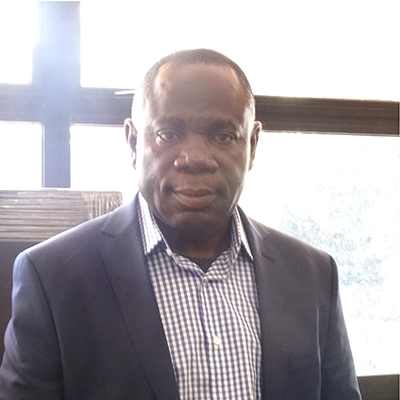
Dr Kwame Amuah, Nelson Mandela’s eldest son-in-law, the husband of his eldest surviving child Makaziwe Mandela-Amuah, is a man of many parts who comes from Ghana. A nuclear scientist who spent years in academia before going into business, this Harvard alumni is now a big-time business baron with interests in many spheres. He says having “an association with Mr Nelson Mandela comes with a cross”, and his “cross” has been a sustained vilification in sections of the South African print media. Our Johannesburg correspondent, Pusch Commey, had a wide-ranging interview with Dr Amuah, chairman of OSR Holdings. Here are excerpts.
Q | This is the first interview you have granted to a major publication. Are you media-shy?
I just happen to be a very private person. I have always shunned the limelight. Pretty much every journalist I have ever met has asked for an interview in one form or the other. The answer has always been no. Eventually, I suppose and per experience, the questions will switch to Mr Mandela and how it feels to be associated with him. The question irritates me for a bunch of reasons, but chief among them is the presumption it makes about me as a public figure. I am not a public figure and have no desire to be one. I agreed to your request for an interview for the simple reason that I share the philosophical bent of your publication and that for once there is an echo of souls.
Q | You have been married to Dr Makaziwe Mandela, Nelson Mandela’s oldest surviving child, for several years. How did you meet?
Yes, we have known each other and been married for over three decades. Maki and I first met through a friend in common in Cofimvaba, in the Eastern Cape during the days of apartheid. The rest is history, isn’t it?
Q | What is your relationship with your father-in-law, Nelson Mandela, like?
This is a question I am often asked and I don’t think I have answered it adequately to anyone. It keeps cropping up. In many ways those of us who have been privileged to be part of Mr Mandela’s life can answer with certainty. Tata [Mandela’s nickname] is a complex character who has learnt the art of containing himself. Very rarely does he show public feelings. We must understand that Tata is of the old stock which holds the adage that a true leader must not show public feelings. Old habits die hard.
To answer your question, I have had a reasonably good relationship with Tata, characterised by mutual respect. We have both had good and bad moments (with respect to my late brother-in-law Makgatho). To be associated with the family for three decades should tell you that there is an echo of souls between a son-in-law and a father-in-law.
Q: Were there intellectual conversations as peers in that department?
You bet. We have had many intellectual debates on issues of cosmology, the existence of God, life after death, and the resilience of the human spirit. Once when I told him I was writing a book on death, he retorted: “How do you write on death when you haven’t experienced it? You better write on love as it is something we all experience”. When I answered that “love is an abstract concept and that it is an illusion”, he said: “So Isaac, you don’t love my daughter.” Quickly, I retorted: “Tata I do, and that is why we have been in love for all these years.” “You believe in love after all,” he
said.
Q | What were his political views in the transition to democracy?
Tata has been consistent in his political views in as far as I can remember. My first face-to-face encounter with him was in 1983 at Porlsmoor Maximum Security Prison. And while conversations with family members were devoid of politics during visitation periods, he would always make it clear why he was behind bars. It was to emancipate his people. And frankly his political views have remained as constant as Einstein’s constant.
Q | There has been debate on Mandela’s Pan-African credentials. Would you say he is a true Pan-Africanist and why? Where would you rank him among the pantheon of Pan-Africanists?
No doubt, he has been a Pan-Africanist and continues to be in the twilight of his life. This elicits the question as to who is a Pan-Africanist. You know, there are varied interpretations of the meaning of an “Africanist”. There are those who believe being an Africanist is a geographical concept. And then there are those who refer to themselves as Africanists because of identification with an idea and a commitment to a liberation ideology and emancipation of all people of African descent. I tend to associate myself with the latter concept.
Let me hark back to your question and say without equivocation that Mr Mandela is a Pan-Africanist through and through. I don’t believe in ranking our heroes. Nkrumah, Lumumba, Amilcar Cabral, Nyerere, Kaunda, and many others appeared on the African scene with its unique challenges. Theirs was to set the African people free from colonial bondage with tactics congruent to the period.
Mr Mandela came into his own at a different period of Africa’s economic and political history, which required entirely different strategies and tactics, but the endgame was the same.
Mr Mandela’s task was to set his people free from the bondage of apartheid ideology and set the new nation on the path to prosperity and freedom. I am acutely mindful of those who accuse Mr Mandela of accommodating the interests of former oppressors. Let me leave posterity to judge this one as my defence will be jaundiced.
Q | Why do you think Nelson Mandela never met Kwame Nkrumah?
Mr Mandela visited Ghana around 1960 or thereabout, for over 10 days but unfortunately he could not meet Nkrumah personally for good reasons. No doubt he saw Nkrumah as a hero. He did travel to Ghana to meet him. The intermediary was Kofi Batsa, the then co-editor of the CPP-owned newspaper, The Spark. Mr Batsa, whom my wife and I met on two occasions in the US, on authority provided the known reason why Mr Mandela did not meet Nkrumah on his first visit to Ghana.
At the time Nkrumah was recovering from a major assassination attempt on his life and therefore access to him was restricted. Mandela, though, met all the relevant cabinet and party officials and the ANC was accorded fulsome support.
This bit of history is important here as there are some who attribute Mandela’s failure to meet Nkrumah as a snub. They claim the reason was that the ANC was open to all races and was losing its Pan-African identity, and that Nkrumah was leaning towards the Pan-African Congress.
The idea that Nkrumah refused to meet Mandela because the ANC was opened to all South African races is far from the truth, and in fact it is not even a historical fact in the least. Nkrumah, while Pan-Africanist to boot, was equally non-racial.
Q | What would you say has been Nelson Mandela’s greatest regret?
I hope you will give me a pass on this question, except to say whatever he might have shared with me will remain private. But remember, he is a human being just like you and me. And how many of us don’t have regrets in our lives? Believe me, Tata has many regrets and where he could do something about them, he has.
My own philosophy in life is not to dwell too much on the past. You remember what Rudyard Kipling said: “If you can meet with triumph and disaster, and treat those two impostors just the same…” Tata has had so much success, and the few failures in his life must be seen as impostors.
Q | You are Ghanaian. How did you end up in South Africa?
It was pure chance and, later, love. After my national service at the University of Cape Coast as a junior lecturer, I obtained a scholarship for graduate studies at the University of Krakow, Poland. A month before going to Poland, I accompanied a friend to visit a friend of his, he was then teaching at a high school in the former South African homeland of Transkei. This is how I set foot in this beautiful land.
Two days after I landed in Umtata, I accidentally bumped into one Mr Zambodla, a South African who had spent over 20 years in Ghana, teaching at Apam Secondary School. He was back in his homeland as a high school principal. Mr Zambodla spoke impeccable Fante, and that in itself initiated a long conversation between us. When he learnt that I had an honours degree in physics and was bound for graduate studies, he immediately asked me if I would not mind serving briefly as a mathematics and science tutor at Buntingville Secondary School, which is now Ndamase High School.
Three weeks into my stay at Ndamase, the principal received instructions from the then president of Transkei, K.D. Matanzima, to post me to Dalinwong Secondary School in Cofimvaba. No questions were asked. That same evening, I was picked up and dropped at Daliwonga. That is how I spent nearly a year in Transkei before going to graduate school. Coming back to South Africa after several years away was purely dictated by family considerations.
Q | You spent time in the US at Harvard and also as a professor. What were your experiences like?
You are right. I spent a considerable period of time in the US, as a graduate student, a lecturer, and science policy expert. I was privileged to have been taught by some leading American professors who later became friends and life-long mentors. I remember after graduating from KSG, Harvard University, a Professor Lewis Branscomb saw to it that I spent time in the highest hierarchy of US government science establishments. It was an exciting, challenging and rewarding period for me as I participated in some sensitive and ground-breaking projects.
Q | What do you mean by ground-breaking projects?
Projects such as the dismantling of retired nuclear warheads and managing the environmental and safety issues around the plutonium. It was to make the world safe and that is as much as I can say on this topic. There was also the Complex Clean-up Project. This project sought to assess the processes and mechanism of cleaning contaminated nuclear sites in the US and Russia. This was a US Congress-approved investigation which took off on the heels of the collapse of the Soviet Union. There was plenty of intrigue. You learnt to understand how the real world works.
Q | What has your experience been like in South Africa, as a Ghanaian whom some with a parochial outlook would regard as an outsider married to the eldest daughter of one of Africa’s greatest sons?
That’s a tall question which requires a book of its own. On the whole, it has been and continues to be a fulfilling experience. I have the most supportive spouse in the world. Rain or shine, she has been a tower of strength. Of course, like everything else there are ups and downs.
The downside is public exposure which unfortunately is part of the package of marrying the daughter of a global icon. I am an extremely private person who enjoys my own company and I don’t enjoy a second moment of limelight. Don’t forget I nearly became a monk, a vocation which is still not far from my mind.
On the question of being a Ghanaian and an outsider in South Africa, I am a Ghanaian by birth and proud of this heritage. But in all things, I am equally a South African and proud of my adopted homeland.
You are right, there are a few who consider me an outsider and go to every extent to make me an alien in my adopted home. Every trick in the book has been deployed to make life unbearable for me, with a section of the South African print media unwittingly aiding and abetting.
Am I bitter? Of course not. I know who I am and no amount of vilification by the media will change who I am. Admittedly, there are many South Africans of every race who have accepted me as their own. I have been blessed with excellent friends and business partners who have stood by me against all odds. So, in the main, life goes on and I prevail.
Q | I suppose from the vicious recurring attacks in the media (sexual allegations etc), you have become a lightning rod. What is your take?
I wish I knew the true answer to your question. You, as a journalist, could perhaps explore the reasons for the never-ending attacks. Different theories have been advanced for these media attacks, and many have gone as far as naming individuals who are behind them.
Five years ago, a private security firm, out of nowhere, offered to provide me with an intelligence report on who were and still are behind the media vilification, and was pushing for my extradition. I didn’t take the offer. I didn’t think it was going to serve any purpose to spend time and energy worrying about these idle pursuits by idle individuals. I have long believed in my innocence and that with time truth will triumph. Yes, it’s a painful experience. Yes, your family might be stoic amidst these media onslaughts, but nobody wants to hear or see his or her spouse or father being denigrated. I have kept silent amidst these attacks because once the media rightly or wrongly sets its mind on a narrative, it manifests itself like a demonic possession, and it becomes difficult to exorcise.
My take on these attacks? Clearly a section of the South African print media, which has been running these stories for years, has been both sloppy and lazy and lack morals in their reporting, which borders on pure tabloid journalism.
A headline like “Nelson Mandela’s son-in-law wanted for sexual assault” will sell newspapers.
There was an allegation against me in the US which first surfaced as far back as 1993. Many years later, in 2005, when I ventured into business and started contesting for contracts in South Africa, this same old allegation was rehashed and ran every year in one particular South African newspaper as if the story was new.
Q | In 2011, a court of law described an attempt to extradite you to the US to face sexual allegations as a “monumental fraud and extortion perpetrated by a deranged complainant”. I suppose you felt vindicated. Any comment on the decision? And how was a dead case resurrected?
Vindication is an understatement. Don’t forget the judge went further, questioning why the case had festered for so long. And why did the South African media peddle a particular storyline for years when a cursory look at the affidavit of the complainant would have established that this was a naked blackmail? I am a firm believer in the saying that sometimes the cause of evil prospers but truth alone is strong.
As already alluded to, the attitude of a section of the South African print media in handling the reportage of my case could be attributed to sloppiness, laziness, or a deliberate desire to scandalise me or all of the above. I will leave this question to media analysts to ponder in the future.
The public mustn’t forget that an association with Mr Nelson Mandela comes with a cross. You become the focal point of all evil schemes and you are always on guard. I don’t know if my silence might have contributed to the frenzy and vilification. A former editor of a large local Sunday publication once said I am a blank slate except for the sexual assault case and that I should start talking about my businesses and the charitable organisations I am funding and supporting.
Should I start speaking to the South African media? I haven’t done so in the past and will not do so now. Pending court cases against some of the media houses will continue unabated. And of course there are those contesting me who have been diligent in trying to make me disappear from the Mandela and business discourse. There are those who also want to get at my wife through me. They want to steal a brand.
Q | It goes with the territory, doesn’t it?
Let me shed a bit more light. Yes, the incident took place in 1993, a year before I relocated to South Africa with my family. To demonstrate that the case was not a scoop as the South African print media wanted the world to believe, the Star newspaper in the US first published the incident in 1993 in an afternoon edition.
In 1995, the Financial Mail had a one-paragraph story on it in their weekly edition while doing an article on a project which I had initiated, namely the South African national research and technology audit. In fact, I volunteered the information to the reporter when she wanted to know if I had regrets regarding business and personal ventures. For the record, I had declared the incident to all the institutions I had been associated with and to the South African immigration authorities.
And then before being appointed a science advisor to the first substantive minister of science and technology in South Africa, and as part of the background checks, the incident was thoroughly investigated and found to be bogus and without substance. Surely, there was no way I would be appointed to advise at the highest levels of the South African government on matters such as nuclear and space affairs with this cloud over my head.
Then in May 2005, an irony of ironies occurred. I had travelled to the United Arab Emirates to conclude a financial transaction on the construction of the first commercially-operated Ion Beam/Proton Therapy Hospital in the Middle East. On the same day as I was being feted and toasted for bringing home to the two sub-regions an innovation in treating cancer, the Sunday Times of South Africa had a front cover story with a headline saying I was a fugitive and wanted in the USA.
Since then, it has been an annual event. Between May and August of each year, the same Sunday Times would run the same story. Even after a competent court in South Africa ruled on the matter and found the allegation to be a “monumental fraud” and an “extortion” as you pointed out earlier, the local press has been rehashing the story for reasons best known to them. I really don’t care what they write, and crucially I don’t even read the South African papers, with the exception of one which I read occasionally to find out how some investments are doing.
Q | How did you transform yourself from an academic into a highly successful entrepreneur?
It was necessity that turned me from academia to business. But I still teach when time permits. I had a cancer scare in 1999 and was given three months to live. While recuperating in hospital, my then employer initiated an investigation into a mega national project I was running which I had personally sought European Union funding for.
Not in a position to mount any defence, because of my hospitalisation, the investigators concluded that I had violated all the financial rules of the institution in paying a consultant I had engaged from New Zealand. On the advice of both my oncologists and lawyers, I submitted my resignation and the rest, we say, is history. So this is the circumstances that led to a business offering to manage a research and development project.
Q | You have made some virulent enemies along the way, I suppose?
Well, this is what everyone tells me. I might have made some serious enemies. But I don’t think I have done anything which might warrant any enemies. I haven’t stolen a penny from anyone.
Q | How did you build your businesses? What has been the most fulfilling?
Simple hard work, resilience, sacrifice, and deferring short-term gratification. It all began with the simple desire to succeed against the odds, that we have discussed. The first business idea I had was to encourage South African businesses with an R&D focus to outsource that aspect to my company. Leveraging the skill base and the excellent laboratories scattered across the South African higher education landscape, I could offer them cost-effective and unbiased services. And boy it wasn’t easy.
A few companies such as Eskom, Spoornet, and the then Anglo Platinum took a gamble on my company, and the rest as we say is history. I have been on my own for nearly 14 years and it has not been all rosy. We have had our angels along the way and we have had our detractors as well, which is expected.
Today our investments are in transport, energy, medicine, pharmaceuticals, financial services, property development, beverages & bottling, plastics and polymer, and resources. Believe me, I didn’t start with a fancy office or huge capital. In fact, I had only 12,000 rands in my savings account. I used a spare room in our modest home in Randpark Ridge as an office. I was my own secretary, salesman, and what have you. I had to piggyback on my wife’s office infrastructure to get along.
Maki introduced me to her then boss at Spoornet, the late Braam Le Roux, who in turn introduced me to key Afrikaaner business executives. For the record, though, I have had excellent rapport with Afrikaaner businessmen and ironically most of my successful businesses have been with them.
In fact, I shied away from the banks from the onset. And, of course, how did we make it without the banks? That is a secret you have to pay me to disclose. Seriously, I have received help from friends and acquaintances along the way. The most fulfilling aspect of what I do is the feeling that we are saving lives daily through our ion beam therapy facilities.
Q | What do you think is the future direction of African business?
Look, my experience in business is unorthodox and might not be applicable to everybody. I really don’t believe in the norms as they limit creativity. A calculated spontaneity to opportunities around you is key to success. You can’t be selective as you seek to find your bearings in the business world. Maki is always telling me I wasn’t cut out for academia and that I should have gone on my own immediately after my doctorate, instead of wallowing in a sector which nearly destroyed my career. In many ways, Maki is right but I will not characterise my years in academia as wasted. I still do teach when time permits and enjoy doing so.
Now to your question about African business, I can’t re-emphasise enough the importance of hard work and perseverance against all adversity and knowing who you are. Business is also about relationships and your ability to maintain these relationships is key.