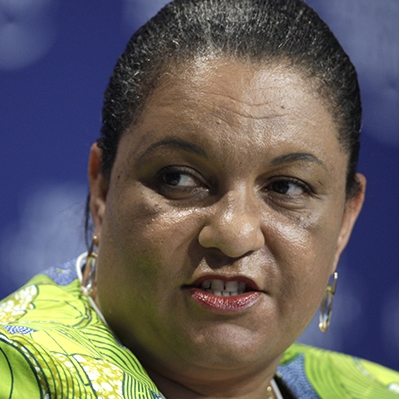
Hannah Tetteh is arguably one of Africa’s most articulate and effective ministers, the new crop of forward-thinking and progressive leaders that, it is said, will see Africa through transformational change. This lawyer by training, who spent many of her formative years in the private sector, oversaw President John Mahama’s recent election campaign in Ghana, which he narrowly won. She is today Ghana’s minister of foreign affairs and regional integration, having served in the previous administration as the minister for trade and industry. She speaks to Omar Ben Yedder on a wide range of issues, from Africa’s standing and influence in the world to the deficiencies in the civil service, holding back the performance of ministries.
New African | Can we say that Africa’s standing in the world has progressed, given that we still resort to external intervention to deal with our internal conflicts?
Hannah Teteh | I won’t use the word progress in terms of the way we are perceived as being more effective or having governments that are more effective than they were in times past. I think that what draws us back is the conflicts that still exist on the continent, and the instability as a result of insurgencies, that comes back to reinforce the perception that Africa is a troubled continent. But thankfully there are enough success stories on the continent as well that draw attention to the fact that there are parts of Africa that are working and working well, and it is my hope that as we get more countries falling within that particular bracket, people will realise that just as every continent has its troubled areas, so do we. But it doesn’t change the fact that on balance we are doing much better than we were, and the world should recognise this fact.
I think that as we have more effective political leaders who are able to articulate the African position on the global stage, what will happen is that increasingly we will get a lot more serious attention, and I think that indeed has happened to some extent over the last decade.
NA | Some people would say that Africa’s influence during the Non-Aligned Movement was stronger on the international stage than it is today, do you agree or disagree with that?
In terms of the fact that Africa had such a large presence in the Non-Aligned Movement, yes I will agree, but you have to look not only at the participation in an organisation but the effectiveness of that organisation in making its voice and its positions not only heard but factored into international decision making.
I think that if we had been able to continue to strengthen the Non-Aligned Movement, it may have provided that alternative forum but it doesn’t seem to have the same kind of impact today as it had in times past. And so we have to look at what is available to us, and I think that for Africans the focus has to be on strengthening our continental organisation, the African Union, so that it becomes an important voice for Africa on the global stage.
NA | You spoke at the African leadership forum about effective leadership and effective government, and about strengthening and professionalising the civil service. Can you expand?
Our governments are as effective as the public sectors that support us, because at the end of the day it is the staff at the different ministries, departments and agencies that do the groundwork on which we depend to take decisions. And to the extent that the public service, civil service, and professional institutions are weak, it also impacts on the output that they give us, and so it’s important for us to have professional public and civil services.
It’s key to being able to transform Africa because if you are talking about an effective state it’s not just your political leadership, it’s the leadership at every level of the state machinery that is expected to implement those programmes on the ground.
NA | How important does Ghana view an institution like the UN? Are you supporting your representatives fully to ensure that Ghana’s voice is heard at the UN in general?
I would say that in terms of UN agencies, and the United Nations itself, Ghana over the years has had its voice heard and its inputs and its opinions recognised. Our UN representative, the current one, Ambassador Kanda, is also doing an excellent job. We have a number of Ghanaians employed in the UN system. Yes, they are international civil servants but they are of Ghanaian origin.
I think one thing about Ghanaians is that we have a great deal of pride in our country and so even though we see ourselves fulfilling the roles that we have, especially when we are employed in organisations like the UN, we also see ourselves as Ghanaians and our work as contributing to the development of Ghana.
Yesterday, for instance, I had a meeting with Ghanaian professionals working in the United Nations and the key focus of our interaction was how to work together to make sure that the skills and the abilities and the information that they have are not only used within this context of the UN but also used to help push development at home. So I would say that within the UN framework, we have had a good high-profile presence.
Of course, the former Secretary-General, Kofi Annan was also a Ghanaian, so even though, again, he was an international civil servant and a very distinguished one, he also came to it from a Ghanaian perspective.
Yes, we have been playing our roles in the different UN committees, on different panels, and in different agencies of the UN with a view to being able to push not only the Ghanaian agenda but the African agenda as well, because we see ourselves within the context of being Ghanaian and African, and that is the legacy of our first president.
NA | And at a pan-African level, is there a dialogue amongst yourselves when it comes to formulating policy so that the countries and ministries go with a unified voice, a common agenda, and one predetermined message?
A lot of that discussion does take place at the level of the African Union and we come out with consensus positions, programmes and initiatives, and in the Ghanaian context what we have been doing is that when there is an initiative that is agreed to, whether at the continental or regional level, we do our best to make sure that it is implemented within our domestic framework, because it’s the only way that we can give effect to the concept of regional integration.
So I’m not in a position to state how this happens in other African countries, but in the Ghanaian context, yes, we do pay attention to it and we work to factor it into our national programmes as well.
NA | I had in mind the Economic Partnership Agreements with Europe, because when I speak to people from different countries they say that Africa has got a common position, but then when they go home everyone starts negotiating with the Europeans one-on-one, which means that there is no real Africa-wide strategy, at least not when it comes to implementation.
In the case of the Economic Partnership Agreements, Ghana negotiated an interim Economic Partnership Agreement (EPA). The operative word here is interim, because we did not qualify for duty free or quota free exemptions under the Everything But Arms Initiatives because we weren’t an LDC. And so after 2008, if we didn’t have an interim EPA we would have been under the General System of Preferences and that would have been detrimental to Ghana’s exports to the EU. So it was more a situation out of compulsion as opposed to wanting to break ranks.
But having said that, we have been very active participants in the Ecowas EPA negotiation and we have been pushing for an Ecowas EPA because the thing about an interim EPA is that it is only meant to be a stopgap measure until the Ecowas EPA is finalised. And as far as Ghana is concerned, we think that it will be very much to our advantage to have an Ecowas EPA that not only helps us to access the EU market, but also to bolster our integration efforts within the region.
NA | Has Ghana’s standing changed since you discovered oil, in terms of influence and in terms of positioning within the UN, and when negotiating with other countries?
I dare say that the impact of the oil discovery has been to create more confidence in Ghana as a growing economy that is going to continue growing for a while. And this has attracted new investors into Ghana, and for that we are very pleased. We are now looking at how we can build on that, to get investors not only in the oil and gas sector but in other sectors of the economy as well.
But having said that, we are also very much aware of the need to focus on building Ghanaian small and medium enterprises, and creating Ghanaian entrepreneurs who will also play a significant role in growing our economy.
NA | Your first president, Kwame Nkrumah, once said “we don’t look west, we don’t look east, we look forward.” As a new government, where are you look-ing?
Forward.
NA | And what does that mean?
What that means is that we consider that we have a progressive outlook in terms of our relations with other countries in the world. We also consider that we have to focus on our own internal growth and development, and we are looking at that not only from the economic perspective, but from the social, cultural, and economic perspective.
One thing we are very clear about in our minds is that we are looking to make continuous progress, so when we say we are looking forward it means not thinking about where we have come from, we appreciate that we have come quite some way, and we now need to focus more on having very structured, well-thought-out, and well-implemented development programmes to be able to achieve middle income status, properly so-called, because right now we are a lower middle income country. What that means is that on the statistics we have improved.
As far as economic opportunities are concerned, yes there has been improvement but the most important thing is that improvement should be reflected in the lives of ordinary citizens. And so, as a government, the focus is on how to make sure that within the mandate and the time that we have, the people of Ghana can see that we have acted in their best interests and we have put in place additional programmes built on the infrastructure that is available, created more opportunities for the private sector, focused more on improving access to education, focused on improving the quality of education, focused on improving social services, so that Ghanaian citizens as a whole can feel that their lives have changed.
NA | In your role as foreign minister, how much of your time is spent looking at foreign affairs within Africa and foreign affairs outside of Africa? Would you say it is 50/50 or would you say that most of your time is spent interacting on foreign affairs issues related to the Chinese, the Americans, and the Europeans?
I would actually say 60/40, with a preference towards Africa because I focus on Ecowas, then Africa, then the multi-lateral partnerships, and then the bi-laterals. But the greater focus for us is within Africa.
NA | And do you think that it is a similar ratio in other African countries? The reason I ask this question is because many African countries seem to give more time to strengthening ties with Europe, America or Asia rather than focusing on inter-African partnerships and trade?
We have a national export policy and we want to be able to increase our non-traditional exports within the next two years up to a volume of about $5bn. When we talk about non-traditional exports, essentially most of those things are light manufacturing goods, cultural products, and services. And the growth of that sector is within Africa because we have been focusing on being able to promote Ghanaian products and services within our sub-region and also within the continent, but with much more focus on our sub-region because we believe that that is the best opportunity for us to grow.
So yes, I know that there may be other countries that have a different focus but we believe that focusing on West African economic integration and being able to, through government agencies, create more opportunities for Ghanaian businesses to operate within West Africa is as important to us as our relations with the rest of the world.
So through government agencies like the Ghana Export Promotion Authority, and the Ghanaian Investment Promotion Centre, we have deliberately planned and executed exhibitions, business roundtables, and business fora across West Africa.
We have also participated in West African trade fairs, and organised some of our own trade fairs, all with a view to strengthening the business relations within West Africa and Africa as a whole, because we think it is important to our growth.
NA | Lastly, one of the criticisms of the UN Millennium Development Goals (MDGs) is that there wasn’t enough African participation when setting those goals, and this is what they are trying to rectify this time around. Do you think there has been sufficient African participation now in setting the MDGs, given that most of them relate to the African continent?
At the start there was the whole discussion about the MDGs, and I think there is always a difference between when you are planning something and the lived experience. So, having had the lived experience of implementing the MDGs, it is now more obvious to us, the areas on which we ought to have also focused, which perhaps we didn’t focus [enough] on, and which are now deserving our attention as we are talking about development goals and objectives beyond the MDGs.
So yes, we have been very engaged in that discussion in different fora and also within our organisation, the AU, and I think that because we have been focused on what next after the MDGs and the areas in which we had significant shortcomings, we are going to have, hopefully, an outcome that is reflective of some of our other development priorities as well as those that were articulated in the MDGs.