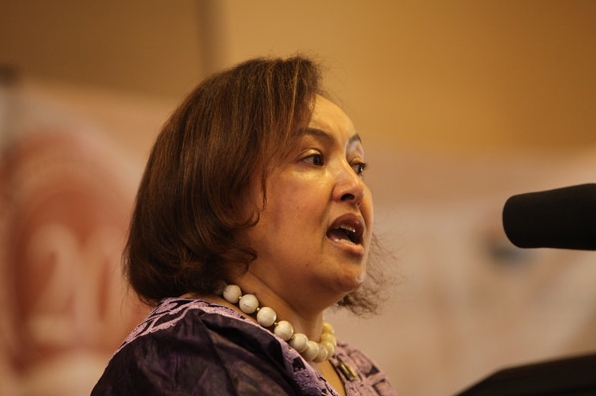
The role African women play in the continent’s development is indisputably one of the biggest assets helping move Africa forward. Increasingly, women are taking lead roles in both the political and socio-economic advancement of Africa. One such woman is Dr Frannie Léautier. Our deputy editor, reGina Jane Jere, who is also the editor of our sister-publication, New African Woman, spoke to this truly inspiring and talented woman leading one of Africa’s most important organisations – the Africa Capacity Building Foundation (ACBF). Dr Léautier, from Tanzania, talks about a wide range of issues, not least where women fit into African society and the crucial role they can play.
Q: You are considered one of the leading women in Africa, heading the Africa Capacity Building Foundation, one of Africa’s most important institutions. What is ‘capacity building’ exactly?
A: Capacity building, let’s say from an individual woman’s point of view, would be the skills that you have available, whether they are to grow particular crops, let’s say, plantain, make plantain, ship part of it and export it to the next city or even outside of the country, that is one example of capability building. The competence to do transformative work is individual capacity.
But we also look of course at transforming a policy, transforming the way compensation is done in the public sector, how farmers are paid, the link between growing a crop and exporting it and all the competencies in between, whether people are teachers, nurses, home makers etc, and the link to childcare, all those policies within an economy are linked to the individual capacity to design something that is appropriate for their community.
Q: Where do you place African women at the moment, politically, socially or economically. Everybody talks about Rwanda being the most empowering, in terms of parliamentary seats and their governance stance, but where do you see the position of women in 2012 and the years ahead for that matter?
A: First of all I think we as women have made a lot of progress. A recent report we launched included a set of indicators that look at gender issues. Many countries have signed up to various initiatives and ratified frameworks to effectively put gender issues at the forefront of policy.
We are seeing different results in terms of implementation. You mentioned Rwanda, which has gone beyond ratification to actually having women in very important positions, the majority of people in parliament are women, but also, see the women in ministerial positions. There’s a huge impact seen in Rwanda’s private sector, in civil society, and also in the public sector.
Other countries have done well in terms of integrating gender budgeting, because if you don’t have gender in the budget, gender priorities don’t happen.
We have a number of programmes such as the provision of grants through the African Women’s Development Fund that helps women at the grass roots level.
An old programme we have had for a while and which we are now in the process of supporting in its second phase, is the Women’s University of Africa, based in Zimbabwe, which focuses on the study of issues specific to women and which encourages women to be more involved in overcoming certain obstacles. We have seen that programme succeed in bringing in women from the sub region to come and study on these very important issues. And the campus, interestingly enough, is majority female, but there are also men who are interested in women’s issues. You find men now studying gender issues and doing a masters degree in that, so we are very happy that the transition has not only gone on to impact women, but it’s impacting men and sensitising them towards the issues of women.
Q: I’m glad you mentioned men being involved because my next question was going to be about how we still largely live in very patriarchal societies, which still limit women’s involvement and advancement in many areas. Many women are still afraid of confronting certain traditional taboos. And it’s not just about existing in a male-dominated society but you also have the girl child issues and harmful practices such as genital mutilation that still continue and actually impede women’s progress. What is your take on that?
A: I think that the cultural issue is a difficult one but we now have a number of role models, women who have really stepped out and taken leadership, and through their example they are showing other younger women how to do it. You mentioned the case of President Johnson-Sirleaf at one point but you have women in all walks of life that are doing incredible things that show that you don’t have to wait. You can actually take leadership on your own and in your own sphere have an impact.
And we try to lead by example. Our top leadership at the Foundation includes three women: the chief of staff and the chief operating officer, as well as our head of communications.
But I must stress that we need to continue to speak out and to support the rights of women. When we published our latest report we noticed that the rights of women get forgotten during certain processes. For example during electoral cycles, many times the voice of women is heard but the rights of women are not necessarily followed through on because people become busy and sidetracked organising and overseeing the election.
We would like to see our countries move towards a place where you can have democracy and you can have women’s rights walking hand in hand, because you can’t have one without the other.
I feel reaching institutional capability to be vitally important, and there’s still a lot of work we need to do in that regard.
Q: We do get a lot of people writing in, especially with our sister publication New African Woman, that women have become too modernised, that we are adopting Western values [at the expense of our own African ones]. Have our societies really moved on in 2012, are African women breaking the so-called glass ceiling?
A: I would say there is no culture, any culture on earth, where beating a woman is acceptable. There is no culture anywhere on earth where leaving half of your population with no opportunity to contribute to society is acceptable, and there is no culture anywhere where the future generation that you are trying to nurture and see succeed is not given the chance to start on the right footing.
We’ve seen that if you educate a girl you educate a society; if you protect the rights of women you protect the rights of everybody. If you give women a chance to succeed you bring up the entire family. Every US dollar that is given to a woman, 70 cents goes to developing the family, the children and everyone else, that’s not always the case if you look at it the other way around, so I think there are cultural issues that need to be respected but they cannot go into the direction of hurting women or denying the fight or chance of success because you deny 50% of the population or are even denying a chance for the entire society to improve because the improvements of society relies and lies on the shoulders of young girls and when they become women in the years ahead. So I think it’s in our interest as the fastest-growing population now in the world – and we are going to surpass China in a few years – to decide how we want to move into that space.
I am very respectful of culture, but I think culture does not mean hurting one group, it does not mean deliberately leaving a group behind and it does not mean taking the best shot for your culture to succeed into the next generation that clearly lies in giving women an equal chance.
Q: How do you view the so-called F word, feminism? Do you think it has reached Africa and applies to the African woman?
A: I would not consider myself a feminist, I just believe that if you are born you should have the rights that everyone else has, so as a young child I never hesitated about it being okay or not okay to go and study an engineering degree, for example. In my culture that was quite a shock.
My father had a difficult time and he came to visit me on campus because he was worried, asking himself what his daughter was doing studying a course which had been a field dominated by men? But because of an upbringing which encouraged me to work hard to fulfil your dreams and to believe that you could achieve whatever you wanted as long as you put your heart to it, it allowed me as an individual to pass through these cultural barriers and do what I thought I needed to do.
You could classify that as ‘feminism’ but I think we should go beyond labels and look at what it really is. Drive and ambition to succeed. To me, whether as an economist or as a social anthropologist, if you want society to succeed you have to find a way where the best talent can be made available for that, whether it’s in engineering, in basket weaving, in farming or at the top of political leadership. If you start to say, well this group cannot go there, it starts off with women, and where do you start to cut the line? So to me being a feminist is simply being informed and conscious about making choices that give an even playing field to all potentials, disabled people, women, people from a different group than yours, from a different faith from yours, because when you start to break things up into different boxes you will always find in one group you are in or you are out, and that means you exclude a whole bunch of people, so feminism means you allow 100% participation and if you don’t then you are letting at least 50% of society out of the game.
Q: At a recent meeting I attended where they invited President Johnson-Sirleaf, I always remember those words where she said, “Africa needs more daring women”. Would you agree?
A: I would agree 100% with her! Taking a stand is a risk and it may mean challenging certain beliefs of the society within which you live. It also means making sacrifices. I would, for instance, love to see more of my children and be able to parent in the traditional sense. Unfortunately that’s not the case, we travel, we have responsibilities that keep us late at work, so sometimes stepping into this you are daring to be a different model.
My work means I am continuously travelling, a ‘commuting mother’. My son joined me for a week during his school holidays. And when he went back and talked to his friends in school they asked: “So how was it spending one week seeing your mother work?” He said, “You know, I am very proud that I was able to do that because my mum is changing the world”, and for a son to say this about his mother – to me it was worth a lot of the other things that you have to give up, not seeing or even holding your children when you want to, and it also made me happy because to him a mother is a person who can change the world and that has changed his outlook towards women in his life, not just his mother.
So there are a lot of challenges. If a few of us are not brave enough to step out there and push those barriers, it will never be easier for the women who come behind us, so in a way I’m also doing this for my own daughter and for all the daughters of women like me, to give them the necessary encouragement to be brave, brave in finding the best scientific discoveries we need, brave in leading nations to do incredible things, brave in stepping out there and creating completely new ways of thinking.
Q: That’s really fantastic, what a great way to end, on that note, but I can’t leave you without maybe just describing in a very brief way what your day is like, I mean you run a very high- profile organisation, how do you start your day as a mother and a very high-profile woman in such an institution? Describe your typical day.
A: On a typical day I would be up at around 5.30, get myself ready for the office, call or SMS my kids. I’m generally at my desk by 6.30 and will spend about an hour and a half reading what’s happened around Africa and the world, following up on key messages that come up. My first meeting would be either around 7.30 or 8.00.
If I’m not travelling, I’m in the office all day. I’d have a series of meetings that run throughout the day. In general, lunch would be had at my desk and I would only leave the office between 20.00 and 22.00. Luckily, these days with technology I can work from home so I will occasionally leave earlier to eat with my children and then continue working. My day would end up with an hour of news, catching up with what has happened.
When I’m on missions, I would start off at pretty much around the same time but I’d be busy meeting people out there and talking about our programme and looking for funding, meeting with different people, ministers, Heads of State and other government officials, heads of women’s organisations, diplomats.
So I spend about 40% of the time with the staff of the Foundation if I’m in the office and 60% of the time with the partners of the Foundation. The profile of people I meet ranges from heads of organisations, individual staff members to Heads of State and heads of governments. But yes I try to make time to go and get my hair done, as every woman has to do, and I like to dedicate at least an hour on a Saturday to do that.
And of course I scan through magazines, make sure my outfit is well prepared and that I have the right clothing for the right event. I try to catch up on the fashion news, and once in a while watch a movie, read a book. I have a confession: I like to listen to music and dance! When I’m not able to exercise, the only exercise I get is dancing in my room!