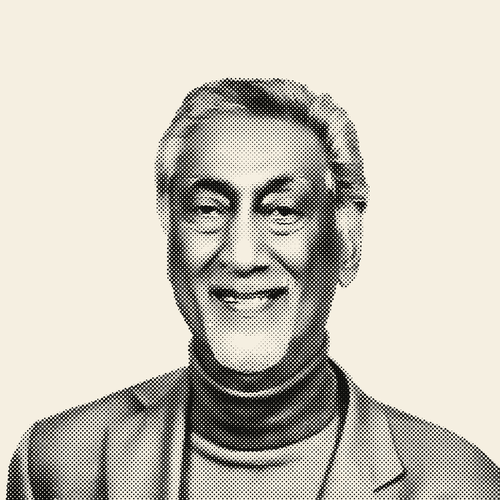
HH, the Aga Khan IV in conversation with Anver Versi, Editor, New African
I felt an unusual nervousness while waiting for my scheduled interview with His Highness the Aga Khan at his home in Nairobi’s Muthaiga area. He, or rather his institutions, had been of such profound influence in my life for so long that the thought of finally meeting the man in person after so many decades was unnerving.
I started my primary schooling in Nairobi while Kenya was still a British colony. Government schools were few and far between, instead parents relied on Christian Mission schools, or community schools to educate their children. The Aga Khan schools in Nairobi and Mombasa already enjoyed the reputation of being among the best education establishments in the country but admission was not easy.
By great good fortune, I was enrolled at the Aga Khan Primary School in Nairobi. The following year, I moved to Mombasa with my mother as Nairobi was becoming increasingly dangerous. I joined a small number of other non-Ismailis at the Aga Khan Primary School there.
This had a huge impact on my life. I loved the school and never once did I experience any form of discrimination as a non-Ismaili. I did well and was amply rewarded for it. I made friends who remain so to this day.
The second major impact on my life was when I went to work for the Nation newspaper. It had been launched by the Aga Khan in 1960, three years before Kenya’s independence, to be a “voice for the voiceless”. Before that, the main English newspaper, The East African Standard, had been strongly focused on the colonial government and white settler community. The Nation, which was tabloid size, stood everything on its head. Now coverage was through the African perspective. Journalists were no longer required to be white. The paper sold like hotcakes and first instilled in me the desire to take up journalism when I finished my education – and that is exactly what happened.
Throughout most of my primary and secondary schooldays, the face of the young Aga Khan, Prince Karim, had beamed out at us from his photograph in the main hallway. I can still recall the surprised buzz, in 1957, that had greeted the information that in his will, Sir Sultan Mahomed Shah, Aga Khan III had looked beyond the next generation, past his two sons, Prince Aly Khan and Prince Sadruddin, and named as his successor to the Imamat, the athletic 20-year-old Karim, who was then a student at Harvard University.
The news had been as much of a surprise to him as it was to us. “Overnight,” Karim was to tell journalist Paul Evan Ress, “my whole life changed completely. I woke up with serious responsibilities toward millions of other human beings.”
After taking a year and a half to visit Muslim communities the world over, he completed his degree. Some years later, he was able to find time to join Iran’s skiing team for the 1964 Winter Olympics in Austria. In another interview with James Reginato, he explains why he returned to Harvard, to finish his BA in history. “There was knowledge there that I needed. I was an undergraduate who knew what his work for the rest of his life was going to be.”
But his very early education, interestingly enough, was in Kenya. At the outbreak of the Second World War, his grandfather had sent him and his younger brother Amyn to live in a house the family owned in Nairobi. In addition to the usual subjects, they were also tutored in Arabic, Urdu, the Koran and Islamic culture.
Back in Nairobi in April, the call came through that His Highness was ready for the interview. I knew that he had had a hectic couple of days in Nairobi and there was a long list of people wanting to meet him. The interview slot had been unavoidably delayed by a few hours so it was almost 7.00pm when I was shown through to a living room. He is over 80 years old and in his place, I might have felt a bit testy to have to sit through an interview.
He breezed in looking as fresh as if it was the start of the day. He gave me a warm smile, shook me firmly by the hand, ushered me to a sofa and turned his full attention on me.
I started by asking him if he recalled anything of his time when at a tender age he was in Kenya.
It was during the Second World War, he reminded me. “My brother and I were together at the time, of course. And, we were very young. So, we were really children with home education. There was a nanny who was also an educator. And, we went back to Europe at the end of the Second World War. So our experience here was when we were very young children.”
Did he have any memories of the time?
“We were in the garden very often. We were interested in the growth of rhubarb. And why does rhubarb grow in grains? All the intelligent questions that young people ask themselves,” he said with a smile and we laughed. I immediately felt quite relaxed.
It was time to get to the nub of the matter. “How would you describe your role as Imam?”
“Oh, that’s another issue,” he said and reflected for a brief moment. “Well, I think first of all, obviously, there’s an issue of interpretation and practice of the faith. And that is clear. But, in Islam an Imam is involved with the quality of life of the communities that refer to him. He’s not just a man of faith, he’s also a man of guidance for social relations, economic development, etc.
“My grandfather, as Imam in his time, was particularly concerned with the security of the community during the War. That was six years with the world upside-down.
“And, then, the question was always going to be the impact of the War on the countries where the Jamat [community] was living. He followed those issues very carefully, he was engaged in international affairs himself. So he was able to lead the Jamat with good knowledge of international political affairs. Obviously, in times of peace, in times of war, the role of the Imam is somewhat different.
“In his case, for example, communicating with the community was quite complex – from Switzerland, from a neutral country. Today of course, it’s a different situation. What I think is new is the more intimate contact with communities that did not have that contact with the Imam before.
“I am referring particularly to the Soviet Union, to countries behind the Iron Curtain. All that has changed the dynamics of the institution because those countries did not have direct institutional contextualisation with the Imamat at the time. Now they do.”
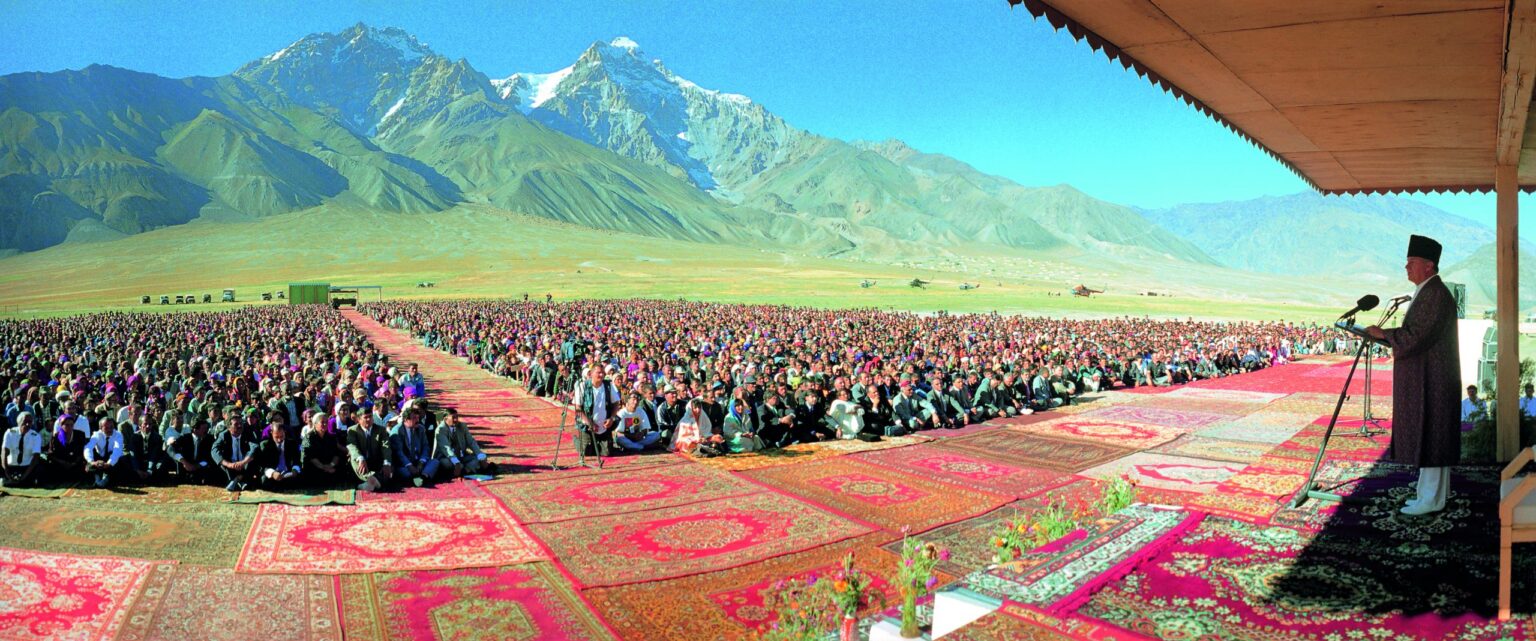
Ismaili communities occupy a broad swath including the central part of Afghanistan (Kabul and the Kayan valley of Baghlan province, where the Ismailis are of Hazara background); and Badakhshan – the mountainous valleys that stretch between northeast Afghanistan, the northern areas of Pakistan, the Badakhshan province of Tajikistan and the Tashkurghan district of Xinjiang province of China; and Russia.
The Aga Khan’s memorable visit to Tajikistan in 1995 established the first direct contact in over a century with these isolated communities. It was the first of many to follow. The Aga Khan Development Network has been working in the region ever since to improve living conditions and to create opportunities for populations across the region.
Expanding on the role of the Imam, His Highness continued: “There’s a whole question of how to organise the community, how to build its institutions, how to make sure its institutions serve national interests in those parts of the world, because our institutions are not linked just to the Ismaili community, we serve the countries where we are present. So that’s changed the dimension and the international dimension of the work that’s being done.
“We now have to work in seven languages, because there is a major language issue. English is becoming, I think, the lingua franca of the community as education evolves. The community is bilingual and very often trilingual, so language plays a very important role. Projecting economic and social development, institutional capacity within all of that is absolutely critical.”
He moves on to the focal role of civil society.
“I think one of the key issues we are dealing with now is the strength of civil society. What we’re looking at is how civil society can build capacity to develop itself outside government rather than being constantly driven by government.
“Civil society is looking at building institutions in healthcare, in education, in economic development, etc. Institution building is an important aspect of what we’re trying to achieve – and these are national programmes; they’re not restricted to the members of the community.”
Moving picture
The Aga Khan organisations have excellent credentials in development around the world but how much of this is influenced by spiritual considerations? The Aga Khan explains that the concepts of din (faith) and duniya (world) are inextricably linked.
“We’re both din and duniya. They live together in the ethics of what we do, and in the ethics of our faith. We function within the ethics of our faith.”
I point out that he is the direct descendant from Prophet Muhammad and Hazrat Ali. How have his ancestors and himself managed to bridge this vast span of time?
“One of the fundamental questions is the ethics of the faith. The ethics of the faith were very, very clearly established at the time of the Prophet and Hazrat Ali. So we have certainty in that domain.
“It doesn’t cover all subjects because the modern world is different from what it was at that time. But we have ethical principles, which are strong, well understood. We’re able to work with those as a starting point.
“What we have to do is introduce, or rather apply, the ethics to a pluralism of societies, which we didn’t have before. The pluralism of these societies today is massive – in terms of the languages, geography, economics, political systems.
“So we have to adjust, country by country, as to what we can do, what we want to do and what works within the government context, so we look at what governments intend to do on leading development.
“Then we try to work within that context. A typical case is countries where development has been uneven – and I’m not criticising, because very often there are historical reasons, but there are countries where some provinces are so isolated they never come in contact with government at the centre.
“If we happen to be in that context, we have to address that issue of isolation and try and compensate where, for one reason or another, social institutions, economic institutions are not present.
“Fairly often we’ve been going into environments which are isolated, underdeveloped. And we’re trying to bring in the capacity for society to improve itself. It takes time. You need consensus around common goals. You need to be fairly rigorous in terms of evaluating the outcomes. Are you achieving the goals that you want to achieve and, if not, how do you improve programmatic or institutional capacity to meet the needs?
“You don’t always achieve the goals you want,” he concedes, “for reasons which, very often, you can’t predict, or which occur as time evolves. So it’s a moving picture, if you want. One of the important things is to monitor that picture so that you have a solid understanding of the changing processes. And a lot of things come into play – economics comes into play, language comes into play, faith comes into play.”
Although the Aga Khan’s institutional activities span several regions, a good deal of the investment, both in development terms and in for-profit enterprises, is in Africa. Does the Continent have a special place in his heart?
“Let me put it this way, in various regions where we are working, there are different challenges. And the Imamat, as an institution, has to be equitable in the way it responds to those challenges.
“However, those responses are not uniquely dependent on what the Imamat wants. Local circumstances, international situations have a massive impact on what can be achieved or not be achieved.
“A lot of the work that the leaders of the community and myself are doing is trying to adjust to changing situations to try and make sure that the changes do not damage the community and people amongst whom they live, and that we can actually use change to build capacity. That’s a tough call.”
One of the unique aspects about your model, I say, is that you want to uplift the standards of living of your followers but also all the communities around them. Are you satisfied that that is also happening?
“I think our institutions, generally speaking, are achieving that goal. Many of them have higher usage by non-Ismailis than Ismailis. So, in many countries, our institutions have moved out of the community context into the national context, so they are serving the country rather than just the community. That development has progressed.
“It’s also changed the nature of the institutions. In some countries, we can deal with the whole country. On the other hand, if you take a country as large as India, we can’t deal with the whole of India, so we would work with the key states of importance to us. It’s a case by case situation.”
Most of the projects his organisations are engaged with involve a holistic approach. He has said: “We try to avoid the single-building syndrome. You have to look at the big picture. If you try to put social and cultural development ahead of economic development, it doesn’t work. You have to do it all together.”
For example, while restoring the walls of the 14th century Djingareyber Mosque in Mali, the oldest earthen building in sub-Saharan Africa, the Aga Khan Development Network also made improvements in Mali’s educational system and in nearly every sector of its infrastructure, including water, electricity, aviation, health, and education.
Media and society
My next question to him was about his ownership of the media in Kenya. When he started the Nation Group, he said he wanted to give “voice to the voiceless”. Is he satisfied with how the group has performed?
“Yes, I am,” he says. “If you look at it historically, it has done what it should have done, which was to illustrate to the public the key issues in national life. And, that has been a good thing.
“Keep in mind that the history of decolonisation in Eastern Africa was a racial process. There’s a tendency to forget that. In pre-independence Kenya, you had a European educational authority, you had an Asian educational authority, and you had an African educational authority.
“Therefore building nationhood and building common premises towards the country are key issues that take time. They need to be omnipresent in civil society, because if they’re not omnipresent, you will end up in a mess at some stage or the other. So, my sense is yes, I think we’ve made good progress, and I hope history will demonstrate that.”
I raise the question of the freedom of the press, which seems to have come under attack by authorities not only in Kenya but also in the US. Does this worry him as a media owner?
“I think all professions have to have their own ethical principles to function so that they sustain society rather than damage society. That’s true for the media and the communications industry.
“There are two ways to go,” he carries on. “Either the State imposes minimum regulation because it’s in the interest of society or the industry does it itself.
“When I started the Nation Group we set up a number of nation-building principles, which the management and the journalists had to abide by. The goal was that the media was going to contribute, for example, to a pluralist civil society. There was a goal to strengthen and add value to the notion of pluralism. It went through the whole organisation from management to the journalists to everybody else and it’s been a very strong principle.”
In 2015, the Aga Khan University set up the Graduate School of Media and Communications in Nairobi, which today offers working journalists and communications professionals the chance to learn from practitioners from some of the world’s leading media and communications organisations. Today it partners with Harvard University and also has an unusual course for media owners. Why the focus on media owners, I wanted to know.
“If you observe the industry globally, you would tend to see the role of owners as being fairly significant. There’s no history of media ownership in Africa and very little even in Asia and insofar as these media groups reflect the ethics, the policies of the owners, I thought it was very important that the owners should be educated in terms of what their products can do to sustain peaceful and developing societies rather than adding conflict.
“You know as well as I do, that there are media that are aimed at creating conflict amongst communities. So, just the very perception that there is risk there seemed to me to be something that we should talk about openly, not hide it, and say to people, you are living in a pluralist society and you have to function within the ethics of a pluralist society. I think that’s now accepted.”
Support for pluralism
One of the Aga Khan’s strongest positions is his support for pluralism, that is, the acceptance of diversity in a society. Again, this is a principle that has come under sustained attack both in Africa and increasingly in the West, especially the US.
In his speech in Sharm el-Sheikh at the Africa 2016 Forum, the Aga Khan made a profound statement on this issue. He said that a good deal of the conflicts were caused by “the fear we so often have that our environment will be controlled by others, which leads to suspicion of the other and hardening of attitudes”. I asked him if the establishment of the Global Centre for Pluralism in Canada in partnership with the Government of Canada was his response to this threat.
“Canada is a pluralist society,” he explained. “And they value their pluralism, they invest in it; they protect it; and very often in law.
“So, I felt that Canada was an appropriate place to develop an institution that would seek to develop and sustain pluralist initiatives around the world using Canadian precedence, but at the same time working in Africa, working in Asia.
“We are both committed to sustaining pluralism around the world, everywhere we can. I think we are agreed on a basic premise, which is that society is not born with the notion of legitimising pluralism. It’s something people have to learn. They’re not born with the understanding or the willingness to enter into pluralist society.”
So there’s always an inbuilt fear? I ask.
“There’s a fear or there’s apprehension or there’s misunderstanding and very often communities don’t communicate amongst themselves as much as they might.”
And are you confident, I ask him, that if this is pushed strongly enough, society might become more pluralistic?
“I think over time we’ll educate enough people so that they’ll have a certain amount of influence in the Western world and elsewhere,” he replied. “But, it’s a long-term process and there’s no measurable outcome, I don’t think. We’ve been looking at that.”
One of the most important aspects of his organisation’s approach, be it social or economic development, cultural restoration or tourism promotion, is the improvement of people’s quality of life and the focus on making the minimum impact on the environment. How much was this a conscious, ethical decision?
“Significantly so,” he said. “This is an established premise that goes way back. Why is it there? It’s there to try to add value to local culture. If you bring modern industry, tourism, anything else, it will tend to ‘de-nature’ the culture of the place where you are going.
“We thought that it was very important not to de-
culture those communities through changing what’s there but add value to those cultures so that there is an increased comfort level, respect and investment in enhancing those cultures.
“Our experience has been that these communities have value and they can be enhanced.
“It’s also socially essential, because if you build institutions in society and suddenly there’s a major divorce between society and your institutions, you’re in deep trouble – and the history of colonisation illustrates this.”
While the Aga Khan Development Network social development agencies, with a budget of roughly $1bn a year, are not-for-profit, the Aga Khan Fund for Economic Development (AKFED) invests in for-profit enterprises. Companies generate revenues of over $4bn and all surpluses are reinvested in further development activities.
In another interview, the Aga Khan noted that he did not see this as a conflict between his role as a spiritual leader as well as a business leader. “We have no notion of the accumulation of wealth being evil. It’s how you use it. The Islamic ethic is that if God has given you the capacity or good fortune to be a privileged individual in society, you have a moral responsibility to society.”
The special role of architecture
Referring to the much sought-after Aga Khan Award for Architecture, I asked him why his focus on architecture? What is the link, if there is one, between Islam and architecture?
“Architecture is the only art form which has a direct impact on the quality of life. There is no other art form that impacts human quality of life.
“So, architecture seemed to me, first of all, basic to the quality of human life. Secondly, it is critical to cultural continuity because symbolism in architecture, symbolism in building is a very strong part of society. So, making sure that is maintained is, to me, very important.
“The basic issue is economics. The industrialised world is a world which every 20 years, 30 years, pulls down buildings, replaces them, etc. In the developing world we can’t do that. We do not have the economics to do
that.
“So we have to build for a much longer time-frame than the industrialised world, which means building in flexibility, building in additional land where you need land to change the product. If you look at medicine and the way medicine has changed in the last 50 years, hospitals today are nowhere near what they used to be 50 years ago. So, architecture has to adjust to change in the building environment. It has to do that. It also has to take into account materials, costs, longevity.”
And what about classical Islamic architecture?
“Then we are moving into what I would call the domain of spirituality. I think that insofar as all major faiths have their own illustrations of spirituality, it is essential that we maintain the symbols of spirituality, and we can bring in modern architectural standards and modern materials, but the premise remains the same.
“I’m very sensitive when a person says, ‘I’ve entered this space and I have had a sense of spirituality’. I am enormously pleased when that happens. And architects can be extremely talented in creating that mood.”
While I knew this was a sensitive topic, I had to raise the issue of how terror organisations such as Boko Haram and ISIL have corrupted the message of Islam and asked, what was the way out?
“The way out. This is a big question,” he pondered. “My sense is that human history shows, very often, that when there has been an excess in one direction, there’s a corrective process that comes in. It doesn’t stay in the domain of excess.
“And I think that history is likely to show that human life without attention to the soul is not something that people will be happy with. They will need to have that access to spirituality. Now, I don’t think that’s permanent in the individual, I think it fluctuates in time, age, social context, etc., but I’m pretty sure that at some time in life most humans look for comfort.”
“Well, in my mind, I believe very strongly in the message of Islam. And one of the messages of Islam is to gain knowledge to understand the creation of Allah. That’s the purpose. And I believe in that very strongly.”
Did he see a conflict between science and religion? No, he said, there was no conflict. The purpose of Islam was to gather knowledge to better understand the creation of Allah. One would assume from this that since the creation of Allah is all-encompassing, all knowledge gained is serving the purpose of Islam.
My final question to him was that looking back on 60 years of his Imamat, what would he consider his greatest achievement?
“I have to be very honest and say I have never asked myself such questions,” he replied with a twinkle.
“And if I did, I probably wouldn’t want to listen to the answers.
“In my life, first of all, there is the happiness of working with a wonderful community. There are challenges every day, but you know, we are looking at the ethics of human life. In that sense, trying to make sure that the ethics of human life are well respected within the context of Islam is a major everyday, every minute issue. It never leaves you.” NA