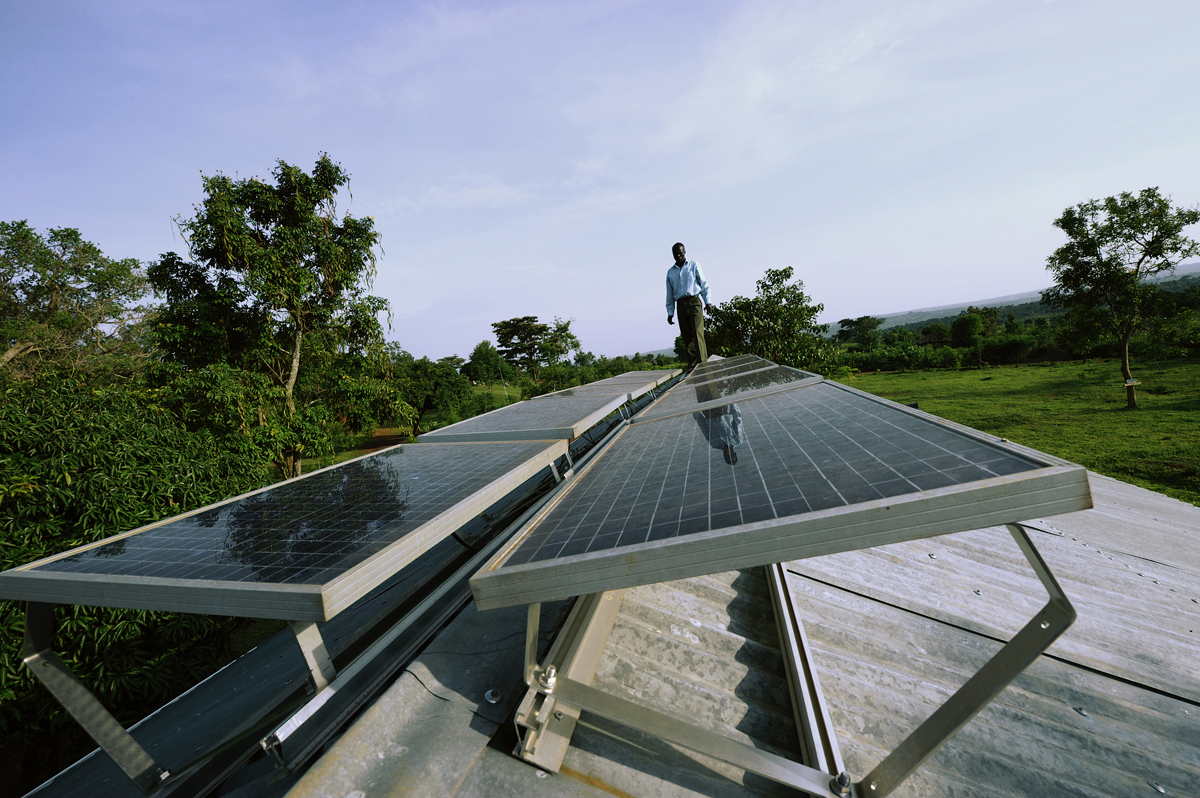
Near boundless human energy drives African economies. Unfortunately, the sort of energy that comes from power plants and national grids doesn’t measure up. According to the African Development Bank (AfDB), 620 million Africans lack access to electricity.
Only seven countries in sub-Saharan Africa – Cameroon, Côte d’Ivoire, Gabon, Ghana, Namibia, Senegal and South Africa – have electricity access rates above 50 per cent. Both Ghana and South Africa suffer from periodic load-shedding due to an overloaded grid.
Improving this power situation is at the heart of the continent being able to deliver on its ambitious social and economic goals.
If the price is right, solar energy’s benefits are various: it is renewable, requires little maintenance, completely silent, and produces zero emissions. Now, it is getting cheaper by the year, as advancements in solar panel technology increase efficiencies and lower the costs of production. As the price drops, African interest has increased.
Last year, South Africa moved into the global top ten of countries harnessing solar power. The country has connected the grid to more than half a gigawatt of utility-scale solar power. In Tanzania, the government is trying to encourage the sector by granting Value Added Tax (VAT) relief on imported solar equipment.
Solar power is set to expand due to these falling prices and increasing government and multilateral lender support. One projection, by management consultants McKinsey, suggests that 30 per cent of energy capacity additions in Africa between 2030 and 2040 will come from solar power.
Massive market
But it isn’t all top-level politicking that is behind the growth of solar in Africa. A number of companies have sprung up over the last few years offering solar solutions and are now beginning to see greater traction and – vitally – significant investment.
Jesse Moore is managing director at M-KOPA Solar, which provides “pay-as-you-go” renewable energy for off-grid households in East Africa. He says the market for off-grid solar power is “massive” given the “huge unmet need” in terms of power supply.
“In Kenya, Uganda and Tanzania there are over 20 million homes off the grid and they spend – waste – a combined $4 billion per year on kerosene lighting,” he says.
“The challenge for entrepreneurs is that selling and servicing solar well, and at scale, is not just a question of developing clever technology and dropping it into the market. Real delivery requires rolling up sleeves and sweating out distribution, financing, after-sale service… But when you combine great technology with this on-the-ground delivery, you can achieve great things.”
M-KOPA Solar believes it is achieving great things, with nearly 200,000 homes using its products, a number that is growing by 500 each day. Moore says part of his company’s growth is down to overcoming the price barrier for consumers.
“We make high-quality solar affordable to everyone by selling solar systems on credit, with a small upfront deposit and daily usage payments that are cheaper than the cost of kerosene,” Moore says.
M-KOPA Solar has also proven popular with investors, this year closing its fourth round through a $12.45 million equity and debt deal led by LGT Venture Philanthropy.
Though Moore believes it is still relatively early days for off-grid solar investment, he feels it is only going to snowball.
“Now that several companies including ours have grown beyond the startup stage and proven they can build scale and generate meaningful revenues, we’re seeing a second wave of more mainstream investors begin to cut cheques,” he says.
“I believe those who have
gotten in early will earn very good returns in the long run. I also believe that the sector will evolve over the next five years to become popular with mainstream investors and that we’ll see some solar companies successfully list on stock exchanges.”
Investor interest, government scorn?
M-KOPA Solar is not the only solar company in Africa to have raised investment recently. Tanzanian company Off-Grid Electric raised $16 million late last year, while Uganda’s SolarNow has raised $3 million in total. SolarNow sells solar systems to rural households and businesses, offering an 18-month credit facility to make them affordable.
Uvie Ugono, CEO of Solynta Energy, a provider of solar panels in Nigeria and Ghana, says solar investment in Africa right now represents “probably the most lucrative investment opportunity in the world”.
“Using Solynta Energy as an example, we strongly believe that we can create a $100 million company just from the Nigerian market alone, so vast is it,” he said.
“Investment at this stage will see investors realising returns in excess of 1,000 times their original investment stake. As mentioned already, in Africa, the demand side of the equation is the easy part. Fulfilling that demand is where the challenges are, due to the difficulties in accessing finance. With the right level of financing available, stupendous returns on investment will be generated.”
Willem Nolens, CEO of SolarNow, says for off-grid households and businesses, solar energy is the most affordable source of power, a situation that is only going to improve.
“The prices of solar energy have dropped during recent years, and the technology improved. Even households connected to the electricity grid have an increasing demand for solar systems, as grid electricity is considered expensive and less reliable than the sun,” he says.
Nolens believes companies such as his are nevertheless playing a vital role in making sure solar power is affordable to regular people.
“Solar energy products have been available to the rural population for a long time. People would typically buy loose components that came without proper warranty, installation and had inferior quality,” he says.
“However, in the last three years, a new generation of solar companies is emerging, that sell solar systems including a credit facility. Because clients pay in instalments, these companies cannot compromise on quality. Dissatisfied clients are not inclined to pay.”
Though Moore is satisfied with the level of support offered by governments to the solar sector, Nolens believes they need to do more. “For instance, grid connections are still subsidised in a country like Uganda, while off-grid households do not get any subsidies when they buy solar,” he says. “The few subsidy schemes that have been there, have to a large extent failed due to mismanagement [by] the responsible government agencies.”
A brighter future
Whether or not African governments are assisting enough, help is certainly at hand from elsewhere. Renewable power – especially solar – is attractive to many policy actors. The AfDB has increased its fund portfolio for renewable energy by 10 per cent to $200 million over the last five years. Dubai-based Access Power and French renewable energy investment firm EREN have rolled out a $500 million joint venture to fund early-stage power projects in Africa.
Interest is understandable, and should reap rewards. According to the International Energy Agency (IEA), if Sub-Saharan Africa manages to unlock its vast renewable energy resources almost half of the growth in electricity generation up until 2040 will come from renewables. Africa cannot afford not to take up the opportunity.