Over 2.5 billion barrels of oil have been discovered in Uganda. Called the Albertine Basin, the field borders Lake Albert and straddles the DRCongo border. Over 2 billion barrels are recoverable, and will make Uganda one of Africa’s top oil producers.
Just a few months after President Museveni’s National Resistance Army came to power in January 1986, the British oil company, BP, is said to have approached the government with the intention of exploiting Uganda’s oil resources. The country did not even know that it had oil, and as there were no Ugandan nationals at the time skilled in the workings of the oil industry, Museveni thanked BP and asked them to wait till he had trained his own people, before exploration could begin. And so he did.
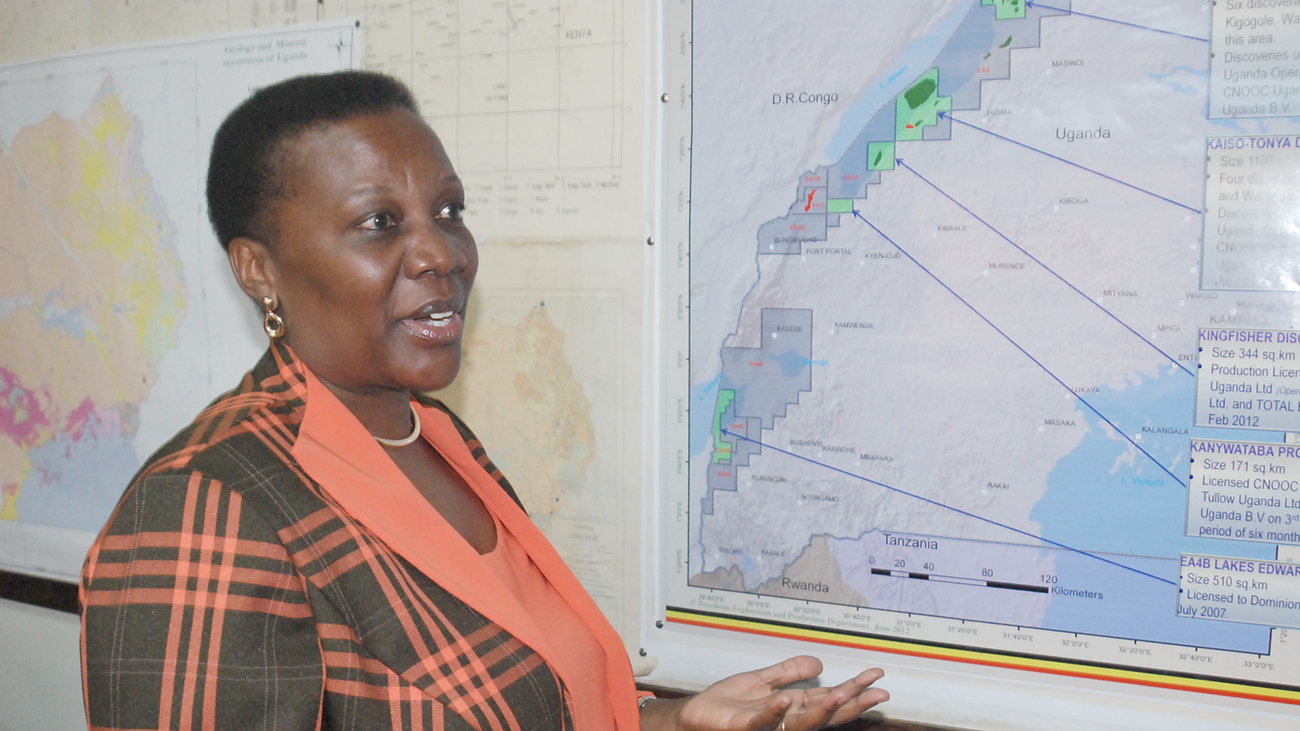
Narrating the story, Irene Muloni, Uganda’s minister of energy and mineral development, said the president “looked at his domestic human resources, and found no person knowledgeable in the oil industry. So he said, ‘no, I think it is safer to develop internal capacity to be able to get the best for ourselves as a country’. And indeed a good number of Ugandans have since been sent for training courses abroad and they are now part of the team that is leading the management of the oil sector. It is why we were able to negotiate a good deal for our country with the oil companies.”
Today three foreign oil companies are working in Uganda’s Albertine Basin field – Tullow, Total and CNOOC – and the first flow of crude oil is expected in 2014. Even so, the government feels that it needs more skilled Ugandans to do the job. So in February 2009, Museveni wrote to the Ministry of Education and Science (MoES) directing that since national oil and gas policy emphasised the need for local skills capacity development, the ministry should quickly develop a petroleum institute whose focus would be the training of locals.
The ministry was also to plan for a future public university focussing on petroleum studies. Faced with such a mandate, the ministry opted for a taskforce approach and asked the director of the Uganda Industrial Research Institute (UIRI), Prof Charles Kwesiga (pictured above)to chair the taskforce. A quiet, thoughtful, hardworking, and practical intellectual, Prof Kwesiga has steered the taskforce into a management implementation team for a new petroleum institute, based at Kigumba near the Albertine Basin oil find.
A pioneering cohort of 30 students have already completed their diploma coursework in petroleum studies, and are now doing their apprenticeship training at the Kenson School of Production Technologies in Trinidad and Tobago, a country famous for its expertise in oil production and management. Another intake of 60 students started at Kyema in August 2011, and were transferred to the Kigumba campus in August this year.
The foreign oil companies in Uganda, with Tullow as leader, had hoped to begin small-scale production this year, but a dispute over capital gains tax and a parliamentary decision blocking new agreements with oil companies until new legislation on oil is passed, has delayed production.
According to Minister Muloni, production will now begin in 2014, starting with 30,000 barrels per day (bpd), then 60,000 bpd in 2015, and finally 110,000 bpd when all systems are on the go. The government hopes to finish the construction of a refinery at Kigumba by 2015. This will be done on a public-private partnership basis, but no investor has yet been identified.
Minister Muloni says the country is happy with the deal it got from Tullow Oil. “It is a good deal because at the end of the day, the net take-home for our country could be almost 78%.” As a country, she says, “We are blessed that we are not the pioneers in oil production, we have seen what others have gone through, and we are adopting the best practices. We are restructuring ourselves to manage the oil resources in the most transparent and accountable manner…
“The Ministry of Energy will produce the oil, the Revenue Authority will collect the money, and the Ministry of Finance will ensure that the money is managed properly. We are also going to have an authority that will regulate the sector, and a national oil company that will handle the business interests of the country.”
The Ministry of Energy itself will have a Directorate for Petroleum to assist the energy minister in the formulation and implementation of the policies that will guide the management of the oil resources.
“We want oil to be a total blessing, and I have no doubt that it will be,” Minister Muloni explains. “I am the one in charge and I have no reason to not manage these resources in the best way possible… We want to transform Uganda into a middle-income country, and this oil is going to help us to do so. So how we manage revenues from these resources is extremely critical to achieving our goal. And we want to thank God for it.”