Africa desperately needs to improve access to electricity, and from fossil fuels to nuclear energy and solar power, the continent is faced with a number of options. Caroline Hellyer examines which might be viable and which might be dead ends.
Africa is home to 15% of the world’s population but consumes just 4% of the world’s energy output. According to the International Energy Agency, this leaves around 620 million Africans without access to electricity.
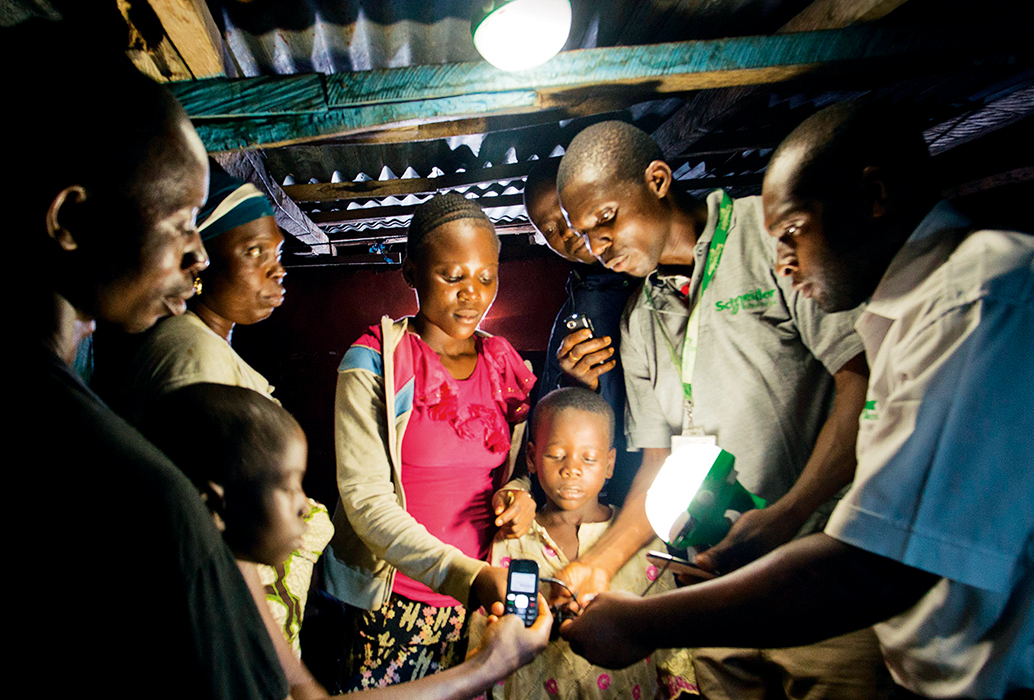
Furthermore, for those that do have access, power cuts are often a daily fact of life and a nuisance to be negotiated by the lucky few that have back-up supplies in the form of generators. In rural areas, generators are of course a luxury, and fuel often means long treks to find wood, charcoal or animal waste, which may be supplemented by expensive kerosene, candles and torches. Toxic fumes damage eyes and lungs, education is impeded, businesses lose millions of dollars, and states lose valuable tax revenues. Africa may be rising but it needs more than a creaking generator and a litre of diesel to fuel that rise.
Paying for infrastructure
The continent is rich in resources but weak in infrastructure, and poor energy systems in particular are responsible for a massive development bottleneck.
Grid supply has never been a strong point, and much of Africa’s power generation relies on ancient and poorly maintained equipment. A huge amount of investment is needed. Indeed, the World Bank estimates that Africa requires $93 billion annually to improve its infrastructure, of which almost half is needed to enhance power supplies. Finding this funding, however, may prove difficult.
Africa may be rising but it needs more than a creaking generator and a litre of diesel to fuel that rise.
“There are not many bankable infrastructure projects in sub-Saharan Africa,” says Rolake Akinkugbe, head of Energy and Natural Resources at FBN Capital in Lagos, Nigeria. “Can African banks meet that infrastructure requirement? I think not on their own.”
Akinkugbe suggests that Africa may need to raise external funds, but this process can be complex and many are wary of the lending terms imposed by international multilateral institutions. Their typical insistence on the deregulation of markets, for instance, can cause consumer energy prices to rise and remove labour protections.
US President Barack Obama’s flagship $7bn Power Africa initiative is one example of an energy-focused multilateral funding initiative intended to attract investment through financial support and loan guarantees. Alongside it is the recently enshrined US Electrify Africa Act, but while these programmes may be promising, Jason Hickel, lecturer in anthropology at the London School of Economics, emphasises the need to be cautious. With a reliance on public-private partnerships, he says, “it is essentially loading up the [African] state with massive amounts of debt which then gets syphoned through to private pockets.”
Pooling power
With investment interest growing, regional cooperation may be one way forward. After all, integrated energy projects along national borders can offer advantages through market pooling and shared generation capacities.
“Can African banks meet that infrastructure requirement? I think not on their own.”
The West African Power Pool, for example, aims to establish a common power grid and market for electricity across the Ecowas regional bloc. This kind of cooperation could bring with it significant benefits, though the challenges of harmonising regulatory frameworks and technical standards against the backdrop of various crises and internal political wrangling has meant that progress so far has been slow.
South Africa meanwhile has entered a partnership deal with the DRCongo to buy electricity from the proposed expansion of the Inga Dam in what could be the largest hydroelectric project in the world. Again though, it remains to be seen whether it will work out. Three international consortia are bidding for the contract to build the dam, but the cost is estimated to be around $12bn and most of the energy generated is intended for business use, with the remainder to be channelled to the Congolese capital Kinshasa.
Nuclear a no-no?
At the US-Africa Leaders’ Summit, held in Washington DC in August, the US-based Nuclear Energy Institute proposed another possible solution to Africa’s power needs: nuclear energy. The Institute claims that several nations on the continent are interested in nuclear power and that countries such as Nigeria and Kenya already have plans in the pipeline.
Greenpeace Africa Executive Director, Michael O’Brien-Onyeka, however, believes that the African interest in nuclear power has nothing to do with technical needs and everything to do with corporate interests and what he refers to as “co-opted corrupt governments”.
At the moment, the only country with a functioning nuclear power plant on the continent is South Africa. Its Koeberg nuclear power station, located in the Western Cape, joined the grid in 1984 and its two reactors supply 5% of South Africa’s energy.

In order to reduce its over-reliance on coal, South Africa also recently signed a multi-billion-dollar agreement with Russia’s state-owned nuclear company Rosatom to develop its nuclear capabilities, which opens the door for the procurement of more nuclear plants. The deal has, however, sparked a lot of controversy. It came as a surprise; there are rumours that Russia managed to secure exclusive rights for construction of the plants, and the lack of forthcoming details about the contract has left much of the public outraged.
“These same companies who were peddling their technology in Europe are now running to Africa and offering ‘Buy One Get One Free,’” says O’Brien-Onyeka.
O’Brien-Onyeka questions the very logic of the deal. “Why would they want to spend so much money within a deficit budget for the last five years for a nuclear energy system that even if you start using the reactors from the beginning, the first watt of energy will not come out until 10 to 15 years, if it is on time,” he asks.
Indeed, large-scale energy projects are notorious for overrunning budgets and completion dates, and it appears that as nuclear energy generation is going out of favour in some developed countries, corporations are seeking new markets.
“These same companies who were peddling their technology in Europe are now running to Africa and offering ‘Buy One Get One Free,’” says O’Brien-Onyeka.
Renewable future
Earlier this year, Climatescope, a joint initiative between the Multilateral Investment Fund, UK Department for International Development, Power Africa and Bloomberg’s New Energy Finance, analysed 55 developing countries for their “ability and potential to attract capital for low-carbon energy sources”. Three African nations – Kenya, Uganda and South Africa – came in the top ten, with South Africa’s clean energy investment growth rate described as “explosive”.
In fact, as the report found, many African countries are moving into new energy frontiers. Several countries including Rwanda, Kenya, Ghana and South Africa have pioneered various renewable energy projects including solar energy and, in the case of Kenya, geothermal power. Meanwhile, North Africa is also beginning to make substantive progress towards domestic renewable energy production, with both solar and wind power including the use of solar for desalination plants. Tunisia is actively seeking investment with plans to store and export energy using concentrated solar power technology.
These kinds of avenues could be very well suited to Africa’s needs. After all, with huge distances to cover, traditional centralised energy production and distribution systems can be prohibitively expensive to construct and maintain. Renewable energy, by contrast, can operate off-grid and with lower maintenance costs.
“The only thing that kills it is lack of expertise and a dearth of knowledge. Not many people technically understand renewables.”
This is why many analysts argue that this is the way for Africa to “leapfrog” energy provision in much the same way that mobile telecoms leapfrogged non-existent landline infrastructure. This innovation enabled not just communications development but spin-offs such as mobile money transfer.
Rolake Akinkube says this telecoms example demonstrates how investors didn’t initially recognise the market and misunderstood Africa and its consumers. “They priced the risk element over and above the potential returns,” she says.
She believes investors were also put off by the uncertainty around the regulatory frameworks and tariffs in the telecoms sector at the time. “No-one quite knew what was going on. It took Mo Ibrahim and people like that – the MTNs of this world – to recognise the opportunity.” Akinkugbe sees a lot of similarities with the development of renewable energy, but in terms of financing it, she adds: “The only thing that kills it is lack of expertise and a dearth of knowledge. Not many people technically understand renewables.”
“We need to have stable feed-in tariffs and we need to have the political backing to sustain that tariff framework.”
O’Brien-Onyeka is similarly hopeful about the potential of renewable energy, which he says “works as both an energy gap bridge and a long-term solution”. Furthermore, he adds, “it requires little maintenance so you have the space to re-skill and re-tool people in terms of viable job creation.”
Indeed, as far as renewable energy is concerned Africa has the opportunity to develop the ability to manufacture the technology and not rely on foreign expertise and labour. There are plenty of young African entrepreneurs showing interest in green energy, who, if supported, could prove instrumental in Africa’s energy future. Unemployment, after all, is also a huge challenge in Africa, especially with the continent’s youthful demographics and the fact its population is expected to double by 2050. As O’Brien-Onyeka puts it, “[Africa] needs an energy pathway that not only provides energy but creates viable jobs.”
If managed correctly, new technologies could provide not just renewable energy but a renewable job market.