An inspirational new book, Gardens of Marrakech, explores their cultural context and engages with the issues threatening their survival. Angelica Gray, a garden designer who grew up in the city, has selected 20 extraordinary gardens ranging from the 12th century palaces, via exquisitely tiled, riad courtyards to experiments in ecological awareness. We asked a recent visitor to the city, Juliet Highet, to review it.
Amidst the historical magnificence of Marrakech and the razzle-dazzle turmoil of its Medina is a parallel history of passionate garden making.
Medieval Marrakech was conceived as a garden city, with orchards, market gardens and pleasure gardens fully integrated into its urban model, so not only was a constant source of food available, but also cool, tranquil relief from the frenetic chaos of city life.
The name “Rose among the Palms” came about not just from its rose-pink protective walls, but also from its lovingly cultivated rose gardens and its status as an oasis city, with its vast plantation of palm trees.
In what is now called the Palmery, ultra-luxe hotels and villas have recently been built, replete with spacious gardens, formal pools and irrigation canals reflecting blue skies.
There is a growing awareness of the need to protect and encourage Marrakech’s garden heritage. King Mohammed VI has instigated initiatives
In the city, hidden behind carved wooden doors in thick pink pisé (rammed earth) walls are smaller oases of calm greenery and flowers, where the only sounds are of birds and gently splashing fountains. Most of these evocations of paradise to come have been gardened for centuries for the palaces of sultans and retreats of grand viziers and their harems.
Other miniature versions are the still, verdantly shaded courtyards of dars and riads, many of which have become chic boutique hotels. Then there are the large public parks for relaxed walks; the iconic Majorelle garden, restored with stylish panache by Yves Saint Laurent; and the hotel garden par excellence of the Mamounia Hotel, an elegant retreat for celebrities such as Winston Churchill since the 1920s.
Marrakech was still a green oasis at the start of the French Protectorate in 1912. But in recent years, rampant development, making it a boom-town for rural people seeking work, who are housed in vast swathes of tree-less apartment blocks outside the city wall; a water shortage caused by tourism within them; and some municipal neglect of public areas, have threatened the “Rose among the Palms”.
But there’s a growing consciousness of the need to protect and encourage its unique garden heritage, in which King Mohammed VI has become involved, instigating new initiatives. His own property is the 800-year-old Agdal, a vast productive pleasure garden made for a sultan, with a huge water tank whose function was for irrigation and to teach his soldiers to swim, but in which ironically, the sultan drowned.
Nowadays families, escaping the heated downtown frenzy, come to the Agdal to picnic beneath trees of citrus fruit, olives, pomegranates, figs and much more.
The great historic sites are inextricable from their gardens and are beginning to receive the government attention they deserve. Unlike the Agdal, the Menara, which is its little sister in size, has an exquisite pavilion or menzeh, surrounded by a lushly planted walled garden.
Sultans and a few favoured courtiers used them as a private retreat for dalliances. Both were built around the same time – 1156-7. As at the Agdal, water is a crucial element, ensuring both profit and pleasure. The Menara’s gigantic reservoir feeds its irrigation system by gravity, watering orchards and enabling 40 varieties of olive as well as edible plants to be grown on a commercial basis.
Such productive gardens, which nowadays double up as urban escapes, are known as arsats, great concentric rings of market gardens and orchards, which both surrounded the city and were arranged around the interior of the city walls right up until the 1950s, and were particularly useful in the past as a source of fresh food when the city was under siege.
The arsat model also inspires the overall structure of the gardens of an unusual guesthouse in the Palmery, Jnane Tamsna. They follow the traditional blend of tall palms sheltering a middle stratum of fruit trees, with a lower level of seasonal vegetables – an edible landscape.
However, there are changes of mood between different planted areas, like movements in an orchestral work, the bustan garden flowing in and around the buildings. The term bustan is derived from the Persian bu meaning “scented” and stan meaning “place”.
So ornamental perfumed plants such as daturas, jasmine and lavender syncopate with aromatic herbs. Its owner, Gary Martin, like other conscientious gardeners, is aware of Marrakech’s precipitous change in the very recent past, which has led to an increasing disconnect between city-dwellers and their agricultural heritage. He has initiated a number of successful “edible schoolyard projects”, in which children tend their own vegetable plots.
The concept of homes in the Medina is to exclude the world outside, to protect the privacy and sanctity of family life
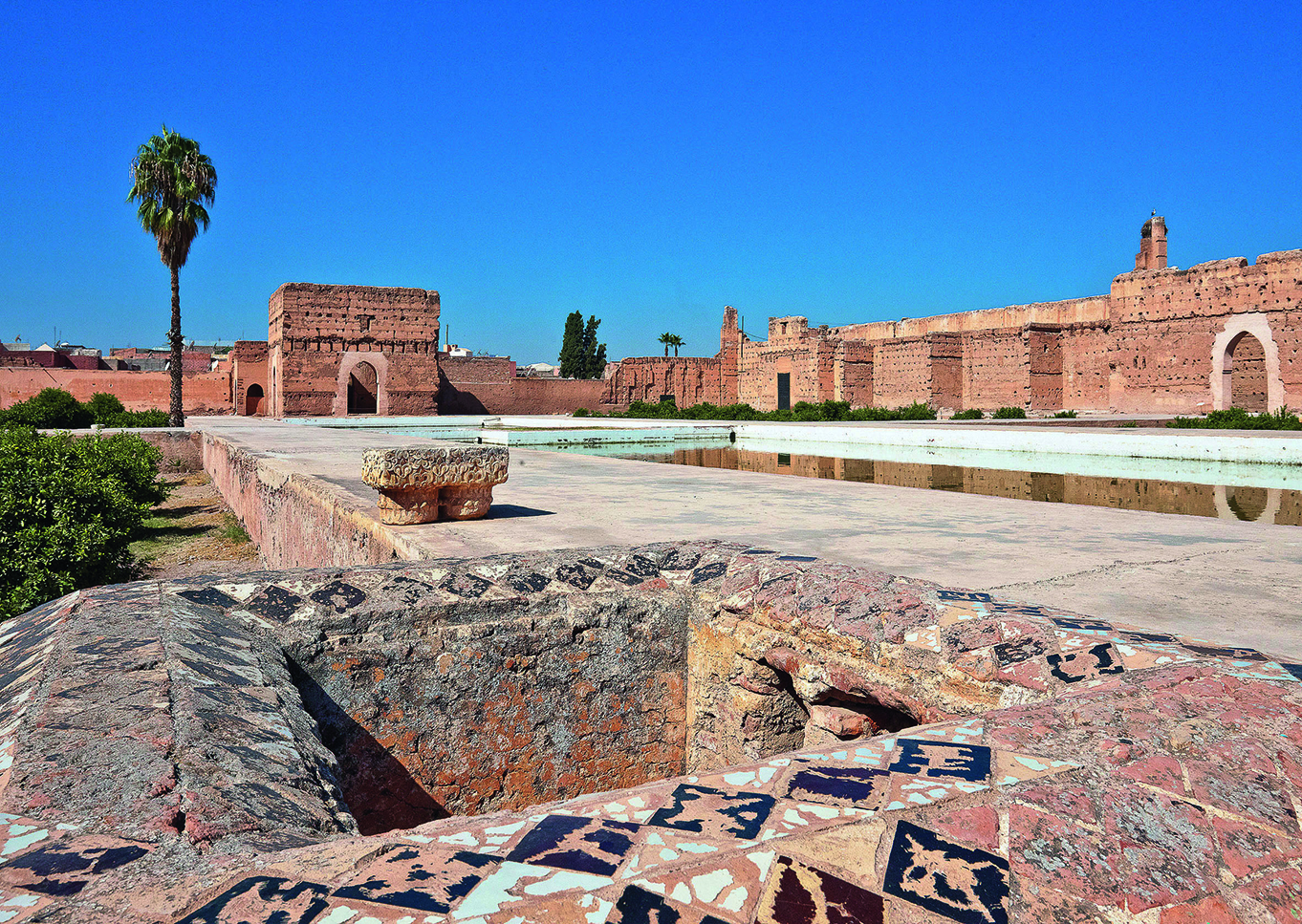
Unbelievably vast in dimension, awe-inspiring and yet unsettling in its now abandoned, empty and ruined state, the Badi Palace is a monument to human achievement and to its ultimate fragility.
“El Badi” means “The Incomparable” and is one of the 99 names given to Allah. It took 25 years to build and only 12 for it to be destroyed by another dynasty, less than a century later. The “incomparable” palace and monumental Andalusian-style courtyard garden at its centre were designed to impress ambassadors and confirm the sultan’s position as a force to be reckoned with. The courtyard contained sunken gardens, pools and pavilions.
The bare surfaces of today were all covered with ornamentation, with results from marble in every conceivable colour to intricate zellij-work pathways and pavilions dressed in onyx, ivory, lapis lazuli and even gold. When it was inaugurated, Sultan El Mansour – the Golden One – asked his clairvoyant what he thought of the ensemble. He replied: “Sire, when this is all in ruins, it will make a huge pile of stones.”
In 1894 Ahmed ben Moussa, known as Bahmad, created the Bahia Palace to rival the Badi, though it is a different and of course later vision of wealth and power, in which the concept of communal family living informs a gentle, harmonious relationship between architecture and gardens, creating three glorious outdoor rooms or courtyards. The first, the Petit Riad, is a masterclass in proportion and balance, featuring the classic four planted areas, evoking the rivers of Paradise in the Qur’an, intersected with tiled paths, and of course, has a fountain at its centre.
Then the visitor bursts into an incredibly richly adorned courtyard, also designed on a quadripartite basis. The buildings around it glow with multi-coloured tiles, intricate plasterwork, known as geps and carved cedar panels. Elsewhere in this marvellous palace, painted plants and flowers flourish everywhere: on doors, shutters and ceilings.
The Bahia also has large-scale productive gardens. Canny Bahmad realised their value so close to the markets of the Medina, growing high-value crops such as mandarins unseasonably ripe in the winter months.
Just ten minutes from the Bahia, the Dar Si Said houses the Museum of Moroccan Arts, built concurrently by the same artisans for Bahmad’s brother, Si Said, whom he made Minister of War. His home and garden are a haven of peace. Dar is essentially a very large house built on more than one storey with several interior courtyards. This reviewer was lucky enough to stumble upon the Riad Si Said, a much more modest but equally exquisite building with just one lovely courtyard; now a guest-house, previously home to Si Said’s concubines.
Whether dar or smaller riad, the concept of homes in the Medina is to exclude the world outside, to protect the privacy and sanctity of family life, and to create a little world of harmony and equilibrium.
Gardens of Marrakech features several outstanding riads, whose link is their gardens, the emotional and physical heart of the house, an outside room open to the sky, decorated and nurtured by the life-enhancing power of plants.
The success of a riad garden depends on the use of fine materials, a strict geometry and up until recently, a range of traditional plants. Its spirit has been described as: “a little bit of nature gathered from beyond the city, like a bouquet, and placed in a vase in the middle of the house.”
Another riad which again entranced this writer, is Riad Enija, altogether more quirky and original than expected. It was built in the 1730s by a wealthy silk merchant from Fez, in the more complex taste of that city involving pattern upon pattern, with an insistence on blue and white separating areas of incised geps plasterwork.
The first impression, as in all successful riad gardens, is of utter tranquillity in the thick of the souks, with the only sound that of birdsong and water, and the visual panoply of light and shadow created by the planting.
However, a dramatic impact has been achieved in the seven interconnected dars by the interplay of contemporary artefacts with the classical Islamic idiom, and it includes vintage 1950s pieces. The symbiosis is a triumph of inspired creativity.
Even more dynamically surrealist, the Jardin Majorelle is one of the glories of Marrakech. Its masterly use of bold, even shocking colour; the tension created by exaggerated verticals and expansive horizontals; and heights of poetic pleasure, such as the water-lily pool reminiscent of Monet, elevate the Majorelle to the status of a world-class garden.
Relatively small, it packs a big punch with its unfolding series of contrasting miniature landscapes or canvases. But the single most influential factor in the drama quotient is the choice of an exhilarating cobalt blue, which its founder, Jacques Majorelle, a painter and plant collector, chose for his villa and most of the garden structures as a result of his exploration of Berber villages.
Terracotta pots have been painted in this singing shade, with an extended palette of eye-watering citrus yellow and orange. Couturier Yves Saint Laurent and his partner Pierre Bergé visited frequently, and in 2000 bought the garden, saving it from destruction by speculators, and endowing it substantially for the future. Saint Laurent requested that his ashes be buried in the garden he loved.
Two very different gardens are inspired by the concept of douar, a traditional little village. Les Deux Tours is not one of the Hollywood-style villas and hotels that have sprung up in the Palmery.
It is a guesthouse blending traditional materials and artisanship with modern convenience, some of which is pretty unique, such as antique brass four-poster beds hung with white muslin for siesta-time dotted around the lawns of broad-leaved grass, which is adapted to the climate.
A new take on a nomad’s tent? Not very “traditional village”, you might think. Yet beyond the series of undulating gardens of delight is the potager – a working (though decorative) vegetable garden, such as any settlement would have needed, this one feeding the guests.
A much grander property, the Beldi Country Club, is an ocean of rose gardens, scenting the air before you even glimpse them. The Arabic word beldi translates as “traditional”, but in Morocco evokes the authenticity of rural life and materials made in an artisanal manner, and naturally, there is a large productive potager.
There is also a clear commitment to traditional construction materials, heritage of the douar. Most of the buildings are of pisé, rammed earth mixed with lime and short lengths of straw. The tall graceful arches of the terrace are made of bejmat, terracotta briquette.
The Rose Garden, with its 3,300 bushes, has become the signature of the club.
Marrakech once had a thriving rose production industry, which collapsed after Independence in the 1950s. Nowadays, roses are used en masse in municipal bedding schemes, sheltered by palms, and create a beautiful entrance to the city from the airport. Once again, Marrakech is “the Rose among the Palms.”