Even at the age of 80, the former President of Nigeria, Olusegun Obasanjo has not stopped working on behalf of the continent. His latest venture is the Olusegun Obasanjo Presidential Library, which aims to connect Africa’s past, present and future and be another pillar in the foundation of the African Renaissance. Hippolyte Fofack, a Fellow of the African Academy of Sciences, describes his visit to the institution.
Although the term ‘renaissance’ is an aspirational concept about a return to greatness and power projection in a world of competing cultures and civilizations, great institutions worthy of global admiration and respect are the true foundation and visible pillars of renaissance.
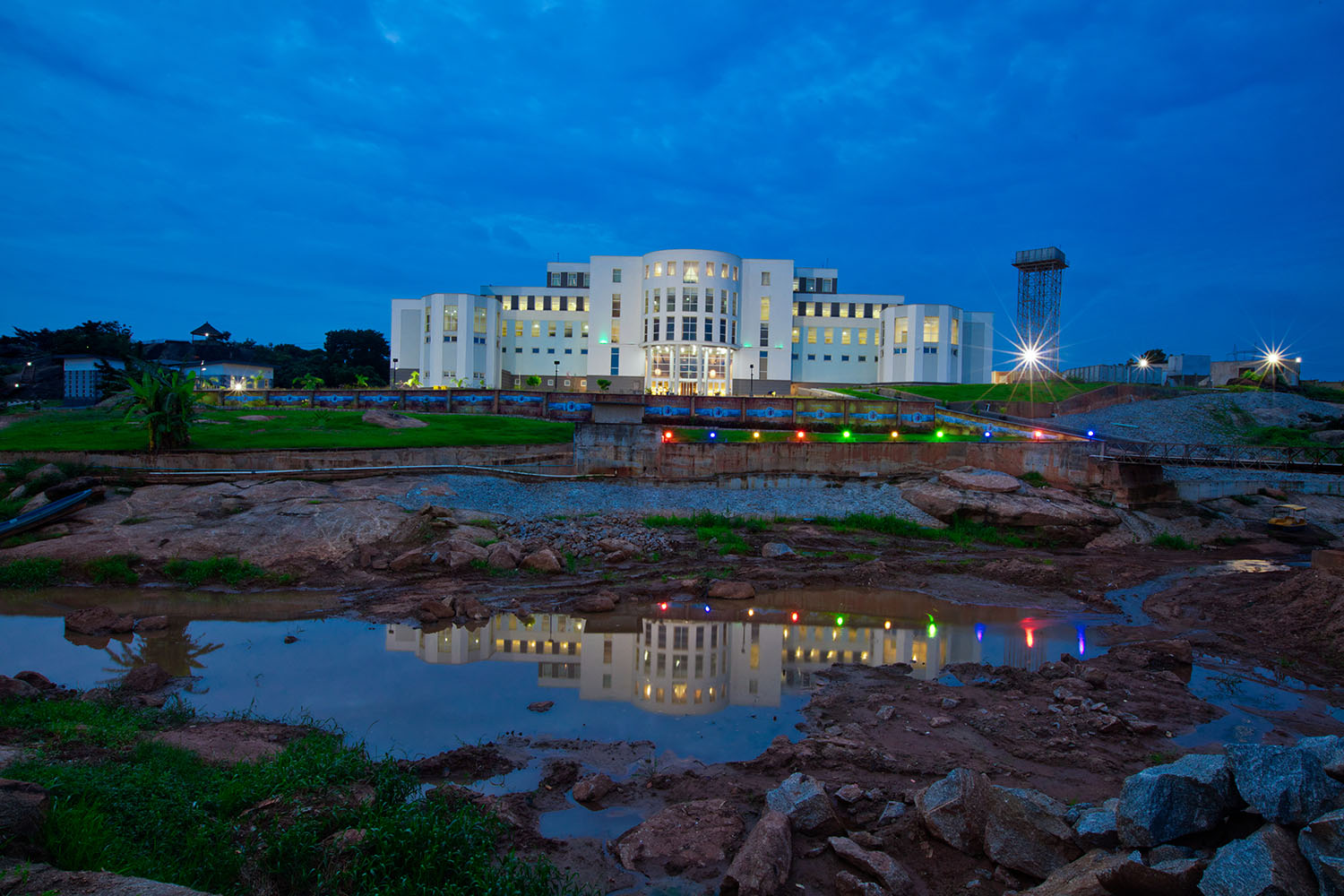
After the long-awaited arrival of the National Museum of African American History on the Mall in Washington DC over a year ago, and before that the Great African Basilica in Yamoussoukro, Côte d’Ivoire almost three decades ago, the Olusegun Obasanjo Presidential Library (OOPL) in Abeokuta, Ogun State in Nigeria is perhaps the third act establishing a foundational edifice of African renaissance on the world map.
These new institutions of African renaissance are bridging the discontinuity in African history and culture since the Great Pyramids of Giza, which survived the test of time and the destruction of African symbols of greatness during the cultural holocaust associated with the institutions of slavery and colonialism.
The former army commander, Obasanjo, who was President of Nigeria twice, fought as a young military officer for the independence of the Congo in the 1960s, having been sent there by the UN, and played a most critical role in crushing the apartheid regime in South Africa, at a time when apartheid was still fashionable in powerful corners around the world, by strategically drawing on the confidence enjoyed by Nigeria under his leadership to help close the last mile on the long march to freedom and independence across Africa.
However, liberating Africa from the tyranny of apartheid and colonialism in his view was not an end, but the first step on a path to renaissance, and his commitment to sending Africa back into the world of greatness has been steady over time.
Over the last five decades, Obasanjo’s footprints have been on every single continental strategy and initiative to promote peace and security and accelerate the process of economic development to put Africa on a speedy path to renaissance. Whether it is the Lagos Plan of Action, the New Partnership for African Development (NEPAD), or more recently, the African Union’s Agenda 2063, the new blueprint to deepen integration and the structural transformation of African economies.
Now, through the OOPL, Obasanjo is drawing together many disparate strands to connect Africa’s past, present and future. Spread over 32 hectares of land (about 40 football pitches) on a majestic hill with a breathtaking view of Ogun State, the OOPL aims to preserve the past, capture the present, prepare for the future, and promote culture and tourism.
As the first of its kind on the African continent, the inauguration of the library in March last year, during the 80th birthday of the former president, brought together Heads of State and government and dignitaries from all over the world, to celebrate the life of a leader who has already given so much to Africa and yet, in his view, not nearly enough.
The former President of Liberia, Ellen Johnson Sirleaf, who attended the ribbon-cutting ceremony, said: “The Olusegun Obasanjo Presidential Library is an initiative in Africa that will spur [a] strong legacy for successful, retiring Presidents on the continent to emulate.”
Indeed, if the OOPL could enhance political transition in Africa, then it is not just about the release of records associated with Obasanjo’s successive presidencies, first in the late 1970s, when he oversaw the transition to democracy in 1979, handing over power to a civilian government in Nigeria, and then between 1999 and 2007, when he was democratically elected as the President twice.
In addition to valuable official documents (15m) and books (2m) and impressive buildings, it also encompasses several tourist attractions, such as the zoological gardens and wildlife park, conference venues and hotel, a spa and wellness centre, houses of worship and prayer, as well as infrastructure for sport and recreational activities.
It is also a museum about African history and culture, with interactive cones, over 4,000 artefacts, a Cultural Village, and the African Fabrics Centre to showcase the diversity and originality of African textiles.
Another important feature is the children’s wing, which is highly interactive, allowing children to be taken through their dream careers. They have their photographs taken at the end to preserve the memory of this exciting journey and set them on a more confident path towards a relevant and accomplished professional career.
Continuous learning
OOPL is set up to promote a culture of continuous learning, in tune with Obasanjo’s motto: “The day you stop learning is the day you stop living, because learning is a life-long process.”
Continuous learning is provided by a number of centres of excellence, including the Centre for Human Security, the Green Energy Demonstration Initiative, the Youth Development Centre to shape the minds of future leaders, and the Institution for African Culture and International Understanding – the first UNESCO Category II Institute on culture in the region. In essence, OOPL is a one-stop centre for human development.
Although it was originally conceived in 1988, the idea finally took concrete shape in 2015 and was inaugurated in 2017. This gestation period of almost 30 dramatic years included a three-year stretch in prison for Obasanjo. Many other leaders would have given up, especially in a repressive environment where people are often reminded of their shortened life expectancy.
Not Obasanjo, the incurable optimist and inter-generational leader, whose courage and commitment to deliver a better world to future generations transcends irrational doubts, and the one-generation mindset that has so often led to the intractable poverty trap afflicting the African continent. But the courage to overcome doubts and uncertainty from the first is alive inside the library. In a recorded video, President Obasanjo transcends his Christian faith to denounce the complicity of the Catholic Church in the most odious crimes against humanity perpetrated in Africa through slavery and colonial rule.
It is one of the most moving and inspiring moments of fearless leadership in Africa and one that is likely to provide a different perspective on African history to visiting tourists and students, and in the process strengthen the African heritage and self-confidence of young Africans.
Indeed, reminiscent of one of Africa’s most instructive proverbs, the African Lion has finally recovered its lost canonical voice, enabling it to narrate its own story and thus correct the historical bias associated with exclusive reliance on the ‘hunter’s’ viewpoint.
A tour at the Arrival Pavilion takes visitors through significant objects in Obasanjo’s life. These include his first car, a well-kept Volkswagen Beetle, a helicopter and miniature warship, and the bike (also known as Keke Baba or Keke Ota) he used to ride around his farm when he left government in 1979.
In that labyrinth of memorabilia, the farm bike, typifying the humble beginnings and nature of Obasanjo, is just as important as the Mercedes Benz and the Nissan Patrol SUV that he used in his victorious Presidential campaign in 1999. Perhaps it is even more important, because it may be more difficult to preserve an object considered as one with little value.
But the presence of that farm bike next to financially more valuable pieces is also highly instructive about Obasanjo, especially in a world where the forces of power are often irresistible, absorbing leaders and ultimately detaching them from their hobbies and original communities. By introducing Africans to the merits of progression in life and historical preservation, OOPL is likely to strengthen their sense of humility and purpose.
Path to greatness
Transparency and historical accountability are other important attributes of leadership, which will not escape any interested visitor to the Presidential Library. In a world where those already in public office are keenly concerned to protect their reputations, how many leaders will willingly open important chapters of their previous lives, and especially the ones in which they had little control over the outcome?
Yet, that is precisely what President Obasanjo has done by displaying his academic records going as far back as primary school. In retrospect, the grade he obtained in a given subject is definitely not as important as the sense of progression in life. The ability to learn from failure is part of the growing-up process and continuous learning is central to success for those striving to achieve greatness.
The systematic quest for excellence, which is a necessary condition to greatness, has always been a permanent feature of Obasanjo’s life. From very modest beginnings, he rose to national, continental and global prominence by continuously expanding his stock of knowledge. Along the way he has touched and changed the lives of many for the better, but in his view, not nearly enough to set the region on a speedy path to renaissance.
The Presidential Library will enable him to touch the lives of even more people in the present and definitely in the near and distant future. He has opened his life and thinking to the world and especially to young aspiring leaders, convinced that only good readers will become good leaders. Launching Africa back into the pyramidal world of greatness is possible, as his life shows. NA