A glistening new book entitled African Gold celebrates the enormous range of gold ornamental objects and jewellery of West Africa. Major gold fields had existed in West Africa for at least 1,500 years, but, as Juliet Highet reports, between the 11th and 17th centuries one corner of the sub-region became the leading supplier of gold in the world. Consequently, this African El Dorado became known as the Gold Coast (later Ghana).
Africa generally is a land of gold, but not all African kingdoms valued or indeed were sources of gold. Most of it, in those bygone days, came from two broad zones – the central West African forest area of Ghana and Côte d’Ivoire; and the Sahel, extending from Senegal to Mali and Niger.
The stunning pieces in the generously illustrated new book African Gold, published by Prestel, date from the 19th and 20th centuries, from a collection begun in 1922 by a Swiss art collector and originally held in Geneva. The collection returned to Africa when it was bought by AngloGold Ashanti, a gold mining company based in South Africa, who installed it in a purpose-built Gold of Africa Museum in Cape Town, opening in 2001.
This was a significant event in bringing back cultural artefacts to the continent of their origin. Around 350 items give an insight into the significance of gold objects – their power, wealth and splendour within their cultural context.
Their diversity of aesthetic artistry is an inspiration for contemporary designers, artisans and historians. In effect the Museum and book preserve the traditions and knowledge of gold-smithing techniques and the extraordinarily rich heritage of the region, both decorative and philosophical. The desirability of gold has motivated humanity to spectacular heights of creativity, and awesome depths of depravity and destruction.
As we know in the current parlous global monetary situation, the value of gold never goes down – quite the reverse. In fact throughout history it has often been the only commodity on which to depend financially. Its non-tarnishing glittering allure and ability to be transformed into objects of beauty and desire ensured that it was carried along the many trade routes across Africa.
The tragic truth today is that all but a tiny fraction of West Africa’s gold, whether in the form of objects, nuggets, jewellery, coins or gold dust, has eventually been exported.
From AD 800 to 1600, gold imported into North Africa enabled Berber and Arab dynasties to strike coins in mints as far afield as Marrakesh and Cairo. The dinars of the Almoravids and Merinids were among the most superb produced in the Islamic world – and almost all were made from West African bullion.
Early medieval Arab geographers and travellers reported on the spectacular gold regalia, weapons, and horse-trappings owned by the kings of ancient Ghana and Mali. A publication of 1756 illustrates a Kulango gold spirit-figure pendant that turned up in Egypt, and another hoard in Libya.
A report of 1809 mentions that an “immense quantity of gold trinkets of the manufacture of Jinni” in Mali was exported from there and Timbuktu to the Middle East.
Warfare and recycling have also been responsible for the destruction or loss of most of the heritage of West African gold ornaments and jewellery. Over the centuries royal treasures were ransacked by the victors of conflict, the loot rarely surviving in identifiable form, melted down into gold dust, or bars and ingots.
Even in peaceful periods, since gold jewellery was a form of wealth, it was not kept if it had been damaged or become unfashionable, the owner taking it to a goldsmith to be melted down and made into new ornaments, at least serving to preserve the goldsmith’s craft and inspire fresh creativity. This process continues to this day in Senegal and Ghana, where hardly any pre-colonial jewellery has survived.
Ironically, the golden regalia of the 14th century kings of Mali and the “gold sceptres and plates” of the rulers of Timbuktu, as well as hundreds of items of Asante goldwork seized by British military expeditions to Kumasi in 1874 and again in 1896, have been preserved in their original form by being looted to Europe, ending up in forlorn splendour in the glass cases of museums.
From the 15th century onwards, Portuguese, Dutch and other Europeans had noted the abundance of gold body ornaments worn by some of the people they encountered on the West African coast, and established forts there on what became the Gold Coast before Ghana became independent in 1957.
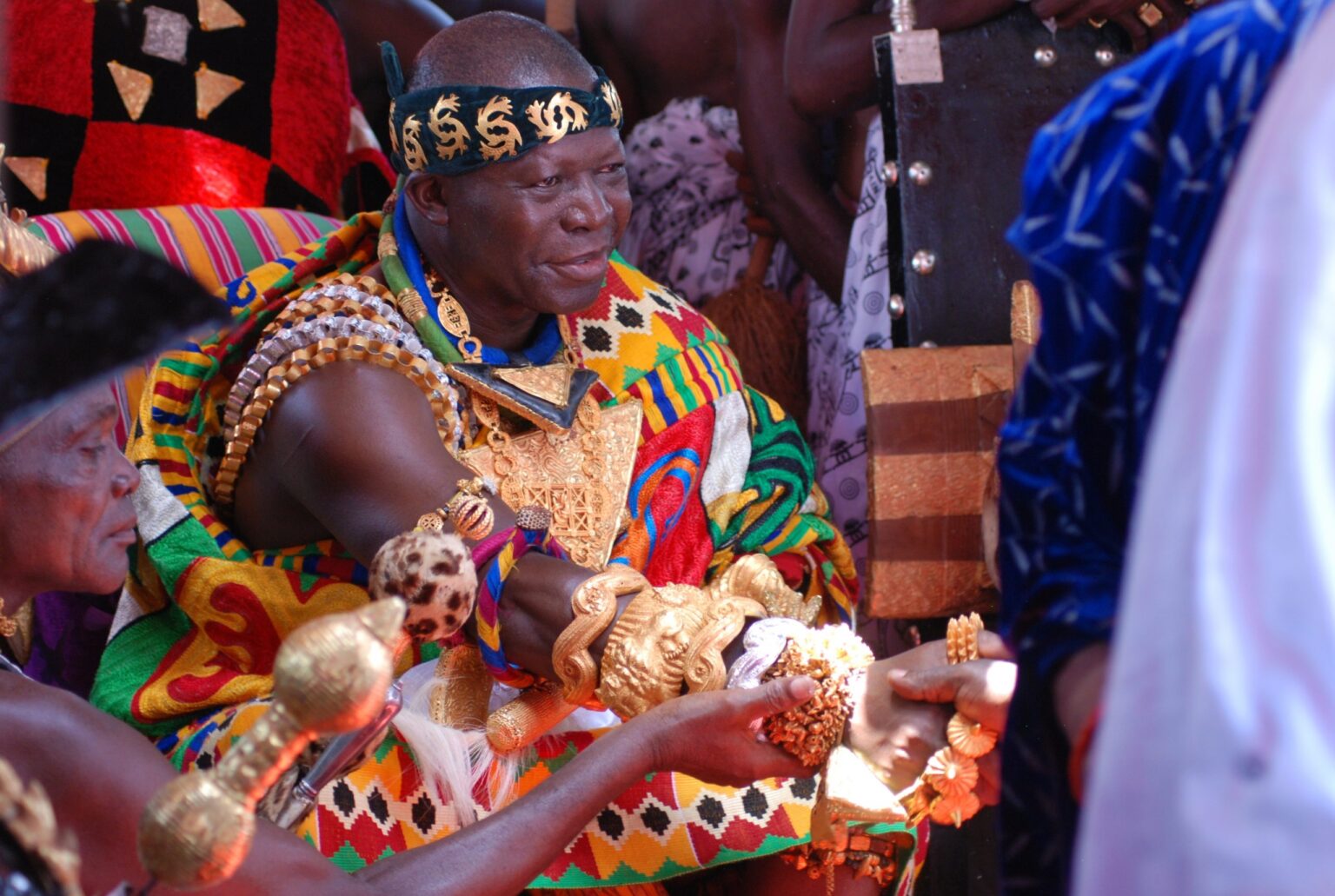
Gold is still commonly worn in some parts of the region, and magnificent displays are to be seen on ceremonial occasions, particularly those of the Akan people of Ghana and Côte d’Ivoire.
In 1817, a British envoy to Kumasi, witnessed a Yam Festival, describing the king, the Asantehene Osei Bonsu as wearing: “A necklace of gold cockspur shells… his bracelets were the richest mixture of beads and gold, and his fingers covered with rings… and around his ankles [were] strings of gold ornaments of the most delicate workmanship. He wore a pair of gold castanets which he clapped to enforce silence.”
His attendants were no less of a superb sight: “The belts of the guards behind his chair were cased in gold… his eunuch wore only one massy piece of gold about his neck.” Even his executioner wore “a massy gold hatchet” on his chest.
So why is gold so significant in West Africa? It was believed that the king or chief, in his bearing and appearance, embodied the power, prestige and wealth of the community. The more opulent his regalia, the more important he was considered to be.
At traditional Ghanaian weddings, the bride and her attendants would be decked out in their Kente cloth and finest gold jewellery, and sometimes they still are. Another description of 1817 tells us that “the girl’s hair was combed in the form of a cone to the top of her head and profusely decorated with gold butterflies… on her girdle hung golden lions.”
To this day Wolof jewellers in Senegal and The Gambia create exquisite filigree butterfly pendants and brooches. Their work is always African in spirit, original and inventive, of an astonishing variety and complexity.
With the spread of Islam south from the late 18th century onwards, most men (with the exception of kings, chiefs and their attendants) abandoned wearing gold jewellery. But for women it continued to be an essential sign of wealth and prestige. Jewels for the hair were displayed in large, elaborate coiffures, like the 19th century bride, the whole ensemble involving earrings, necklaces, chokers, chains, pendants, brooches, bangles, finger and toe rings.
One of the most striking features of Akan gold rings and weights is its wealth of proverbial imagery. Most depict an object – animal, bird, fish, insect, fruit, seed, etc – that is associated with an Akan proverb or aphorism, so that they convey a message. Frequently this message emphasises the wealth and invincibility of the king or an individual, serving as a warning to enemies, or the indication is a moral one, emphasising decent conduct.
Gold beads were made in the form of cowry shells (once used as currency), drums, padlocks, amulets and talismans. Some of the most exquisite and evocative examples of Akan gold-work and cultural values are “soul discs” or “soul-washers’ badges”, with the intention of purifying the chief’s soul.
However, linguists and war leaders, as well as young women at their puberty ceremonies, could also wear them. Today, they can indicate the principle mourner at a funeral. Some Akan queen-mothers wear gold bracelets in the form of a babadua plant, which spreads very rapidly, and is therefore a potent symbol of female fertility.
The passion for gold jewellery shown by the Akan is shared by women further north in the Sahara, the Sahel and the region of the Senegalese and Gambian rivers. But in the past, particularly the 19th century, some men also adorned themselves with gold hair ornaments, earrings, bracelets and rings, especially the more important kings of the Sahel. Until very recently, copious amounts were worn by women, notably in Senegal and southern Mali, whose Peul women of Mopti on the River Niger, were famous for their magnificent jewellery.
One of the most spectacular examples of this is their earrings of gold, hammered into a four-lobed shape, often engraved with elaborate designs. Some were of an enormous size, weighing up to 300 grams. To avoid laceration of the earlobe, a thong passing over the crown of the head sensibly supported them. They also wore superb bicone pendants as the centrepiece of a necklace of openwork gold beads. One of the most graceful of gold pieces, found in all Sahelian countries, is a choker occurring in two main forms. One of these is a swastika, known as “the claws of the lion”, another is a quatrefoil surmounted by a stylised flower.
Along with the Peul and Wolof peoples, others most noted for their fine jewellery in the Sahara, Sahel and Senegambia, include the Maures, the Tuareg, the Sarakole, the Tukulor and the Mande.
One could sigh that a collection of West African gold objects and jewellery is now on display in South Africa, but at least it has returned to its own continent.
(African Gold by Timothy F. Garrard is published by Prestel. ISBN 978-3-7913-4119-4.)