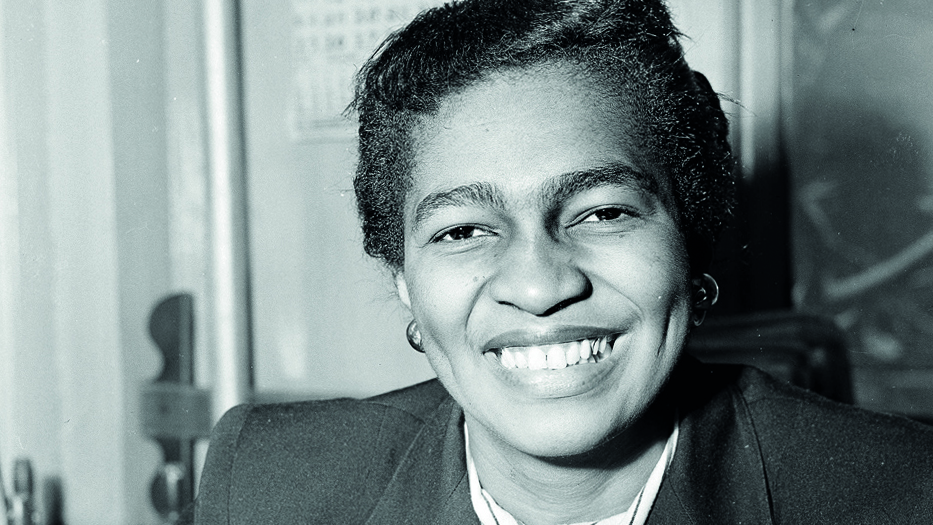
Today, the African and Afro-Caribbean media in the UK is well developed but 60 years ago, despite the large numbers of black and Asian immigrants, there was a yawning vacuum. It was filled by a remarkable woman whose legacy continues to be felt today. By Clayton Goodwin
Sixty years ago a landmark in publishing was established. In 1958 the first publication of the West Indian Gazette (Afro-Asian and Caribbean News) brought to London, and the UK, an outlook on life which had not been seen before. It was the result of the enterprise of a remarkable woman.
She arrived in the UK in controversy, and she died in obscurity. Yet in her few years in London, from 1955 to 1964, Claudia Jones put down the roots of a number of initiatives that now define the African/Caribbean presence in this country.
She was born in Trinidad, and resided for most of her life in the US before which she was deported for her Communist sympathies. As her homeland was then still a British colony, she was sent to its ‘mother country’, Britain.
Today, Claudia Jones is recognised as an icon for people of African descent as well as for women’s rights and her Marxist credentials. She is one of the few people, other than the Queen of England, to have had her portrait on the country’s national postage stamps. Jones was indeed a woman for all seasons.
There had been publications before which sought to serve the Caribbean/African community but the West Indian Gazette was the first to do so on a regular basis – even though the frequency with which it appeared was dictated more by the funds available than by the schedule.
It could not have been otherwise. There was no homogeneous black community. Immigrants arrived here from different homelands, went about their business, and expected to return to the countries they had come from. Perhaps it needed an American to pull all the disparate strings together. Claudia did it just in time. Nobody – neither native nor migrant – had faced up to the pressures of sustained immigration. Passions simmered with few outlets for expression. Tensions among some white people were building up to the explosion of violence on the streets of Nottingham and Notting Hill later in the 1950s.
Immigrants, too, were beginning to understand that they would not return ‘home’ as soon as they had expected and that they had to put down some roots here. However, they lacked a voice for their aspirations and fears, and a channel of communication within the community. The West Indian Gazette provided that voice.
With Claudia Jones at the helm, it was bound to be a strident voice that was already versed in the language of protest and identity. In its early days she was assisted by the counsel and experience of Amy Ashwood Garvey, first wife of the visionary Marcus Garvey.
The newspaper did more than just bring Africans and West Indians of the Caribbean diaspora together. Claudia placed her readership in the whole Africa story, and put that story in the then current framework of international politics in which Capitalism and Communism seemed to be squaring off for Armageddon.
All this time, too, the colonies were making their way, some more harmoniously than others, towards independence. Somehow the West Indian Gazette provided both the big picture and the more intimate localised scene, as well as an appreciation of literature and the arts.
Consequently, statesmen of international renown made their way to the office on Brixton Road, along with the bus-drivers, housewives, the unemployed and the scarcely employable of the immediate neighbourhood.
Nurtured journalism skills
Apart from its social, cultural and political service, the West Indian Gazette provided a platform for learning the skills of journalism including in advertising, publicity and marketing, office management, and getting to know the community.
This was not just for West Indians and Africans. I was then a student at the School of Oriental and African Studies moonlighting as an apprentice journalist. As such I was privileged to meet Frank Worrell, captain of the West Indies cricket team, and, searching the telephone directory for a suitable address, wrote to the West Indian Gazette asking for information on the great man and the islands his team came from.
Claudia replied that I could learn best about West Indians by helping to distribute copies of her paper among my fellow students – and, if I wished, submitting articles to be considered for publication.
It was not a singular experience. Anybody willing to put their shoulder to the wheel was welcome. From seasoned hands and enthusiastic newcomers, Jones welded a heterogeneous team into an ensemble of what appeared to be incompetent competence.
It was all rather exciting as every experience encountered had to be original, or, more correctly, had not been written down before. Yet Claudia fought against lack of funds, demands for payment, and declining health. When she died on Christmas Eve 1964, aged only 49 years, and the newspaper folded early the next year, it seemed that the dream had died with her. Claudia had no way of knowing what she had started.
Nevertheless, the seed she planted could not be prevented from growing. The lot of steering the ship through the choppy waters of the next decade fell to Aubrey Baynes, an urbane Vincentian business graduate who knew both poverty and a degree of affluence.
Whereas Claudia’s reputation has grown, mushroomed, since her death, Aubrey has been largely forgotten – unjustly, in my opinion, because he was the true father of the Caribbean/African press in the UK. He had broken into the market with Daylight International, a glossy magazine of erratic publication, and made his mark as editor (but not publisher) of Magnet News, which for its short duration did come out weekly on a regular basis.
By the turn of the 1970s, Aubrey achieved his goal by publishing the longer-lasting West Indian World, which combined many of the aims of his predecessor.
The task, however, was too much for one man. He struggled financially from the outset. Baynes was personally communicative, with a friendly mien. It was said that he spent too much time chatting with contributors about a story rather than applying the appropriate pressure to those who owed the enterprise money. By 1973 he was forced to sell his newspaper to Arif Ali, then publisher of the pocket-book monthly Westindian Digest, who went on to found the Caribbean Times / African Times and other titles. Arif Ali (originally from Guyana) had a flair for business, journalism and self-promotion that bordered on genius.
Saturation but no depth
Today hardly anybody needs the UK Caribbean/African weekly press as a first source of information. There is saturation in the national media – especially television, radio, not to mention the social media – covering any market or community. It is a different world to that of Claudia Jones. However, the demand for what she pioneered is just as great.
There may be much news and commentary, but it often lacks balance. It presents neither the whole story nor all sides of the story. Our readers may find there is frequently a lack of accurate, or informed, interpretation. Syd Burke, the Jamaica-born broadcaster, summed up the need by introducing his LBC radio programme Rice ‘n’ Peas as providing a “black point of view”.
With the media outlets now available, everyone can get as much public exposure as they want for themselves and their opinions. I derive much pleasure from reading my copy of the New African digitally by merely tapping a key on the computer. Yet there was a lot to be said for the frisson of excitement of those far-off days when people waited expectantly for the next edition of the West Indian Gazette to come out to see if their name was there (for probably the only time in their life).
Sixty years ago Claudia Jones gave a voice to the voiceless so that they could be heard – that deserves to be celebrated. Let us leave the final word to the lady herself (in her last published essay): “The newspaper has served as a catalyst, quickening the awareness, socially and politically, of West Indians, Afro-Asians and their friends. Its editorial stand is for a united, independent West Indies, full economic, social and political equality and respect for human dignity for West Indians and Afro-Asians in Britain, and for peace and friendship between all Commonwealth and world peoples”. NA