Archives can represent a rich seam of evidence and information on the behaviour of colonial administrations. Perhaps this is why Britain is dragging its feet in returning files taken away when its colonies became independent. Dr Mandy Banton provides an analysis of the current situation, with additional reporting by Dr Susan Williams.
On 5 April 2011, The Times reported that British attempts “to cover up one of the darkest episodes in British colonial history have been revealed by the discovery of a vast cache of documents relating to the Mau Mau rebellion in Kenya”.
The British government claimed that these documents belong to the UK, although many people disagree. However, the government also claimed that liability for atrocities committed by the British in Kenya was not its responsibility. That had been transferred to the Kenyan government at independence.
Archbishop Desmond Tutu was among those who reacted angrily to this extraordinary stance. He said: “ … the British government’s attempt to pin liability on Kenya for British colonial torture represents an intolerable abdication of responsibility. Britain’s insistence that governments around the world ‘should respect international human rights standards’ will sound increasingly hollow if the door is shut in the face of these known victims …”
Media reports speculated on the possible existence of comparable collections of official documentation removed from other former British colonies, fuelling assertions, rumours and half-truths long in existence.
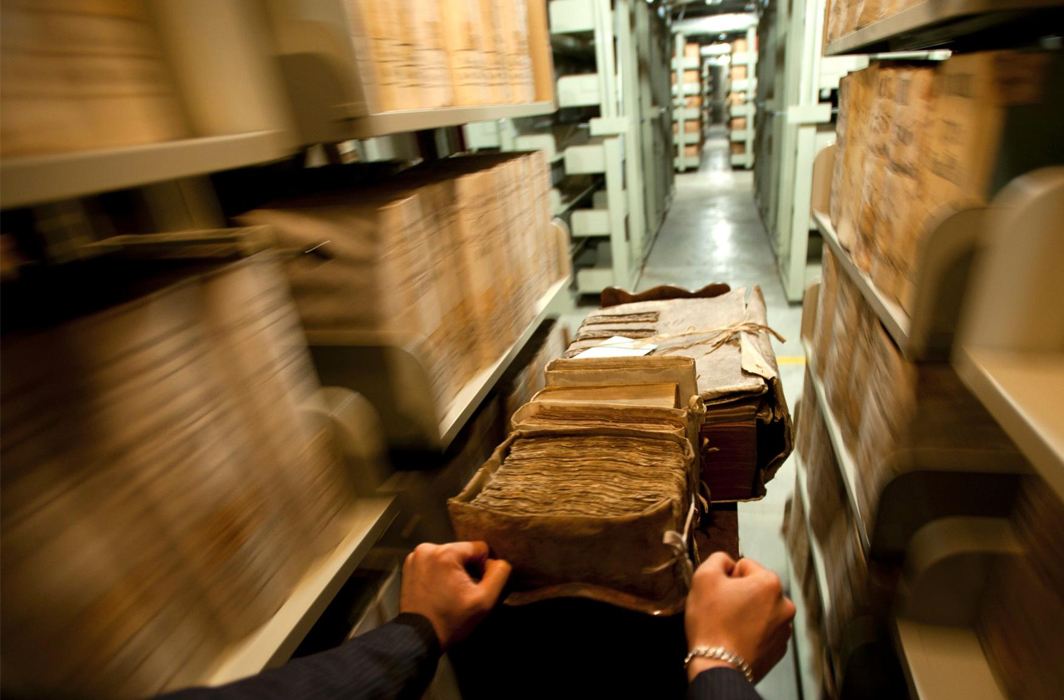
The British Foreign and Commonwealth Office (FCO) subsequently admitted that it held 8,800 such files and volumes. All of them were kept in a high-security building at Hanslope Park, 50 miles north of London. They came not only from Kenya, but from a total of 37 colonial territories. There were, in fact, almost 20,000 files and volumes.
These documents, sent to London at independence or shortly afterwards, are now in the UK National Archives. They are known as “migrated archives” – documents removed secretly from the countries in which they were created, and quite distinct from the internal records of British government departments.
They include collections from Botswana (Bechuanaland), Cameroon, The Gambia, Ghana (Gold Coast), Kenya, Lesotho [Basutoland], Malawi (Nyasaland), Nigeria, Sierra Leone, Swaziland, Tanzania (with separate collections for Tanganyika and Zanzibar), Uganda, and Zambia (Northern Rhodesia).
A report was commissioned by the British foreign secretary, William Hague, in 2011 to examine “What went wrong and what lessons should we draw?” It emphasised bureaucratic incompetence and loss of corporate memory, rather than any deliberate intention to conceal the existence of these migrated archives.
But the suggestion that they were simply forgotten, or perhaps considered of no interest or importance, does not ring true. We know that there were sporadic discussions about them, and what to do with them, over many years.
Why were these papers not left to form a part of the public records of the newly independent states – housed in the national archives of those states? Why are they now opened to the public in London, rather than being returned?
More questions than answers
The first of these questions is easier to answer. Between the late 1940s, when Sri Lanka (then Ceylon) achieved independence, and the early 1960s, British officials in London and around the empire gradually developed a policy for the “disposal” of the records created by the colonial governments.
The early discussions, in the Colonial Office in London, were tentative and begged basic questions: “Are we entitled to do as we please with these records? Are they UK government or Ceylon government archives? Are we entitled to withhold them from the Ceylon government?”
But by 1961 responsibility for policy development had passed to the intelligence and security experts, and such doubts were swept aside. Standard guidelines were sent from London.
They instructed British governors in Africa, and elsewhere, to ensure that ministers and senior officials in the newly independent governments did not see documents that might “embarrass Her Majesty’s Government or other governments; might embarrass members of the police, military forces, public servants or others, e.g. police informers; might compromise sources of intelligence information; or might be used unethically by ministers in the successor government”.
Some such documents were consequently sent to London; uncounted and uncountable numbers were destroyed. Yet more were destroyed after their arrival in the UK.
Until the early 1980s, it was assumed in the Foreign and Commonwealth Office (FCO) that the surviving “migrated archives” would eventually be returned to their countries of origin – at least in part. But in 1982 a British official noted that such a return to one country would result in an avalanche of requests from others.
Furthermore, it “would act as a warning to those territories which have yet to achieve independence”. In other words, nationalist politicians would become aware that their local records would be at risk as independence approached.
The matter, the FCO believed, might be a source of embarrassment not only to Britain, but also to other former colonial powers in Europe. Such Eurocentric views failed to recognise the very real damage created by refusals to return documentation, to provide details of their contents, and, indeed, even to admit to their existence.
Professor Nathan Mnjama, a Kenyan national who works at the University of Botswana, has campaigned for the return of the Kenyan records. More generally, he states: “The removal of these archives from Africa and other colonies has resulted in major gaps in our documentary heritage. This scenario denies our citizens and research scholars access to critical information and data relating to British colonial administration in our country. The removal of these records further makes it difficult to hold the colonial administration accountable for its actions and atrocities.
“Moreover, many of our scholars spend huge sums of money travelling to the UK to access records that ought to have been available locally. A solution must therefore be found that satisfies both parties.”
Returning the migrated archives
In 1969 the Eastern and Central African Regional Branch of the International Council on Archives urged member states to seek the support of the UN and the OAU in securing the return of migrated archives, or at least the provision of copies, and where necessary to seek financial support from the UN.
The United Nations Educational, Scientific and Cultural Organisation (Unesco) recognised the truth and force of the arguments presented. It stressed: “In the name of human solidarity, national communities are required to assist each other in the search for historical truth and continuity. Military and colonial occupation should grant no particular right to retain records acquired by virtue of such occupation.”
Unesco pointed out that archives not only document the history of a country and provide a basis for national identity, but “they are also a basic source of evidence needed to assert the rights of individual citizens”.
We have seen the truth of this in the use of Kenyan documents to support the successful claim of Mau Mau veterans against the British government. A draft Unesco convention recommended the formulation of bilateral or multilateral archival agreements for the settlement of claims. Unfortunately it did not come into force, and the matter was apparently forgotten.
More recently, in 1991, the European Parliament, considering a call for the return of archives to the developing world, concluded that the European Community had no authority. But it expressed regret that some member states still held “… information concerning the colonial and pre-colonial period in the developing countries, which is not available to those countries but is of major importance both for their cultural identity and their economic development”.
It urged member states “to open talks forthwith with the … countries whose archives they hold, with a view to their return”.
It is not known if the British and other European governments responded directly to this challenge, but by 2004 the Federal Archives of Germany was working with the national archivists of the former German colonies of Cameroon, Togo, Namibia, Rwanda, Burundi, Tanzania, and Zanzibar, and with funding bodies, to provide microfilm of papers of the former German Colonial Office.
To go back to the second question, raised towards the beginning of this article, why are the “migrated archives” now opened to the public in London, rather than being returned? It should be noted that the FCO obtained a legal opinion that the 20,000 files created by colonial governments, but removed to the UK, are British public records.
But British officials refuse to provide the wording of that opinion, or explain the rationale behind it. Certainly the legal definition of “public records” includes “records belonging to Her Majesty whether in the UK or elsewhere”.
However, this was inserted into the 1958 legislation to cover records of British embassies and high commissions, not those of colonial governments. This was confirmed by the highest legal authority in 1976.
Although the UK National Archives agreed to take custody of the entire collection of “migrated archives”, it is clear that staff there had doubts about accepting the validity of the 2011 legal opinion.
Only two years earlier, they had suggested that the documents should be returned to the former dependencies.
On a more positive note, we should appreciate how fortunate it is that these records have survived. There was a very real risk that they might have been destroyed in their entirety at various times during the long period of their concealment, as was occasionally recommended.
Now that they have been deposited in the UK National Archives, it is most unlikely that the decision will be reversed and the documents returned. But why will the British government not provide free copies?
In May 2013, Professor Philip Murphy, director of the Institute of Commonwealth Studies at London University, stressed that by paying for digitisation the government might go some way towards addressing its historical responsibilities, and also encourage a frank debate about the imperial past.
“Despite the UK government’s claims to the contrary,” he wrote, “there is a plausible case for arguing that they are actually the property of the countries in which they were generated.
“While their physical repatriation would be unlikely to serve anyone’s interests, the UK should bear the costs of making them freely available in digitised form.
“This important act of reparation would allow scholars from Britain’s former colonies access to key documentation on their countries’ struggles for independence. It would also provide a stark memorial to those who have suffered at the hands of British forces.”
With Hague gone…
Foreign Secretary William Hague emphasised the importance of understanding history. He has been quoted as saying: “Just as one draws on economists and people with specialist knowledge of a particular country, so we should be drawing on the insights provided by our historians.”
Hague unexpectedly stepped down from office in July 2014, and this may cause a problem. It may well prompt officials and politicians to revert to their sometimes expressed opinion that historians are not the best people to decide which documents should be preserved.
Despite the FCO’s stated commitment to transparency, and “to complying with our public records obligations”, there may be a danger that, unless such commitment is endorsed at the very top, the FCO may be less open in providing access to its own internal records.
Subsequent to its release of the “migrated archives”, it was forced late last year to admit that it holds over half a million files and volumes which had not been dealt with in accordance with the public records law, which requires government documents to be assessed for release when they are between 20 and 30 years old.
With the exception of some from Hong Kong, these appear not to be records removed from the colonies, but papers created by the FCO and related government departments in London. Some date back to the 19th century.
The published inventory is not well detailed, but it is possible that when their content is known these documents may require a whole new assessment of the history of Britain’s relations with its dependencies, allies, and enemies.
Professor Margaret MacMillan, historian of the First World War, has said: “Now I am wondering whether I will have to go back and rethink my work on such matters as the outbreak of the First World War or the peace conference at the end.”