As Western governments’ perceived fear of Chinese influence in Africa continues to make news, we reveal how recently declassified official British government papers show that checkmating China in Africa, has always been a major Western preoccupation. Cables, marked “secret”, sent from British embassies in Africa to London in the early 1960s, talked about how Britain and its allies could prevent the Chinese from gaining a foothold in Africa. Tom Mbakwe dissects one such “secret” cable.
This particular cable had a main title, “Communist Chinese Activities in Africa”, and a sub-title, “Chinese Interests and Intentions in Africa”. The main body read:
The Chinese have recently resuscitated the idea, first put forward by Mao Tse-Tung in 1946, of two “intermediate” zones of the world distinct both from the Soviet Union and from the United States. The first zone consists of underdeveloped countries in Asia, Africa and Latin America, including those still seeking independence; the second of industrialised capitalist countries, including Western Europe, Canada and Australia.
The former is of interest to China both because of her militant communism and because of her urge to establish world influence. She regards the underdeveloped world, and Africa in particular, as a key area in the struggle between East and West. She feels that her example is particularly relevant to underdeveloped countries, and her desire to gain friends and influence in these has been sharpened by the Sino-Soviet quarrel.
China’s interest in Africa began to manifest itself on a serious scale from about the time of her participation in the first Afro-Asian Conference at Bandung in 1955, which the Russians did not attend. The Afro-Asian People’s Solidarity Organisation was set up on that occasion with Chinese support.
[The cable then delved into what the Chinese were up to practically in Africa. The activities included the following]:
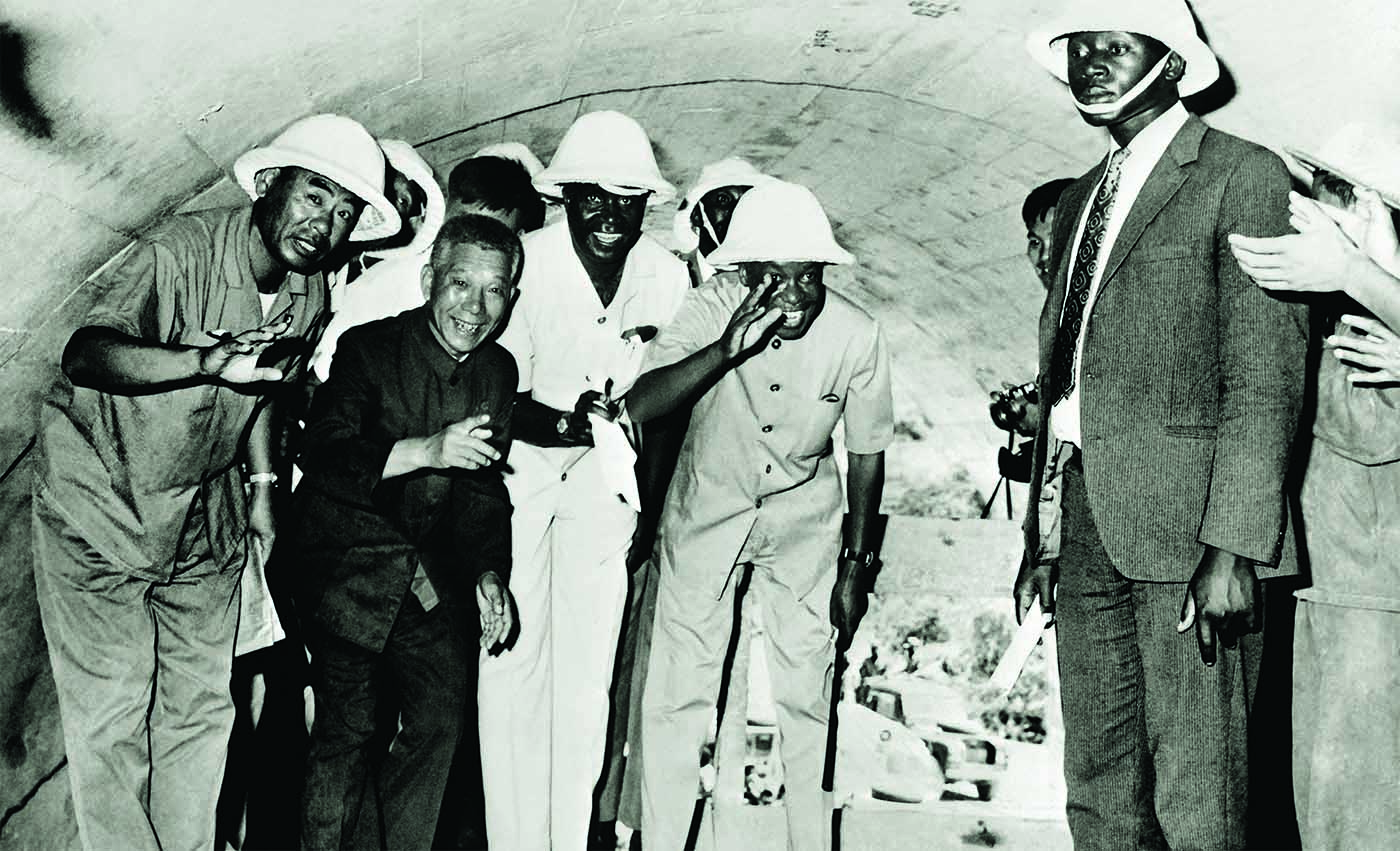
(a) The training of selected individuals as communist leaders; the increase of diplomatic relations by 50% during the last 6 months; [there has been] the impact of their powerful propaganda effort; last but not least, the popularity they have earned, e.g. in Guinea and Mali, by the generous terms which their technical assistance is offered and the simple way of life adopted by the [Chinese] technicians themselves.
(b) The main limitations on the Chinese have been the reluctance of Africans to see the Sino-Soviet dispute projected into Africa; the fear felt by thoughtful Africans that China may be regarding their relatively under-populated continent as an eventful outlet for their surplus millions; Chinese inability to provide large scale economic or military aid; the inherent reluctance of Africans to put out the energy necessary to follow the Chinese pattern of “self help”.
(c) The most effective positive counter-measure to Chinese influence is continued Western economic involvement in Africa and the policy of contributing to the continent’s economic development through trade and aid. Britain plays a large part in this. The Commonwealth machinery for continuing consultation is also useful, as are British and Western positive efforts in the field of technical cooperation and information.
[The cable then talked about:] …special information work designed [by Britain and it allies] to expose Chinese and communist intentions and warn Africans of their dangers in expanding in Africa.
[The cable said:]
China’s immediate aims in Africa appear to be as follows:
(a) To establish formal diplomatic relations with a greater number of African countries; 18 African countries still have relations with Nationalist China, against only 14 so far in relations with Peking.
(b) To woo African votes in the United Nations, where the Chinese may now appear to be more keen to be seated than they have in the past admitted.
(c) To promote “Afro-Asian solidarity”, to the exclusion of the Soviet Union; this was a main theme of Mr Chou En-lai’s visit to Africa in January 1964.
(d) To gain the support of African countries in the Sino-Soviet split.
(e) To win African support for Chinese policies in general.
(f) To subvert pro-Western governments which are having difficulty in maintaining their authority; weak central governments threatened by provincial rebellion, as in the Congo, are the obvious target.
(g) To develop trade; the Chinese need fine quality East African cotton to fulfill their present trading commitments, and they have gained an interest in Saharan oil; they have even been prepared to expand their trade with South Africa, although in deference to the proclaimed boycott on South Africa.
[Chinese aid to Africa appeared to be a major concern to the British as the cable talked about China’s “principles of aid” in the following terms]:
They are interest-free and are to take the form of equipment, commodities and manpower; they are said not to be tied to Chinese goods. The Kenyans have expressed pleasure at the relatively unconditional nature of the loan.It is difficult to estimate how much of the Chinese aid offered in the past has been utilised. The fact that much of the Russian aid offered has never been implemented and that there has been considerable dissatisfaction with the Russian goods and services supplied may at present militate in China’s favour.
But the principle of self-help is not so likely to appeal to Africans, who lack Chinese energy and efficiency, and feel that they need capital investment rather than exhortations to hard work from non-Africans.
When President Nkrumah of Ghana dwelt on what Africans could learn from China’s “do-it-yourself” methods, it was probably Chinese aid and technical training that he was seeking, rather than advice on economic planning. The Chinese may therefore win some friends in Africa through their aid and technical assistance, but will probably be disappointed if they expect Africans to apply the principle of “self-help”.
[Under a sub-head, “cultural and educational exchanges”, the cable said] the Chinese effort in this field is small in comparison with that of the Soviet bloc. There are of course even greater language difficulties for African students in studying in China than in Russia.
[Then came the rub: how Britain and its allies could checkmate China in Africa. Under the heading, “British counter measures”, the cable made the following suggestions]:
Counter measures can be divided into two categories. First, the direct manifestations of Western interest and activity in Africa. The greater the scale and success of these, the greater is the likelihood of their preempting Chinese activity. Foremost among such measures is the continued commercial involvement of Britain and her Western allies in Africa, particularly on realistic industrial development projects; the expansion of aid-through-trade (as outlined by Mr Edward Heath at the Geneva conference), and the continuation of aid proper should help to prevent China making political capital out of the gap between developed and underdeveloped countries.
The continued use of the Commonwealth machinery of consultation at all levels, including the highest, is another positive way of preempting Chinese influence. Other specific and positive measures include:
(i) Technical assistance, channelled through the Department for Technical Cooperation and primarily geared to the Commonwealth, although a modest effort is now being made in the ex-French territories.
(ii) The Information Services (of the Foreign Office, Commonwealth Relations Office and Central Office of Information) which involve the overt exploitation of mass media both centrally and by officers in the field.
(iii) BBC Services (external broadcasting services and English language courses), which will be substantially augmented when the Ascension Island station opens, probably in 1965.
(iv) Visits – an important and growing programme of sponsored visits by Africans to the United Kingdom (both official and through non-government agencies).
(v) The British Council, which currently spends over £1 million and has permanent establishments in 23 African countries (including some not yet independent).
(vi) Voluntary Services Overseas and other bodies cooperating in the “Lockwood Scheme”, under which about 600 graduates and school-leavers are at present working voluntarily in Africa on temporary jobs connected with teaching, agriculture, medicine, administration and social services.
(vii) Students in the United Kingdom – there are approximately 20,000 African students in the United Kingdom (compared with approximately 4,000 in all communist countries put together).
The second category of counter-measures consists of information and related work undertaken by Her Majesty’s Embassy with the specific purpose of checking the spread of communist, including Chinese, influence in Africa. This is largely channelled through [the] Information Research Department which supplies posts in Africa with material and suggestions to be passed to local authorities [and] leaders of opinion.
[Thus 50 years ago, the same concerns expressed by the West about China’s influence in Africa, and how to counter them, were as prominent as they are today. Nothing has changed.]