David Anderson is a historian, researcher and author whose book, Histories of the Hanged, is a seminal work on the Mau Mau’s liberation struggle in Kenya, and the colonial administration’s brutal response to the demand for independence. Stephen Williams interviewed him.
For a start, could you talk about the background on how you got involved with Kenya and the Mau Mau story?
Well, I first began research in Kenya in the late 1970s as a doctoral student doing my thesis research. But I didn’t start working on the history of the Mau Mau period until the mid 1990s when I discovered some archives within Nairobi on legal trials of Mau Mau suspects in Kenya, and I used those materials in writing ‘Histories of the Hanged’ that was published finally in 2005.
But in the late 1990s, I began giving public lectures and talks on the sort of atrocities that occurred during the campaign. Then in 2000, I was first approached by the Mau Mau veterans’ association and then by the Kenyan Rights Commission to get involved in the legal case.
So I talked to them in 2000, but I did not at that point get involved in the case. I used to write from time to time and I helped them as best as I could but I was not directly involved. And then in 2010, by which time the legal firm Leigh Day had taken over the management of the case, they approached me to ask about doing a statement for the court.
By then I had been in discussion with Leigh Day about trying to trace the documents on the case that I suspected were somewhere in the UK. So Leigh Day made a succession of applications for these documents but they were all rejected.

So eventually I was asked by Leigh Day to write a witness statement for the court that would identify what I knew about the records, and how I knew that they had been moved to Britain. So I did that in November 2010, and that was what led directly to the discovery of the Hanslope Collection in January 2011. The reason for that was that the court had ordered people to make full disclosure on the basis of my statement. And at that point, having spent literally two years denying that any documents existed, the UK government made the Hanslope disclosure.
Do you think the UK government was reluctant to part with the documents or to give you sight of them? Or was it a case of the right hand not knowing what the left hand was doing?
I think that knowing the way our Freedom of Information Act operates in the UK, government departments have literally two-dozen different excuses that they can make for not locating a set of documents. It is very easy for them simply to say, “I’m sorry, we cannot find them”. And that in effect was what the people in our government were doing with these documents.
And the truth was that someone in the Foreign and Commonwealth Office knew exactly where the files were all the time. But they chose not to technically find them! And I think that was a matter of a decision by someone, whether on the diplomatic side or on the records management side, I do not know; but it is impossible to believe that they didn’t know that they had the documents.
How were you so certain that they had the documents?
I knew for certain. There were three very significant pieces of evidence. One was that in the Kenyan national archives, I had found correspondence regarding the dispatch of the documents in 1963, which actually gave me details of the flight they were on, how they were packed, who collected them at Gatwick Airport in London and so on. So that was quite a detailed record.
In the second place, I and some colleagues found some documents in London of correspondence between the British government and the colonial government in Kenya after 1963, when the Kenyans had rumbled the fact that the documents had been taken and they asked for them back. And there was a series of correspondence in which the British government lied through their teeth.
I mean, it is well established, that there were three different interventions by Kenya and the British government showed quite categorically that they decided to lie, and there was no doubt about it. I mean Kenya was quite angry about it.
And the last time, it was in the very early 1980s when Nathan Jammah came at that time looking for the documents. And it is well established that the British lied, so I am saying nothing controversial.
The third strand of evidence was rather strange; although the UK government was denying that these documents existed, what we came to know is that the Hanslope disclosure had been used by the foreign office over many years as a reference collection. And from time to time, diplomats and their friends and colleagues had consulted papers with the collection.
I had heard various whispers of this special collection being hidden away in Milton Keynes (a small town near where the Hanslope collection is housed). And that was confirmed to me by a fellow historian, Colin Murray, who was writing a book on the history of Lesotho. Colin had known a former diplomat, a former high commissioner to Lesotho, who arranged for him to have access to materials in Hanslope.
So in very early 2002, 2003, Colin actually went down and saw the documents. And Colin actually at the time called me and told me what he had seen. And then in his book, in the acknowledgements, he describes his visit down to Hanslope Park.
So if ever there was a situation where something was hidden in plain sight, this was it.
Thus, not only did we know that the UK government was lying but we could prove it with documents, as the government had knowledge of the Hanslope archives because they had written it in their documents! We actually had a witness who had seen the damn things! So when I wrote my witness statement, I wasn’t being speculative.
What was the nature of the documents that you uncovered? The reason I ask that is, in your book’s preface, you mentioned that capital punishment cases leading to execution were actually meticulously recorded by the colonial authorities or the courts, and I wonder whether detentions and torture were included in the archives, or was it simply the records of the people who were hanged?
That’s a good question. And it is important to separate two different things. The recordings that were made regarding legal records concerned the fact that in the British colonies, all local courts with capital cases gave defendants the right of final appeal to the British Privy Council. And that remains the case today for many countries in the Commonwealth.
Now what that means in practice is that there has to be somewhere the full record of that case ready to be acted upon, up to the final minute or final hours of the execution. So in every colony, it has usually been the case that capital punishment cases were kept in a separate category. So when I went hunting for the Mau Mau trial papers in the early 1990s, again I knew that they were likely to exist. And sure enough, we found them in the Kenyan national archives. Now those papers however were not copied to London. Only in the case that it went to the final appeal did the Privy Council get the papers. So all those records were in Nairobi.
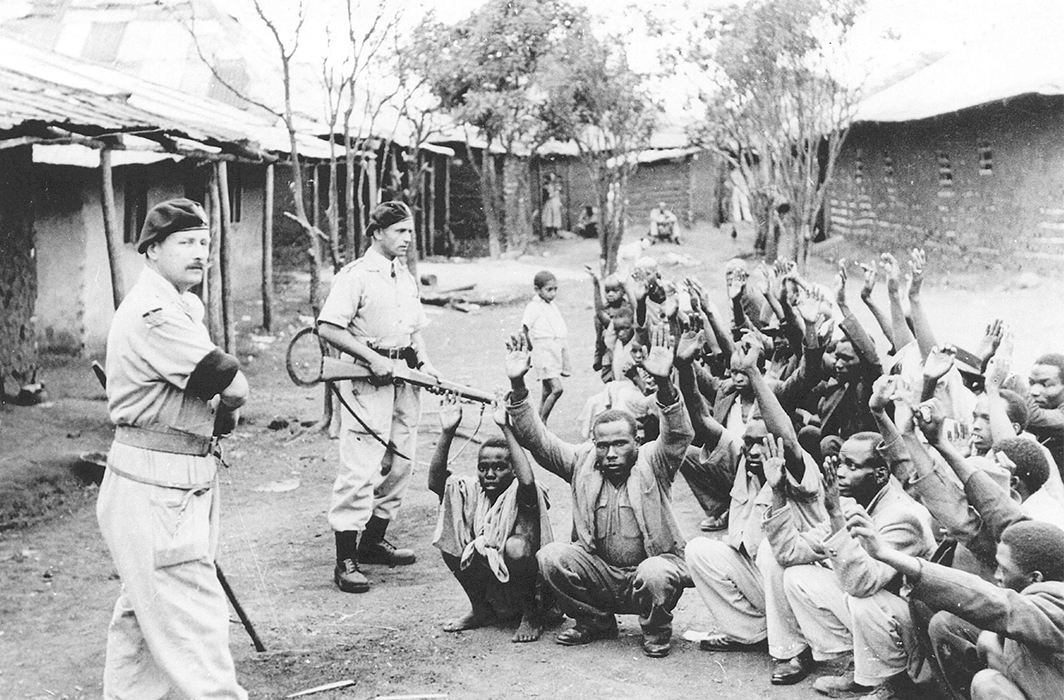
The records that were shipped back to Hanslope, were records that had been moved from Nairobi in 1962 and 1963 and were retained back in the UK. Those records cover a wide variety of topics and subjects, including the implementation of the punishment regime, under the scheme of detention without trial in Kenya.
The British kept those particular records even in 1958 and 1959, on the legal proceedings taken against British officers for those tortures. So there was already anxiety about possible prosecutions, and in fact one of the reasons why the detention system was closed down so rapidly in 1959 and the detainees quickly released, and amnesty issued, was to prevent further prosecutions taking place – because of the anxiety.
So the British took those files back home, partly because they did not want the Kenyans to get their hands on them but also because they wanted to have a record of their things for themselves, should there be a subsequent legal challenge from the Kenyans. But burning them would not have been good enough. They actually wanted a clear record, and the files showed quite clearly that there was a high degree of dissent within the British government about the maintenance of those tortures and punishments.
So there was a debate going on whether this should be done or not. And it had been my suspicion that some of the officers who were involved in that debate wanted those papers kept to demonstrate that not everyone had rolled over.
Were you shocked when you learnt the full story, the extent of the brutality, contained in the archives?
No, by then I was not. I had already been through 3,500 case papers of trials of Mau Mau suspects in which there had been regular abuse of prisoners reported in the records. I had had my sweaty palm moments previously, a few years previously, in the national archives while going through this material.
By the time I got to the Hanslope papers in 2011, I pretty much knew the sort of things that had happened. What was surprising was to see how fully the officials had understood the implications of what they were doing, in the sense that this was not an unintended consequence. They realised that by imposing a system of torture, this was likely to result in serious injury and possibly the death of the inmates. And they took that step nonetheless. They didn’t do so in ignorance.
Have you researched any other archives, specifically African archives?
I have worked in many African countries researching their archives, and this includes South Africa, Nigeria, Ghana, Ethiopia, Uganda, Namibia, Zimbabwe and Malawi.
You have also worked in non-British former colonies. So how does the attitude towards archiving differ from country to country?
There are two ways to answer that question. There are certainly differences in bureaucratic efficiency of different governments, which creates records in the first place. But there is also a difference in approach to archiving.
Some of the richest and most shocking archives of all are from the Portuguese colonies. And yet most will say the Portuguese were not the best bureaucrats. Yet, the point is that when the Portuguese left Angola and Mozambique, they brought back a great deal of archives with them, and so we are getting access to quite significant and very illuminating archives located in Lisbon. But that has got nothing to do with Portugal’s attitude to anything. It just happens to be that that’s what is left. So these things are not down to attitude, they are often down to serendipity.
So I am sure what is behind your question is, are the British more inclined to keep these things than other people, do we document things more? Well, the answer is there isn’t really any way of adjudicating that. We kept lots of the records, yes, but we also destroyed records.
And part of the process of decolonisation, as we know from the Hanslope papers, was that there was a systematic pattern of destruction that was ordered from London. Officials were dispatched from London to oversee this process and there were bonfires in every colony. The British burnt documents before they left.
And has that left a huge hole in understanding what was going on in the colonies?
I think that certainly the historians who worked on imperial history in the later period of the 1940s and 50s are acutely aware of the gaps. I think as a cadre, we are a little shy in discussing the gaps, and we are perhaps not too interested in exploring this. So the short answer is “yes” and the records we now have do not fill all of the gaps but the process of the revelation of Hanslope has allowed us to discuss with greater freedom and honesty what those gaps may mean and what they might imply. And I think we are now having quite a lively and interesting discussion emerging from these stories about what we don’t know as well as what we do know. And that, I think, is very refreshing.
There is talk about archives not being the be-all-and-end-all of historical research, and that you cannot expect to find everything in the archives?
I think that historians have always been aware that archives really give you a particular trace of the past and it has a particular patina to it, and it gives the official mind’s view of what happened, and we need more than that to reconstruct history. But for some topics and some areas, the archival sources are critical. If you take, for example, the records of the Kenyan detention camps, they were all burned, so we still don’t have the records of the camps themselves. I am quite convinced that they were torched deliberately. I have some evidence to support that contention.
Often historians, when they are writing books and articles, if they are professional and have integrity, they will steer away from areas where they aren’t sure of the evidence.
What about the debate around the “special collections”?
The most recent revelations about the special collections also illuminate one or two quite interesting points. Firstly, the truth is that the Hanslope disclosure, as we now call it, was initially at the heart of the special collections. So what we are now calling the “migrated archives” were merely a subset of the Foreign and Commonwealth Office’s special collections.
And the reason that they ended up reviewing the special collections in their entirety this past year was because once the former British foreign secretary, William Hague, decided that the migrated archives should be released, he also instructed the records managers in the Foreign Office to sort out any other irregularly held collections. That order was given to the staff and they had to comply. That’s why we suddenly moved from the relatively small number of 8,500 files of the migratory archives ending up being 23,000.
So what the story of the Kenya papers has done is open up a much wider issue about how government departments keep their records and whether they are respectively archiving them for the public use or not. They should be doing that, but some departments are clearly not doing so in the way they should be. And that also raises some concerns about how departments select what kind of records they keep and what kind of records they destroy. And the discussion of the destruction of files concerning the legal tampering in India is quite revealing on that score. It is said that the file relating to the advice given to the Indian army to destroy the Golden Temple has been destroyed. By anyone’s reckoning that file would be considered historically important. But somebody put it through the shredder. And the point is that it is happening all the time.
The destruction process really requires more oversight, doesn’t it?
I think what it requires is for the keepers of the records to have a more productive role in liaising with departments about what it is they are doing. My understanding is that their role has been diminished.
You mentioned that all the files on the detention camps in Kenya were destroyed. I wonder if there is any evidence that the British authorities learned lessons on how to conduct these detention camps from previous scenarios such as the Boer War?
There is certainly evidence that the British had an understanding of how to run detention camps in the 1940s and 50s. But they learned from one colony to another. There were detention camps in Palestine, in Malaya, in Cyprus and in Kenya. The Kenyan ones were vastly larger and the laws committing people to them in Kenya were far, far looser than anywhere else. But there is definitely a colonial learning curve. However, it doesn’t go back to the Boer War.
There is no evidence to suggest that anyone in the 1940s thought the Boer War was a useful model. But remember that we were just at the back of the Second World War, and lots of camps imprisoned people all over Asia and Europe. The British military had got used to these kinds of things.