Denied the freedom to exhibit their work, a generation of formerly neglected artists nevertheless expressed their personal pain and the collective outrage of a marginalised majority at the policies of the oppressive apartheid regime. Most were black, a few were white; sharing a common commitment to justice, they became the spearhead of modern art in South Africa. Juliet Highet reports.
At Bonham’s auction house in central London in March, a sale of South African contemporary art drew huge attention. Its historical significance was ably expressed in a unique and moving piece of ANC heritage, linking Nelson Mandela to another leader of the armed struggle to end apartheid, Arthur Goldreich.
Mantle for Nelson was the timely pivot of this sale of South African art. An artist and designer, Goldreich was also imprisoned, but escaped jail dressed as a priest. In 1983, while Mandela was still incarcerated, he created this painted collage and raffia hanging, symbolising a mantle for Nelson to “fly” from jail, as if he were on a magic carpet.
“A child understands fear, and the hurt and hate it brings”, wrote South African author Nadine Gordimer. “Censorship is never over for those who have experienced it. It is a brand on the imagination that affects the individual who has suffered it, forever.” This older generation of artists, who had experienced at first hand the daily struggle simply to survive, and were hardly able to sell their art, bequeathed a telling legacy to today’s movement of contemporary South African artists.
This could still be described as “resistance art”. Willie Bester’s father was Xhosa, his mother “coloured”, making him “other coloured” in the obscene classification of apartheid. Like so many of South Africa’s non-white citizens, he and his family endured forced removal from their farm to a “homeland”.
In 1986, Bester attended the famous Community Arts Project in Cape Town, a political organisation that aimed to empower black or marginalised visual and performing artists in the movement towards liberation. He realised that his skills represented a means of fighting back: “I was angry … so I used my work as a tool against apartheid. I didn’t care if it matched your curtains or not. My art was a chance to be heard… I am sometimes tempted to go to the seaside and paint beautiful things from nature. But I don’t do it, because my art has to be taken as a nasty-tasting medicine for awakening consciences.”
He uses township rubbish to retrace the political history of South Africa, his assemblages built of bones, newspaper clippings and tin cans, barely concealing threats to life, as in his A Tribute to Steve Biko (1992). Although George Pemba never positioned himself as a political artist, he joined the ANC in 1945, and when the Nationalist Party came to power in 1948, anchoring and reinforcing discriminatory legislation, inevitably the impact of apartheid on the daily lives of his people began to dominate his work, including their urbanisation, with its degrading and poverty-stricken consequences.
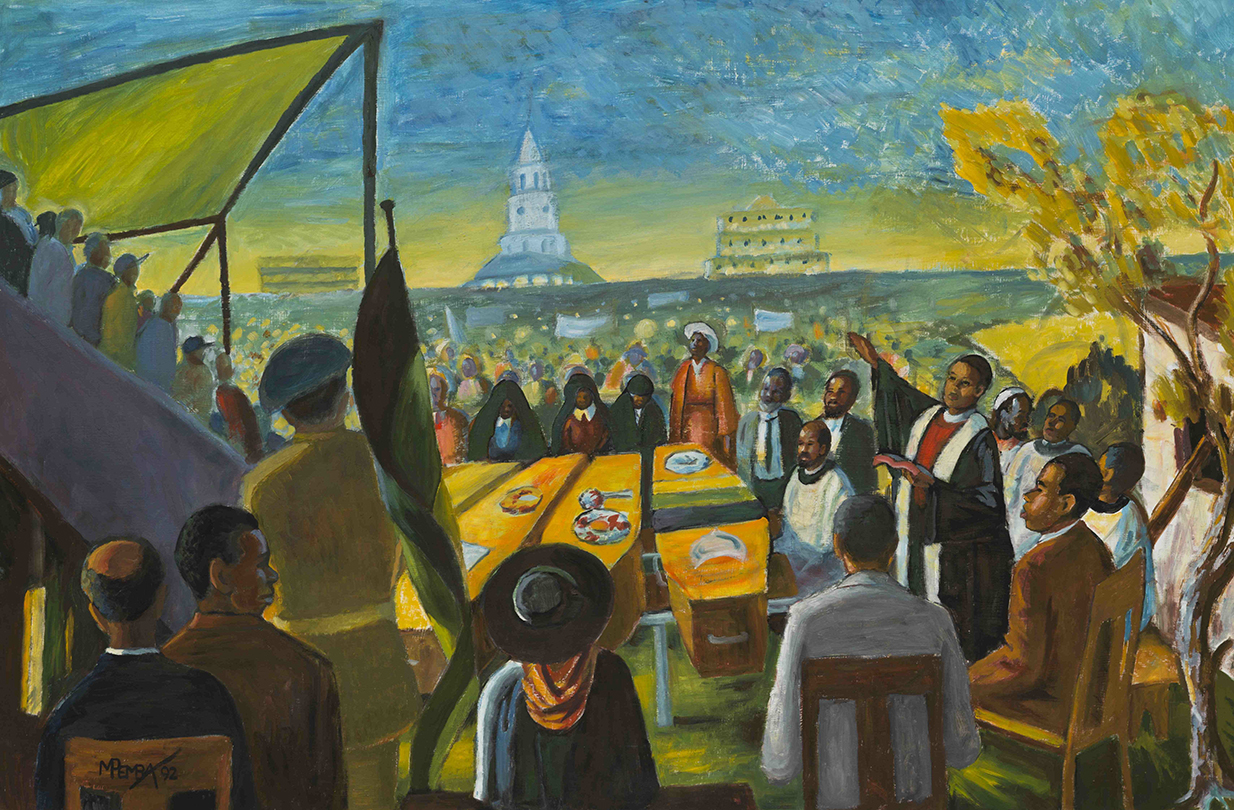
“Sometimes I paint to express pain and sorrow, like the train massacres and life in hostels,” Pemba says. His painting Bisho Massacre Funeral depicting a mass funeral for its victims, is solemn, emotionally subdued, giving poignant dignity to each mourner. The artist and film-maker, William Kentridge, was born into a wealthy Johannesburg family, descendants of Jewish refugees from Europe’s pogroms. For generations the family has been deeply involved in politics and human rights issues.
His work explores themes of conflict, loss and reconciliation, cultural and personal memory. “I was six years old and my father was one of the lawyers for the families who had been killed (in the Sharpeville massacre). I remember once coming into his study and seeing on his desk a large, flat, yellow Kodak box … Inside were images of a woman with her back blown off, someone with only half her
head visible.”
Using the metaphor of the box, as in Black Box (2005), he has constantly re-examined South Africa’s recent history, the light and darkness that are outside and within it – the box and the history – the essential incompleteness of its victims and of those who engage in this victimisation.
Kentridge’s work Domesticate the World refers to the domestic arena, the chief place of contact between black and white people. Firmly imprisoned in a tight box, an apparently naked white man is curled up, asleep or dead. Kitchen equipment hangs incongruously above him, the whole image conveying considerable unease.
“I am trying to recapture moral terrain in which there aren’t really any heroes but there are victims. A world where compassion just isn’t enough, ” the artist explains.
Earlier, between 1988 and 1989, he produced a group of works titled Casspirs full of love, featuring disembodied heads in the landscape or packed into cabinets. Casspirs were armoured military vehicles deployed to townships permitting police to open fire on unarmed civilians in order to “keep the peace”.
The title is ironic – a message Kentridge heard on a radio programme from a mother to her son in the South African security forces: “This message comes to you from your mom with Casspirs full of love”. Kentridge had a magnificent Head in the sale, a painted print overlaid with torn shards, the African male head tilted back with eyes closed, like a death mask.
Another of the older generation of black South African artists, David Koloane, describes the difficulties for them under apartheid. In 1989 he wrote: “How effective a role can the artist play within the community, in an environment devoid of any creative infrastructure such as museums, galleries, tuition institutions, where all such facilities are located in the affluent and privileged section in a racially divided society?”
Koloane is one of the founder members of the Fordsburg Artists’ Studios, now known as the Bag Factory, which when it opened in 1991, provided the only dedicated space for black South African artists in Johannesburg, and still plays a vital role.
Koloane’s figurative paintings often depict township life with an oppressive, suffocating intensity. He writes: “The commuters leave their homes against a mist of brazier fire, smog and industrial emissions. They return … under a blanket of dark and ominous layers, which hover over the township so much that shape and form become blurred.”
Another leading exponent of Township Art, as the movement came to be known, was Koenakeefe Mohl, who was born in 1903 and against all the odds, recorded much of Southern Africa’s social change during the 20th century.
When very young he was punished at school because he would not stop drawing in class, and then withdrawn from school by his father to herd goats. However, with the help of some sympathetic expatriates, he managed to study art in South Africa, Namibia and Germany.
Back in Sophiatown in 1944, he was one of the first black artists in his country to be involved in art education, establishing his own art school, curiously named White Studio. Then in 1960 he was a founder member of Artists Under the Sun. Although he loved painting landscapes, Mohl is most famous for his township scenes and also, poetic odes to the plight of miners travelling to and from work, faceless and dehumanised.
A white art patron advised him not to concentrate on landscapes, but to paint the poverty and misery of his own people, since apparently Europeans had perfected the art of landscape depiction. Mohl responded: “But I am an African, and when God made Africa, he also created beautiful landscapes for Africans to admire and paint.”
Life in the townships was not all despair and desperation; there was the joyous escapism of shebeens (informal bars) swinging with Township Jazz.
One of the leaders of the Township Art movement, Dumile Feni, loved this music, and dancers whirl in his drawings and sculpture. However, his concentration on people eloquently betrays their tension, pain and anger – in taut muscles, contorted postures, clutching fingers and tortured expressions. Eventually totally demoralised by the impact of apartheid, he and fellow artist Gerard Sekoto emigrated, never to return.
Sekoto died in exile in 1993, the year before Mandela became President. For 46 years in Paris, cut off from his roots, he reached back into his South African past. One of the paintings in this sale, his The Family on the Road, is a sombre tribute to black experience in a divided land.
Ernest Mancoba also left South Africa for Paris in 1938, where he died in 2002, aged 98. The creative freedom of Paris enabled many a black artist and musician to work – and think – freely. Still in South Africa in 1929, his sculpture Bantu Madonna had created a scandal due to its depiction of the Virgin Mary with “negroid” features.
Mancoba’s often abstract painting, in tune with the prevailing European art styles, also called on his deep identification with African spirituality. In particular he drew on ubuntu, describing its philosophy as: “A human is a human by and for other people.” Having been ignored in art historical terms for most of his life in his homeland, after the end of apartheid, Mancoba was honoured with large retrospectives at the National Gallery of Cape Town and the Museum of Modern Art in Johannesburg.
Another early township artist, Lucas Sithole, born in 1931, stayed in South Africa, creating sculptures full of humanity and empathy. Working in wood, stone and liquid steel, some of his work is elongated, elegant yet powerfully emotive. They are my best friends appears to depict someone severely malnourished. It resonates with compassion. I am very very tired is permeated with tenderness. One of his more solid sculptures, this time of a wild animal, is titled I am no longer running, to which one’s heart goes out, so much is it suffering.
Gavin Jantjes’ prints, posters and collages are different – they are heavy-hitters provoking the viewer to address the searing effects of the brutality and humiliations of apartheid.
His series A South African Colouring Book has titles which could have been drawn from children’s books, like Colour This Whites Only, and Colour These People Dead. One print, titled Colour This Labour Dirt Cheap, shows a black woman on her hands and knees cleaning toilets marked “For Whites Only”. A writer as well as a visual artist, Jantjes expresses how others have defined Africa: “We were experienced, not appreciated. Colonial archaeologists, ethnographers, and anthropologists who studied each segment separately from each other painstakingly dissected our cultural body… African art, like slaves, was used to enhance the development of other non-African cultures… it became the catalyst for the most fundamental change in European art history.” (Think Picasso, Braque and Brancusi.)
Jantjes continues: “Our art, both traditional and contemporary, is not the conglomeration of characteristics, curiosities or things. It is the superstructure, the dynamism and creative potential of a culture that nourishes creative expression…
“Creativity is our domain. It is action toward and for fuller humanity… Oppressors have never been creative. Clever, yes, but never creative.”
Skip forward two decades and relish Return of the Exile by Helmut Starcke, a large, dramatic painting. On eagle wings, like an avenging angel, the exile descends from the sky.
Though powerfully built, his rib cage is skeletal, his eyes agonised, his mouth open as though shouting. From a belt round his waist hang useful tools for reconstruction, such as pliers and a hammer. What kind of angel is he? Of reconciliation and redemption, or retribution?
The end of apartheid and Mandela’s monumental contribution gave Africa and the world immense hope. On the arts front there is cause for optimism – it’s rocking. Many artists, once exiles, have returned home with the conviction that culture can and must play an important role in Africa’s future.
Exiled artworks too are returning. During the apartheid era, many expatriates sympathetic to the black cause bought its art because they liked it and thought it was good. Some exhibited it in their homes, a boon to the artists for whom a sale was enough to sustain them and their family for a considerable time, and enabling them to buy fresh art materials.
These art lovers, who were also bringing township musicians to embassies for regular jazz sessions, included an Australian diplomat named Diane Johnston, who showed drawings by Michael Maapola to guests in her apartment.
She was evicted, the apartment ransacked. Worse was to happen to Maapola, whose drawings of police violence and prison scenes recorded the ugliness of apartheid at its peak. He was imprisoned, and his studio, full of paintings and sculpture, was torched.
Among the increasingly concerned expatriates and diplomats who were buying Township Art and exporting it, was Bruce Haigh. “We could – and should – have grabbed everything, because we didn’t know how much the security police was wrecking.”
Now, decades later, these collectors are giving art back to South Africa, helping to restore an important part of the country’s historical record.
In that momentous year, 2004, a non-profit group called the Ifa Lethu Foundation was set up to retrieve apartheid-era art, film, memorabilia and oral histories from around the world. Its chair, Mamphela Ramphele, former partner of Steve Biko, has obtained financing from the government and various companies significant in the country’s economy.
Commenting on the return of many collections spirited abroad, including of his own work, Michael Maapola said just two words: “Exciting, exciting.”
During the direst days of apartheid, Gavin Jantjes declared: “One makes art with genuine optimism, with the belief that someone is going to understand, is going to accept one’s expression as essentially philosophical, political, historical and artistically truthful.
“If one does not have this belief, why make art? I am addressing humanity in its fullest conceptual meaning which implies its ability to transform the world and make it more humane.”