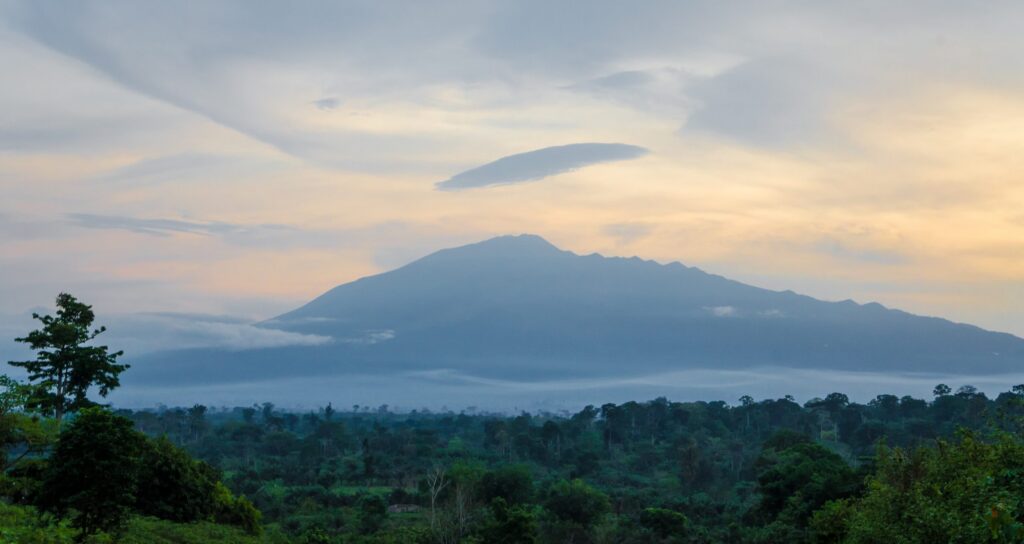
In race, which is where we all emanate, it is absolutely essential for human equality that all can meet at the mountain top. My search on relationships between Black Africans and Black Americans, on which I embarked all but half a century ago, was, as it happened, the start of self-knowledge.
It was very early in 1965 that I journeyed to the United States of America for the first time, to the city of New York. Even writing that city’s name now, brings me back a heady excitement across the years! In some ways I must have been somewhat of a callow youth, although I had stayed in London a couple of years before, and had also been to Nairobi in Kenya (hardly a metropolis compared to London and New York, but very big in our East African terms).
Indeed it was while working in Nairobi that an invitation from the Farfield Foundation came, to attend a 10-day seminar. True to those times the Foundation proved to be CIA funded, as had been the case of the famous magazine Encounter in England, and perhaps a myriad of others.
But even had this CIA association been known to me, I would still have gone. If the spy-body was going to do its business in this laid-back fashion, where was the pain? To this day I would likely take the same view; although we have since heard of the exploding cigars with which they were hoping to entice Fidel Castro of Cuba. To say nothing of the more hugely explosive stuff for Libya’s Muammar Al Gathafi half a century later, which in the end more or less helped to finish him off!
Landing in New York was rather pulverising to the spirit; the city immediately gobbled you up, with you helpless to resist, and its tempo was dizzyingly fast. No, it wasn’t until a couple of months later that I semiconsciously began to pick up its rhythm and go with it, that I truly came to know New York: to feel it; and how by doing so other cities knelt before its presence. The original trip had only been for a couple of weeks; I kept extending it, to nearly 11 months!
One of the principal reasons for this was that I got interested in what in the early 60s came to be called “Black Power”. The spinoff was the slogan: “Black Is Beautiful”. Who first thought of it? It was powerful, beautiful, arresting: it made you pause in your tracks. And, of course, it was true! Now perhaps these words have become “Square”, “Un-cool”, “Too much”. I don’t care!
Mention the words and I am wafted back: to 1965, to New York, and, after I arranged my trip all over the States, to: Syracuse, Buffalo, Chicago, Washington, Iowa, Madison, Colorado, San Francisco, Los Angeles, Jackson Mississippi, Little Rock, New Orleans (these names as I write come off my tongue as if I had memorised them, or visited and revisited them, but not so; for most it was one-offs, but somehow I never unpacked them from my suitcase of discovery).
How I arranged this trip was to go to Life magazine and raise my idea of traversing the United States, talking to American Negroes (as they were then called) everywhere I went, to see what they thought about any connection between them and Africans. Should I meet any Africans on the trip I would put the same question. As I wrote in my article on my findings, nearly 50 years ago, the trip ended up by being a Journey of Discovery, not least of myself. It was a turning point in my life.
For in the event, by the time I returned to New York from my travels, at which I was eager to make more contact with people with whom I was increasingly identifying, I found what I sought, and more. For I had discovered dark hitherto neglected corners in myself. Before coming to America, I had never realised to what an extent the unity of black people was necessary to gain (or re-gain) the dignity of our race.
Life, in the form of one of its editors, Dave Manness, took to my idea swiftly. I can even today remember my excitement, my incredulity, at how such a big fish as Life magazine had been so easily landed. As in fishing it might prove a long time before the fly re-did its magic; if ever! Sometimes I look back and wonder what at that particular time made me pick this subject; or even (I am being serious!) what made the subject choose me!
True, I had met some Black Americans in Uganda, when during my final year at Makerere University, a very few came (the huge majority was white) in the programme, Teachers for Africa, to be sent around the country teaching in senior schools. If there was, which I doubt, any special attraction between those black visitors and our black country, I was hardly aware of it.
But a half decade afterwards, here I was in America, precisely in New York, and, unknown to me, in this city there was Harlem, where the American Negroes lived their lives, in various stages of want, very many in penury. Perhaps one day I was driven through Harlem, not totally unlike going to the cinema, or, God forbid, a game park! Then one night somebody said, “Come party in Harlem,” and it sounded like unfinished business.
Nothing might have evolved. But in the event, enjoying the people and their atmosphere, it was as if in my soil a seed was planted; which could not but grow. And so I went to Life and my scheme was accepted. (As it happened, because of massacres in Uganda, I lost the plot. But the article appeared in UK’s Race journal in 1967. You can find it at www.onemansweek.com).
I truly didn’t know what to expect. Some Ugandan friends hadn’t seen merit in my journey; the growing number of Black American friends, in New York, and on my trip (especially on my trip) had been keener. For, by the time I set off, I was already preaching the Gospel of Black to Black: African to American. Perhaps time makes me more certain now than I really was. But my great excitement, as in Mao Zedong’s first step of a thousand miles’ journey: that had me by the throat!
I must say most places I went, especially when the Brothers and Sisters knew what I stood for, it was like light filtering through fog, and mostly as One People. I remember especially in Madison County outside Jackson, Mississippi, a working-women’s group making me there and then a rudimentary shirt of startling green that could not fail to be beautiful. These ladies and I seemed to be holding hands across time and distance. Of course, there were some American doubters of this closeness between Black Africans and their kin who had spent centuries in a foreign land when brought across the Atlantic as slaves. Some of the doubters were famous. James Baldwin, author of strong fiction, but also a powerful polemicist, including the early 60s’ The Fire Next Time, went to Ghana looking for any spark among Africans. He found none (which was okay) but wrote in very disparaging tones about any possibility of it. From that day to this I have never read another book of his.
I cannot finish without mentioning sport. In fact because of South Africa’s apartheid policies, I got the opportunity to play in the First World Cricket Cup in the UK in 1975. South Africa was barred and a Combined Team from Kenya, Uganda, Tanzania and Zambia substituted. (Part of me almost thanked apartheid!)
Before, in 1963, I had watched the great cricketer Sir Frank Worrell captain the West Indies in the twilight of his career. With a hand here, a finger there, he controlled his mercurial players like conducting an orchestra. It was the true birth of the Windies modern era. It was the first time I saw Garfield Sobers, the game’s all-time greatest all-rounder.
To be mingling, in 1975, with these heroes was a gift from God. Within a decade the West Indians, under Clive Lloyd, had become arguably the greatest warriors ever seen on the cricket battlefield and went without a series-defeat for the next 15 years; latterly under the fearsome batsman Vivian Richards. No wonder some philosophised that cricket was like life, only more so! See the film Fire in Babylon by Cowboy Films.
The point is that with mainly black West Indians rising to these pinnacles, they served as heroes reaching pinnacles to which others of their race (and any race) would aspire. For a people who had been downgraded for centuries around the known-world, nothing could better raise the rallying cry of togetherness-as-one. Probably nobody today serves the purpose of role model better than the fantastic sprinter, Usain Bolt. At that elevated level, those attaining it belong rightly to the Whole Wide World, in addition to a section of it. But until they get there, those of racist mode find it difficult to picture them in such positions. In race, which is where we all emanate, it is absolutely essential for human equality that all can meet at the mountain top.
We were already learning in Africa that for our continent to grow apace we had to work as a unit, difficult though that might be to put in practice. But to reach elsewhere to others of our kind, was new to me. My search on relationships between Black Africans and Black Americans, on which I embarked all but half a century ago, was, as it happened, the start of self-knowledge. Without in any way segregating against other races, which is sinful, I find myself still travelling the journey!