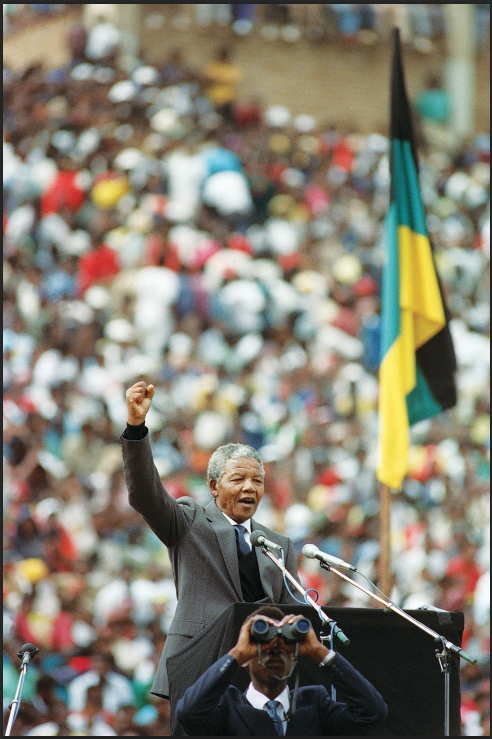
So how does one write about Nelson Mandela without name-dropping or being banal? It is almost impossible! writes Xolela Mancu, author of the book – The Meaning of Mandela.
The banalisation of Nelson Rolihlalha Mandela of course lies in the repetition of what is otherwise true – his reputation as a man of reconciliation. Nothing wrong with that, but it is often at the risk of reducing Mandela into a one-dimensional man. At its best the banalisation inspires us to celebrate a man that both Helen Zille and Jacob Zuma – only Madiba could make those two sing from the same sheet – have rightly called the greatest South African ever, each in his own colourful way of course.
At first blush there is no getting around the banalisation. In 1997, I travelled to the other end of the earth in northern India at the invitation of Indian activist Bunker Roy. Bunker, who founded the Barefoot School in Tilonia I Rajahstan, introduced me to a group of men who seemed to live in a bygone era, hardly dressed and barely capable of speaking English. I had never seen such poverty in my life, let alone the sense of alienation.
I decided I should do a thought experiment to see if they were really of this world. I asked them if they had ever heard of Nelson Mandela. Even if they did not understand everything else I was saying, they nodded in recognition of the name. That is when I recognised that we had in our country, not only the greatest icon in the world, but possibly the most recognised icon in modern history. I won’t go into ancient history for fear of offending religious sensibilities.
This sense of Mandela as a global icon was confirmed a year later. I was a Visiting Scholar at Harvard University, the same year that the university called a special assembly to award an honorary doctorate to Mandela. This was only the third time that Harvard had called such an assembly – in all of its 400-year history. The first time was to honour the founding president of the US, George Washington. The second time it was to honour Winston Churchill, and the third time it was Mandela. You can imagine how proud I was, as I tried to take up a seat as near to the stage as possible.
And then the man appeared in his ill-fitting suit to uproarious applause by the thousands upon thousands of Americans gathered at the Harvard Yard. Henry Louis Gates Jr. announced the establishment of a new programme in Mandela’s honour at Harvard – the Nelson Mandela Fellows.
These two contradictory experiences confirmed that Mandela had the same impact on the low and the high-and-mighty. In short, he was the very embodiment of a transcendent, global consciousness in a world that had run desperately short, or even out, of such leaders. And so you can see how unavoidable the banalisation can become.
Some years ago I invited to South Africa three distinguished scholars: Wole Soyinka, Cornel West and Henry Louis Gates Jr, to give public lectures on the meaning of Mandela – the lectures were published under the book of the same title. Soyinka warned against the banalisation of Mandela: “The world already knows what he is, and indeed our greatest task these days is to maintain a sense of proportion, and avoid further banalising a symbol that has been stretched to an almost inhuman dimension.” Soyinka wondered what it must have meant for Madiba to be in such a position: “It strikes me as poor reward that even as we continually debate issues of identity, we have moved to deprive a man to whom the world owes so much any lingering sense of his own identity.” But then again, Soyinka concluded, “Mandela probably gave up on that entitlement a long time ago.
Unfortunately, Soyinka’s words will sound particularly prophetic as Mandela’s political and familial will start tearing at each other over who best has the claim to his legacy – politically and, more importantly for them, financially. It’s going to be a sorry sight.
But even those who seek to deprive Mandela of that individual identity for lofty ideals should bear in mind Cornel West’s admonition: “Let us not make Nelson Mandela some kind of icon on a pedestal belonging to a museum. He is a wave in an ocean, part of a rich tradition that raises certain kinds of questions, beginning with our own lives and our willingness to muster the courage to examine who we are as humans.”
In short, let us celebrate Madiba but do so in a way that makes his story relatable and usable to the great majority of people.
Equally unavoidable is of course the name-dropping. Those of us who were blessed to meet him or spend some time with him have our Mandela moments. I first met him at the installation of Mamphela Ramphele as Vice Chancellor of the University of Cape Town, where I gladly learned that he read my columns. I would subsequently have numerous encounters with him including a phone call he put through to me in search of a black consciousness activist he wanted to talk to for a book he was writing. I think it was during the course of those conversations that I convinced him, if he needed any convincing, to do a number of things for the Steve Biko Foundation, including delivering the Steve Biko Lecture at the University of Cape Town. He also obliged to host Chinua Achebe when we hosted the latter for the lecture in 2002.
However, the banalities and the name-dropping can never take the place of real political analysis. What pleases me most about my relationship with Nelson Mandela is that I did not have to grovel to find myself in his company. I responded quite robustly to his attack on black consciousness in an essay he wrote while he was in prison. I was never so awed by Mandela that I held back from my criticism of his ideas about racial reconciliation. In Luli Callinicos’s book, The World That Made Mandela, I am quoted as saying that he gave “a generous reading of the racial situation in this country”. Some of my critical essays can be found on the Nelson Mandela Foundation’s website.
Those essays did not draw Mandela’s enmity, quite the opposite. A man treated like a saint everywhere he turned, appreciated the humanising effect of criticism as an act of love – a quality that has been completely lost on many of those who claim to be his products.
As a social scientist I understand why, his protestations notwithstanding, Mandela had to be elevated above his other comrades in the struggle, some of whom spent as many, if not more years, in prison. His elevation performed a political function. In his seminal work, Democracy in America, the French philosopher, Alexis de Tocqueville observed that during the turbulence of revolutionary periods men are “speedily frightened at the aspect of this unbounded independence”.
“The constant agitation of all surrounding things alarms and exhausts them. As everything is at sea in the sphere of the mind, they determine at least that the mechanism of society shall be firm and fixed; and as they cannot resume their ancient belief, they assume a master.”
Mandela assumed the authority role by assuaging the fears of the whites and assuring black people that he was not going to sell them out. If a man could pledge his own life for our freedom, then surely we could pledge ours to him or to the cause of freedom in his name. To black people, Mandela became synonymous with freedom. The challenge was greater for whites, the majority of whom were raised on a staple of Mandela the terrorist. Put differently, to black people he was the confirmation of an extant spirit of forgiveness or what is called Ubuntu but also a validation of the struggle for freedom. To many whites he was a revelation that he was not a raging terrorist with horns on his head. To some he was a different kind of black man. This is an important distinction because it has implications for how he will be memorialised. The danger is always there that as a “revelation” he will be separated from the rest of the black world. He will be used as the black man who would forgive and forget about the past, and will thus be an instrument to smother critical voices about continued racism and injustice in the world.
But Mandela as “confirmation” would require an acceptance and a celebration of black history and the values of freedom it embodied through him. He was, after all, a child of his people, and a product of their efforts. Understanding and accepting that will make it possible to contextualise our world within the “invisible lineage” – a term I borrow from the scholar Paula Backscheider – of black political thought and struggles for justice. His vision of an inclusive, non-racial, democratic society would be impossible to imagine without those prior struggles. Mandela ‘”never walked alone”.
But even as an authority figure, Mandela had his detractors. Govan Mbeki would not speak to him for years for his decision to unilaterally enter into negotiations with the apartheid government in the 1980s. Mandela also became a lightning rod for debates about the nature of the political transition – and he showed he could be much more ruthless than he ever let on.
If you do not believe me, ask ANC member Pallo Jordan and leader of the United Democratic Movement, Bantu Holomisa, both of whom were booted out of the cabinet and the party respectively for crossing Madiba. Also ask F. W. de Klerk, who received a public dressing down by Mandela for showing bad faith during the negotiations by publicly attacking the ANC.
Mandela let loose on De Klerk in this way: “Even the head of an illegitimate, discredited minority regime as his has certain moral standards to uphold. If a man can come to a conference of this nature and play the type of politics which are contained in his paper, very few people would like to deal with such a man … I was discussing with him until 20h20 last night and he never hinted that he was going to make this attack … and he has abused his position because he did not think I would reply. He was completely mistaken. I am replying now.” It was about time, some of us said.
To pretend unanimity in the Movement would not only be false to history. It would also make it difficult to explain subsequent developments in the political culture, including the turn towards a more radical black nationalism under Thabo Mbeki. Mandela’s biographer, Anthony Sampson described the nature of the contradiction in Mandela: The Authorised Biography as follows: “In his first months as President, he [Mandela] enjoyed a brilliant honeymoon, particularly with white South Africans, to whom this tolerant old man came as a wondrous relief…at the end of the first hundred days in office the Financial Times could find no whites who had a bad word for him. It was a normality which carried its own dangers, as black militants saw the revolution betrayed, and younger ANC leaders including Thabo Mbeki knew they must make reforms which would offend the whites.”
What makes Nelson Mandela a unique historical figure is also that he did not only emerge as a leader, but also one who achieved what the sociologist Max Weber called the “routinisation of charisma”. This is the process by which the leader gets his disciples and followers to transfer their loyalty and commitment from the person of the leader to the institutions of the state, particularly the constitution of the land. Thus many of his promulgations were ruled to be non-constitutional by the very Constitutional Court he had been instrumental in setting up.
Against the objections of his advisors, he obeyed a court order that subpoenaed him to answer to a white rugby administrator who objected to his decisions to transform the all-white sport.
Max Weber had also argued that charismatic leaders existed only in the “process of origination”, after which they disappear. Mandela will most likely be remembered for his decision to step down from office after one term in office. “Don’t call me, I will call you,” he said, as he gracefully and with his inimitable humour, stepped down from office and out of political life. But as Tocqueville put it, when the authority figure disappears “men are no longer bound together by ideas but by interests; and it would seem as if human opinions were reduced to a sort of intellectual dust, scattered on every side, unable to collect, unable to cohere.” Unfortunately, that would become our fate as his successors did everything in their might to undo his legacy.
Now his death has put paid to any hope that some might have harboured that he might still save us from ourselves. Ironically, however, his death can take us back to the time when we used to imagine what life would be like if he were to be released from prison. At that time we were riding on faith, hope, conviction and a sense of purpose. Despite his jailers’ attempts to deprive us even of his image, pictures of him were smuggled out and did the rounds clandestinely in our townships. Despite their attempt to muzzle his voice, we continued to play recordings of the Rivonia speech. Every little boy in the township knew that speech by heart.
In short, the more they kept him away from us, the more we indulged in revolutionary fancy. Someone must have whispered in their ear that were he to die in prison the country would be set on an irreversible course – that they were better off with him outside than inside prison, where he would continue to be the projection of our revolutionary musings. And so they let him free.
That was a smart move on their part for one of his first pronouncements was to call F. W. de Klerk a “man of integrity”. What did he mean by that, the militants amongst us asked indignantly. How could someone we held responsible for the murders of our people in the townships be a “man of integrity” by our own beloved leader? As if that was not enough, Mandela went to Davos and came back speaking a different language, telling us he did not believe in socialism any more. He told the trade unionists to go jump if they did not like that.
How could he get away with all of that? He had something that many progressives do not like to talk about – authority. Without that authority Mandela would never have been trusted by the whites to protect their interests nor by the blacks not to sell them out. Progressives never learned to talk about authority during Madiba’s time, they were even less able to do so when his successors started abusing it. And so we remained in suspended animation, with some of us still calling on him to intervene to call his successors to order. But he knew better. Any such intervention would have undermined the very institutional authority he had bequeathed our country. We would have to find our way this time. With his death he has thrown the gauntlet back at us with a sense of finality. He will not come back to shepherd us through a political breach of our making. He did his part. We should do ours by using the very gift he bequeathed to us all those 27 years in prison – the capacity to imagine a different world. As South Africans we all need to show that we are indeed worthy of him.