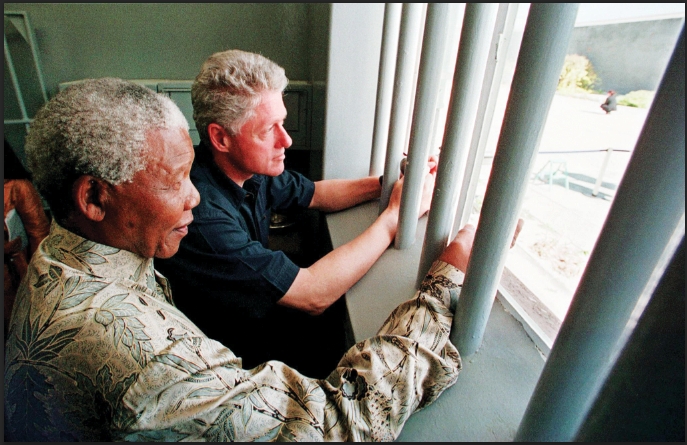
Over the years since his release, Mandela teased visitors with the comment that he was still not free, while pointing a finger at his personal assistants: “And these are my jailers.” We can now pose the question more clearly: To which cultural universe does the personal memory of Nelson Mandela belong? Is it part of the collective memory of South Africans in particular and Africans in general? Or is it part of Europe’s globalising civilisation? This piece by Ayi Kwei Armah, the Ghanaian literary icon, is an abridged version of a review he wrote for the New African on the autobigraphy, Nelson Mandela: Conversations with Myself.
To which cultural universe does the personal memory of Nelson Mandela belong? To the collective memory of the oppressed Africans whose struggle for political emancipation he helped to lead? Or to the memory bank of European civilisation, in whose name the defenders of apartheid declared Mandela and his comrades terrorists, and on whose behalf they arrested, incarcerated, and isolated him for over a quarter century? The cultural world of Mandela’s captors, conventionally called Western civilisation, has over the past millennium grown vigorously, extending its control from its small European homeland to all continents. In the process, it has elaborated an impressive discourse presenting itself as not just European, but as universal.
By contrast, the African cultural universe, the other matrix to which Mandela’s memory might be connected, has little institutional support on the world scale. European culture has publishing houses, film studios, major magazines, websites and transnational broadcasting services to propagate its viewpoints worldwide.
Mandela’s African world has had to fight even for the basic right to vote. So far, it has scant cultural, educational and media power with which to project its claim to world recognition. Hence the inertial tendency even of helpers to integrate into sumptuous institutions of the European universe, instead of creating the new institutions needed for the projection of African memory.
Yet from what we know of African history and philosophy before Africa was turned into a hunting ground for slaves and a reservoir for the pillage of raw resources, African society originally set great value on memory management. That is what Herodotus, father of European history, meant when he described Ancient Egyptians as the most historically conscious of people. It is what foreigners still mean when they describe Africa’s old cultures as ancestor worship. What they mean is that memory management was long an indispensable part of the African way of life. Generations knew how much they could benefit from the experience of predecessors. They, in turn, would add to the common pool of ancestral memory, if they lived well according to culturally useful norms.
For a society’s memory bank is the prime reservoir from which humans have normally fetched insights and inspiration for individual and social growth. The deeper the memory pool available to any group, the more profoundly innovative its members can be when seeking intellectual tools for solving the many societal problems of life and death. Ancient African society preserved its social memory in a variety of media, in architecture and medicine, in sculpture and painting, in temple liturgies and lay music and, above all, in language.
Scholars now take it for granted that Africa has traditions of oral memory dating back thousands of years. Less well known, but increasingly open to research, is the fact that a considerable portion of Africa’s memory bank consists of written texts. The latest to be unearthed come from Timbuktu and Djenne in Mali. The oldest are Ancient Egyptian papyri and stelae, some more than 5,000 years old.
The recognition that the personal memories of exceptional individuals like Mandela form a logical part of a larger African memory pool would stimulate interest and research in that great multi-millennial pool of our ancestral information, now hidden from most because of discriminatory education policies designed in the past to retard our intellectual emancipation.
That large pool of social memory would include the words, ideas and deeds of other liberators like Lumumba, Nkrumah, Malcolm, Cabral, Fanon and Diop, Williams, Douglass and Sojourner, and reach all the way past the medieval states to the time of unifiers like Amenemhat and the prototype of them all, Menes the leader, who unified Kemet more than 5,000 years ago. Mandela is keenly aware of a small part of this general tradition, and he mentions local heroes like Makana and the Khoikhoi Autshumayo with great respect for their record as would-be liberators.
The fact that most Africans cannot now access this ancient pool of knowledge only means that we suffer from induced cultural amnesia. The remedy is serious, organised study, supported by continental African institutes equipped and funded to research all our historical, philosophical, artistic and scientific heritage.
Social memory management enables new generations to know what values their society had, over the millennia, come to consider useful, what it had found harmful, and what behaviour patterns it thought should be avoided, because it saw them as destructive. It is part of the workings of every dynamic society. It was a standard aspect of African socialisation until foreign invasions snapped the links of common memory. Readers with a short view of African history think the first foreign invaders were 15th-century Portuguese, Dutch, French and English sailors. But these were latecomers. Persians invaded Africa more than 2,000 years earlier. They were followed by Greeks (Alexander) and Romans (the Caesars), a little before the birth of Christ. By the fourth century after Christ, Christianity had become Rome’s imperial religion. One Christian Roman emperor, Theodosius, defined Egyptian culture, with its temples, schools, writing system, sculpture, art and pyramids, as a pagan manifestation of devil worship, and banned the teaching of hieroglyphs, Africa’s oldest written records. Africa’s social memory is still numb from that attack.
Arabs were the next invaders. They too called African culture pagan devil worship, and intensified the violent assault on Africa’s social memory. Africans have since then had a rough time reconnecting with the entirety of our social memory, while foreign experts keep trying to persuade us that we have nothing worth remembering, and would do well to integrate our personal narratives into their Arab or European social memory.
Mandela’s memory
We can now pose the question more clearly: To which cultural universe does Nelson Mandela’s memory belong? Like the legacy of all outstanding beings, it belongs ultimately to humanity at large. But where is its cultural home? Is it part of the collective memory of South Africans in particular and Africans in general? Or is it part of Europe’s globalising civilisation?
Verne Harris works at the Mandela Centre of Memory and Dialogue. Answering this question by integrating Mandela’s book [Conversations with Myself, published by Macmillan, London] into the tradition of European memoirs, he gives it a literary structure borrowed from a writer out of European antiquity, the 2nd-century Roman emperor Marcus Aurelius. Question: Is it sensible to model an African freedom fighter on a Roman emperor whose job, after all, was the snuffing out of other people’s freedoms?
Considering Mandela’s life and work, such an option calls at least for a rationale. Harris supplies one, by saying Mandela was “steeped in the classics”. By this, Harris means the European classics. He concludes that Mandela was steeped in them because, he says, Mandela studied Latin at school, and later, at university and in prison, he sometimes acted in Greek plays.
The word “steeped” implies a degree of immersion in European culture not borne out in Mandela’s statements.
Concerning his intellectual achievements, Mandela evaluates himself as a “mediocre man”. By this he means his educational development was so structured that it did not allow him to rise above average levels of instruction. Consequently, he says he is someone who possesses “scraps of superficial information on a variety of subjects”, but who lacks depth and expert knowledge on “the one thing in which I ought to have specialised, namely the history of my country and people.”
Evidently, in his youth, Mandela wished to study African history and culture seriously. But because of apartheid, he could not. However, Mandela sought mentors, to learn about the African past. He listened to knowledgeable elders who “could trace the movements of each section of our people from the North to South”. His mentors would have been researchers and professors teaching African history, philosophy and culture at universities and research institutions. But under apartheid, their information could only be relayed to Mandela through informal channels.
He says no-one ever briefed him “on how we would finally remove the evils of colour prejudice, the books I should read in this connection and the political organisations that I should join if I wanted to be part of a discplined freedom movement. I had to learn all these things by mere chance and through trial and error.”
In case you still wonder what kind of history Mandela dreamed of studying, consider his musings on a short 1962 trip he made to Egypt. He did not go there to study, but went on urgent business: to undergo a crash course in insurrectionary warfare as a necessary step toward dismantling European minority rule in South Africa.
Yet he remembers: “My chief interest was to find out the type of men who founded the high civilisation of olden times that thrived in the Nile Valley as far back as 5000 BC. This was not merely a question of archaeological interest but one of cardinal importance to African thinkers … concerned with the collection of evidence to explode the fictitious claim that civilisation began in Europe and that Africans have no rich past that can compare with theirs.”
In a 1987 letter to the South African university administration, Mandela wrote: “I hereby apply for exemption from Latin on the following grounds. Although I obtained a pass in this subject in the 1938 matriculation examination, and … passed a special course in the same subject at the University of Witwatersrand in 1944, I have forgotten practically everything about it.”
Elsewhere, Mandela also requests permission to substitute African Politics for Latin. Hardly an avowal of deep immersion in the European classics. Patently, Mandela would have loved to plunge his consciousness into the long stream of African history and memory.
His memory managers and publishers, on the other hand, seem content to integrate his memory into the Western cultural universe. This tension surfaces, in other parts of the book, sometimes so subtly a casual reader might miss it.
Mandela is much written about. Readers might therefore expect to find little that’s new here. Yet there are mild surprises. One is Mandela’s stance on the issue of “natural” rulers. Born a Xhosa prince, he might be expected to favour chieftaincy.
On the other hand, his rational politics made him a champion of universal equality. So do his political convictions outweigh his inherited prejudices? Mandela’s response will surprise egalitarians. “We must never forget,” he says, “that the institution of traditional leaders is sanctified by African law and custom, by our culture and tradition. No attempt must be made to abolish it.” Given the sorry record of hereditary rulers in the African people’s spoliation, this sounds odd, but only if we assume that Mandela is a born revolutionary. If such a man was drawn to embrace armed insurrection, the reason lies less in his temerity than in the cruelty of the system he fought to end, apartheid.
Europe and apartheid
Like Nazism, apartheid is conventionally presented as an aberration in European history. In fact, it was part of the worldwide expansion of Europe, the globalising process that replaced the populations of North and South America, Australia and New Zealand with immigrant Europeans, and transferred other people’s land and wealth to European descendants.
In Africa, that European adventure was most intense in Algeria, Kenya, Zimbabwe and South Africa. In the conflict between South African democrats and apartheid supremacists, European nations such as Britain, France and Germany, along with the USA, were not bystanders. They were active allies of the white supremacist regimes.
In a conversation with Ahmed Kathrada, an ANC comrade, Mandela is prodded to remember the moment of his betrayal and arrest. Mandela, disguised and underground, was driving to an appointment with a US embassy contact. The contact tipped off the apartheid security service, and Mandela was taken off to spend 27 years in jail. Here, there is no mention of the embassy’s role. Instead, we are served shreds of misleading gossip. Did Walter Sisulu betray Mandela? Was it Kathrada? Red herrings. It is handled as if it belonged to the field of trivia. The impression this casualness creates is that the struggle is past, no longer a matter of serious attention.
For the decision to integrate Mandela’s memory into the narrative of European social thought seems based on the assumption that with the achievement of the formal right to vote, the struggle for the emancipation of Africans in South Africa is over. Such a supposition would be tragically shortsighted. Deeper than the political struggle lies the pending struggle for economic democracy. It cannot be waged intelligently unless the oppressed know who we are, who we have been throughout history, and what our relationship ought to be to the material and intellectual resources we need for living: the land, the air, the subsoil, and environmental resources of our continent. As long as Africans lack this cultural knowledge, our leadership will continue selling raw materials, raw energy, raw labour, which means they will continue creating poverty and unemployment at home, because they don’t know that Africa has a tradition in which unemployment is unacceptable, land cannot be sold, and resources are not for export, but for use in industry and agriculture involving every living adult in gainful work and shared prosperity.
Mandela’s generation were prevented from acquiring this salutary knowledge of African history. Still, they did a great job for posterity by courageously confronting apartheid and forcing it to concede the political franchise. They thus opened the way to the future, assuming that the vote can be used to create hugely better educational and health facilities. In that sense, they played the special role of the Vulindlela in South Africa, and the Wpwawt in Ancient Egypt. They opened closed waves.
It is for coming generations of Africans to widen the now open ways to knowledge, to spread knowledge of regenerative values, and to use that knowledge to organise our society. Mandela is a master of the sell-deflating quip, a short, Zen-style statement that, by pricking his iconic persona down to a miniature, reveals hidden realities behind the public image. Remembering the decision to adopt armed struggle over 50 years ago, he laughs at how cheaply he was initially outvoted by conservative ANC officials. More funnily, when he wished to recognise teenagers’ contributions to the liberation struggle by lowering the voting age, he was shown in a cartoon that implied he favoured giving the vote to babies in diapers. “I did not have the courage,” says this courageous man, to pursue the matter.
The book Conversations with Myself contains another such insightful quip. “Frequently over the years since his release he (Mandela) has teased visitors and guests with the comment that he is still not free, while pointing a finger at his personal assistants: ‘And these are my jailers.’ ”