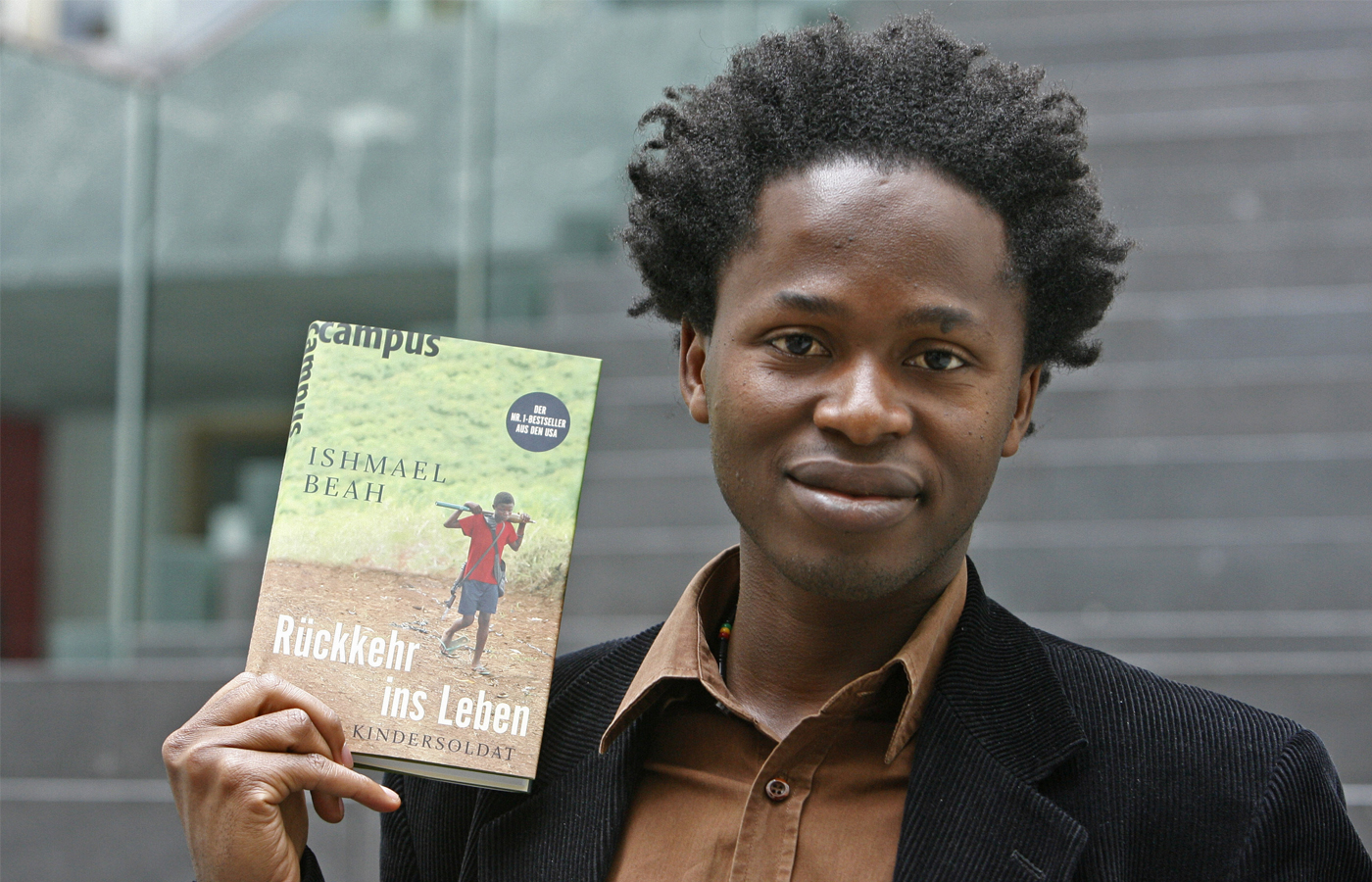
Sierra Leone’s child-soldier done good, Ishmael Beah, has published another book following on from his first in 2007, which detailed his gruesome life as a child-soldier and sold over two million copies. Leslie Gordon Goffe met him in New York at the launch of the new book.
Books about child-soldiers sell well. In fact, they sell really, really well. Ishmael Beah’s 2007 memoir, A Long Way Gone, which tells of his life as a child-soldier forced to kill in Sierra Leone’s civil war and of his escape later to a new life in America, sold nearly two million copies and was translated into everything from Hungarian to Hebrew.
Time magazine ranked Beah’s memoir as the third best non-fiction book of 2007 and applauded Beah for taking “readers behind the dead eyes of the child-soldier in a way no other writer has”.
“The only wars I knew of were those that I had read about in books or seen in movies such as Rambo, First Blood, and the one in neighboring Liberia that I had heard about on the BBC news,” wrote Ishmael in A Long Way Gone. “The first time that I was touched by war I was 12.”
But Beah’s book and other child-soldier narratives have been dismissed by some critics as little more than “disaster pornography”. Author Myriam Denov, an expert on children and armed conflict, said the narratives contribute to a “gruesome fascination with depicting and commercially benefiting from people’s suffering and degradation”.
This criticism, though, did little to dim sales of Beah’s memoir. And now Beah, 33, who lives in New York City, is back with a new book, a novel, Radiance of Tomorrow, which looks at the struggle by Sierra Leoneans to put the past behind them and look to the future after 11 years of civil war which left 100,000 dead and over a million displaced.
“I wanted to look at why people go back after war and how do they move towards a future when the past is trying to pull at them,” said Beah at an event in New York to launch his new book.
So excited are Americans at the publication of Beah’s new book, there was standing room only at the New York book event. One American admirer shouted from the back of the room: “Mr Beah, it is an honour to be in the same room as you and your spirit! Do you have any wise words for American teenagers trying to make sense of the world?”, the man asked.
“I don’t know everything there is to know,” smiled Beah, a little overwhelmed at the status surviving life as a child-soldier has earned him. “Still, I will never write another Long Way Gone. I did that already.”
The popularity of child-soldier stories means it will be difficult to resist. Others in the mini-genre include Senait Ghebrehiwet Mehari’s 2004 story of life as a child-soldier in the Eritrean Liberation Front. Titled Heart of Fire, the book was released in Germany where she lives.
In 2007, the same year Beah’s memoir came out, Ugandan Grace Akallo’s story of life as a fighter in the Lord’s Resistance Army, Girl Soldier, was also published in the US. And in 2009, the story of Emmanuel Jal’s life as a child-soldier in the Sudan People’s Liberation Army, War Child, was published in Britain, where he lives.
“People come to the stories to see and believe that the human capacity to recover is possible,” explains Beah patiently to the audience gathered at the New York book launch. People want, Beah adds, to be convinced that though the human spirit is dulled, it does not fail completely.
A half of the world’s child-soldiers are in Africa, according to a UN report. But children have been forced to fight in wars in Europe and elsewhere since time began. Eight-year-old Momcilo Gavric enlisted in the Serbian army in the First World War. Given medals for fighting, Gavric became a national hero and had memorials dedicated to him.
In the US, the 13-year-old Willie Johnston, who enlisted in the Union Army and fought in the American Civil War, was given the Medal of Honour, America’s highest military honour, awarded for personal acts of valour above and beyond the call of duty.
Beah was, like Willie Johnston, just 13 years old when he was forced to become a child-soldier in the Sierra Leone Army. He didn’t receive, nor would he have wanted, medals or memorials for what he did in his three years as a child-soldier. “I am still alive and living life,” he says happily, “so I am still learning.”
What Beah has learned, too, since the publication of his memoir, is that though more than two million people bought his book, it was not an indication of increased interest in Africa and the problems the continent faces.
Beah realised quickly that if he were to make a difference. he would need to do more than simply write books. He became UNICEF’s first Advocate for Children Affected by War, a member of Human Rights Watch Children’s Rights Division, and called for more to be done to stop the trade in blood diamonds, which has fuelled conflict in many parts of Africa.
“There is so much interest when countries are at war,” Beah said gently, scolding the New York audience. “People wanted to go when the bloodshed was there, but as soon as that stops the attention goes somewhere else.”
With the publication of his new book, the attention is back on child-soldiers in Africa and on Beah himself, at least for a time. This time, though, Beah has chosen to write a novel instead of another true-to-life non-fiction book.
“I felt it was not healthy to write two memoirs in a row,” he says, suppressing a laugh. Asked whether he will change his mind about memoirs, Beah was firm. “I could write only one,” he answered.
His stance has probably not pleased his American publishers. Non-fiction did, after all, make Beah a celebrity and his publishers, Sarah Crichton Books, a lot of money, too.
So, why fiction instead of non-fiction, Beah was asked. “Fiction is more liberating,” he answered, because it allowed him to “play with language” and experiment with Sierra Leone’s ancient oral tradition. “Fiction, too, allowed me to think what it would have been like to be an amputee in the war or feel like to be a girl impregnated. I could not do this in non-fiction.”
Free of the restrictions of non-fiction, Beah has produced in Radiance of Tomorrow a fine work of fiction based in a post-war Sierra Leone where people try to put the harsh past behind them in the hope of a brighter future as they rebuild a war-torn town.
There are child-soldiers in Beah’s novel as there were in his memoir. But these are former child-soldiers, like himself, who have put down their AK-47s and stopped getting high on cocaine and gunpowder. The former boy soldiers want to find their families, if they are still alive and go back to being boys, if it is not too late.
There are elders who want their old homes back, no matter that they are pockmarked with gunshot. They want the land back, too, and set about clearing the earth of the bones of the dead heaped high upon it.
There are amputees in this book and rape victims, and foreign mining companies in the mix, which rape the land and foul the returnees’ precious drinking water.
The stage is set for a difficult transition. Food is scarce and it is not long before violent retribution for past crimes begins.
“There are practical difficulties,” Beah says of life in post-war Sierra Leone. “Yet all of us wanted to go home even when the war was on. We couldn’t wait for it to end and get there.”
Though Beah is a celebrity in the US, and is stopped in the streets by admirers where he lives in New York, he still longs to return home permanently one day to Sierra Leone, which he visits often. “I consider myself a Sierra Leonean with some American tendencies,” Beah laughs. “I am actually making my preparations to go back home and live there because when I am there the smell of the place, the sound, they are intoxicatingly beautiful.”
So, how has he been received there, I asked him. Are Sierra Leoneans proud of his literary success and have one-time child-soldiers like him been forgiven?
“I have been received quite well in some places,” Beah discloses, careful not to overstate the national desire to forgive and forget. “People are still working towards forgiveness and people I have been able to reconnect with have been forgiving.”
So, has he himself been able to forgive those who abducted him and forced him to kill? He answered: “I have also forgiven certain people and there are still some people who do not like the fact that I have come out of that war alive and that I am able to write about it and have opportunities in my life. Some people do not like that.”
Beah’s memoir can be found here and there in Sierra Leone. Not so long ago, he attended a book event in celebration of A Long Way Gone in Freetown. He found it very moving.
“I just sat in the back and I got a standing ovation, people clapped and welcomed me,” he recounts, savouring the precious memory. “I try to make my work accessible so people back home can read and understand that we, from this generation, are not only capable of fighting, we are also capable of other things.”