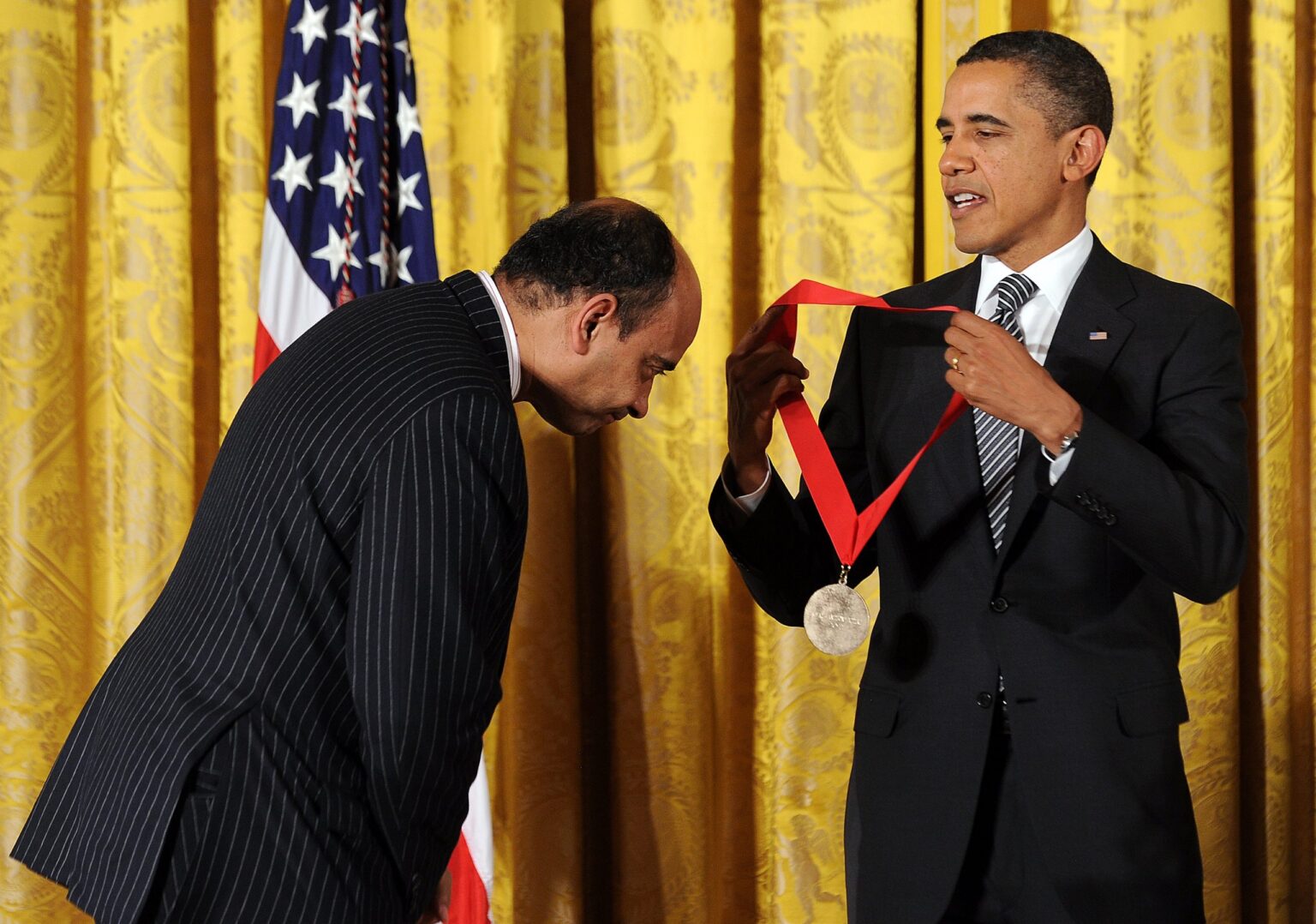
The first African to get a PhD in philosophy from Cambridge University in the UK was of Ghanaian-British descent, named Kwame Anthony Akroma-Ampim Kusi Appiah. A pure genius, Kwame Anthony Appiah, as he is better known, has been described by Stanford University in the US as “our postmodern Socrates”.
On 13 February, US President Barack Obama decorated him with America’s 2011 National Arts and Humanities Medal in the East Room of the White House. Ivor Agyeman-Duah looks back on the life of the Ghanaian who the historian Henry Louis Gates Jnr admits “has the most settled mind of all of us put together”.
In 1962, there was a small palaver at the Okomfo Anokye Teaching Hospital in Kumasi, Ghana’s second city. An eight-year-old boy, Kwame Anthony Appiah, had been hospitalised. The Queen of England, Elizabeth II, was visiting Ghana’s president, Kwame Nkrumah, to see the newly built hospital.
Meanwhile, Anthony Appiah’s father, Joe Appiah, a lawyer and Nkrumah’s roommate in London and one-time advisor, was in jail. Appiah had accused Nkrumah of dictatorship and joined the conservative opposition, offending his old friend.
But Appiah had also married well – to Peggy, a daughter of Sir Stafford Cripps, Britain’s former chancellor of the exchequer (finance minister), who was from a line of distinguished aristocrats. He had helped negotiate the terms for India’s independence.
Appiah lived with his new family in Kumasi and among his extended family, headed by the king of Asante.
When the British Queen got to Anthony Appiah’s bed during the tour of the hospital, she asked, according to one version of the story, after his father. Young Appiah pointed to Nkrumah and said: “This man has imprisoned him.”
Anthony Appiah is not so sure of what he might have said, or even whether he was aware of why his father was in jail. But the opposition and their newspapers had certainly made enough noise about it – much to Nkrumah’s embarrassment.
The Malawian doctor looking after Anthony Appiah, who was conducting the royal hospital tour, was eventually deported. Nkrumah said he was in league with the opposition.
But the controversy of the Appiahs’ marriage was fodder for the international media and partly inspired (with the story of Seretse Khama and Ruth Williams of Botswana) the Hollywood film, Guess Who is Coming to Dinner?
Joe Appiah was a scholar of Roman classics, and wanted to name his son Socrates, against the wishes of his wife. She feared the possibility that if he did not live up to the name, he might become a laughing stock. Finally, he was named after an illustrious ancestor, Kwame Anthony Akroma-Ampim Kusi Appiah. Among the Asantes, Appiah’s people, there is a saying that: “A child may resemble his father but he has a family.” And he grew up to become the philosopher that the mother feared he could not be.
He became not just a philosopher but, as Stanford University in the US referred to him, “our postmodern Socrates”. They said: “Appiah conducts his Socratic interrogations in the language and style of analytical philosophy. The questions he poses and the conclusions to which he leads us are, like those of his ancient predecessor, often deeply disturbing, since they expose the ‘false presuppositions’ and outright ‘errors and inaccuracies’ of our most cherished forms of selfhood.”
In 2009, Forbes magazine listed him as one of the seven most powerful thinkers in the world. In December 2010, Foreign Policy magazine also described him as one of the top 100 global thinkers.
On 13 February 2012 Anthony Appiah was invited to the White House and decorated by President Barack Obama among others, with the highly prestigious National Humanities Medal. Obama praised him in a citation “for seeking eternal truths in the contemporary world. Your books and essays within and beyond your academic discipline have shed moral and intellectual light on the individual in an era of globalisation and evolving group identities.”
Anthony Appiah’s fame and respect are based on critical thinking. When he went to Clare College, Cambridge University in the UK in 1972, after school in Kumasi and in Britain, it was initially as a medical undergraduate. Although he was an outstanding student, he concluded that “medicine was not at all exciting.” During an interview at his home in Pennington, near Princeton, New Jersey, USA, in 2007 he told this writer, in a gale of laughter, “perhaps I wanted to do it as a goodwill gesture towards the Malawian doctor”.
He switched to the more rigorous discipline of analytical philosophy, earning a first class honours degree and a Ph.D – a challenging field even at Cambridge, which is famous for its teaching.
At 21, he began teaching at the University of Ghana where Kwame Gyekye and Kwesi Wiredu were leading African philosophers. But whilst at Cambridge, two people had changed his professional path – the African-American historian Henry Louis Gates Jnr (who would later chair the W. E. B. Du Bois Institute at Harvard) and Wole Soyinka, the future Nobel Literature laureate under whom Appiah studied for his Ph.D. The three would become close collaborators.
It was Appiah’s mother, Peggy, who gave him the ticket money to fly to the US after being convinced by Gates’ arguments that the US was the place to be. He went to teach African and African-
American literature and philosophy with him. Gates told me that while Appiah was still at Harvard, he was the “most settled mind of all of us put together. He was the first African to get a PhD from Cambridge in philosophy. He is a genius and I wouldn’t take a job unless we both had jobs. He is the architect of our revised undergraduate programme and is writing a proposal for the Ph.D programme. No one in my life has taught me more than Anthony Appiah. He is a great man. He gave up tenure at Yale to go to Cornell with me. He left Cornell to go to Duke with me. That kind of friendship is very rare…”
Appiah would later move on, to Princeton, in 2002, as a Laurence S Rockefeller University Professor of Philosophy. Before he turned 50, he did groundbreaking work with Gates including the publication of The Dictionary of Global Culture (1996) and Africana: The Encyclopedia of the African and African-American Experience (1999), sponsored by Bill Gates, on which he was the lead editor.
The New York Times proclaimed it as finally fulfilling Du Bois’ dream, and Nkrumah’s, of producing an encyclopedia of the African experience. A secretariat was set up when Du Bois lived in Ghana to create this, but the lack of funds and leadership led the dream to fail. Though some African intellectuals disputed the model elaborated in the work and downplayed the achievement, none disputed the quality.
It has, however, been through Appiah’s independence that global attention towards him is better understood. His Herskovits Award-winning book, In My Father’s House – Africa in the Philosophy of Culture (a title that Obama said he would have used for his first book had Appiah not already chosen it!) was also a bestseller. Between 2005 and 2010 he published The Ethics of Identity, Cosmopolitanism: Ethics in a World of Strangers (which won the 2007 Arthur Ross Award of the Council on Foreign Relations), Experiments in Ethics, and a New York Times bestseller, The Honor Code: How Moral Revolutions Happen. These works, other books, book chapters and editorial work have been translated into over 10 languages including Chinese.
He is fiercely proud of his Ghanaian-British identity. His views have been appreciated by public policy makers who think that in a world in flux, he is a dependable voice. His father, Joe Appiah, encouraged his children to always remember who they are in the world. “They have names from Yorubaland, from Asante, from America, from Norway, from England. And watching them playing and speaking to each other in their various languages, I, at least, feel a certain hope for the future of humanity.”
Anthony Appiah has also been engaged in controversy. In the epilogue to In My Father’s House, he brought a family dispute into public knowledge when he attacked the wife of the king of Asante, Otumfuo Opoku Ware II, for matters relating to his father’s funeral. He later reconciled and renewed his loyalty to the king as we read in “Whose Culture is it Anyway?”, an essay in Cosmopolitanism.
He also offended the Chinese government when, as the president of PEN American Centre, his powerful letter helped the dissident Liu Xiaobo to win the Nobel Peace Prize in 2010.
Appiah was refused a visa to China but in the Chinese edition of The Honor Code – Friends and Strangers, he reminded them that criticism of China is not based on hatred. His maternal grandmother, Lady Cripps, mobilised, in today’s terms, the equivalent of $150m “to help the Chinese people, but not to interfere in their affairs”.
In 1964, Lady Cripps and her daughter, Peggy, met with Mao Zedong and spent three months helping poor people in that country. On the floor of Appiah’s house is a rug of the Chinese “Long March” given to Lady Cripps by Mao Zedong.
About the Chinese, he has written: “But if you care about your nation’s honour, you have to be concerned when those strangers who are also friends – people who know and care about China – also lose their respect for you.”
Few philosophers have turned what is generally seen as a technical tool into effective public gain the way Appiah has. He has been an advisory board member of the United Nations Democracy Fund and was one of the experts invited by the Commonwealth Heads of Governments that in 2007 authored Civil Paths to Peace: Report of the Commonwealth Commission on Respect and Understanding, chaired by the Nobel Laureate, Amartya Sen.
Appiah is also a former trustee of Ashesi University in Ghana. He is a favourite choice of the BBC World Service and has produced a documentary, Obama: Professor President which in 2009 explored the intellectual influences and ideas which shaped Barack Obama, the scholar and academic.
The Malawian doctor of “conspiracy” fame died some years ago, but he described many incidents of his time in Ghana to his daughter. In 2011, she went from Malawi to Kumasi, Ghana in search of the Appiah family. The family had actually moved, but people showed her where Abena, the philosopher’s sister lives in the upmarket neighbourhood of Nhyiaeso. Abena was very surprised at the recounting of the incidents in their fathers’ lives. When her brother’s name arose in conversation, as it was bound to, she described how he had almost become a medical doctor, but eventually turned to philosophy.
She might have added that he has written a number of detective novels such as Avenging Angel and Nobody Likes Letitia, and he also writes poetry. It is the poetry of a polymath, settled and post-Victorian in its etiquette, as the example reproduced here (two odes to his parents, above left), ably demonstrates.