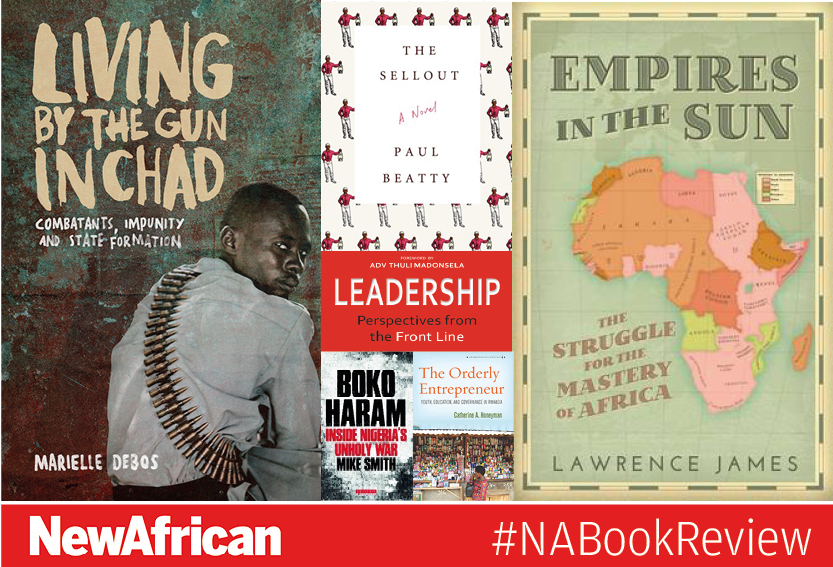

An insurgency in Nigeria by the Islamist extremist group Boko Haram has left thousands dead, shaken Africa’s biggest country and worried the world. Yet it remains a mysterious – almost unknowable – organisation. With rough exhaustive on-the-ground reporting, Mike Smith takes readers inside the conflict and provides the first in-depth account of the violence and unrest.
He traces Boko Haram from its beginnings as a small Islamist sect in Nigeria’s remote north-east, led by a baby-faced but charismatic preacher, to its transformation into a hydra-headed entity, deploying suicide bombers and abducting schoolgirls. Much of the book is told through the eyes of Nigerians who have found themselves caught between frightening insurgents and security forces accused of horrifying brutality.
It includes the voices of a forgotten police officer left paralysed by an attack, women whose husbands have been murdered and a sword-wielding vigilante using charms to fend off insurgent bullets.
It journeys through the sleaze and corruption that has robbed Africa’s biggest oil producer of its potential, making it such fertile ground for extremism. Along the way it questions whether there can be any end to the violence and the ways in which this might be achieved.
Interspersed with history, this book delves into the roots of this unholy war which is set to shape the destiny of Africa’s biggest economy and most populous state.

How do people live in a country that has experienced rebellions and state-organised repressions for decades and that is still marked by routine forms of violence and impunity? What do combatants do when they are not mobilised for war? Drawing on over 10 years of fieldwork, Marielle Debos explains how living by the gun has become both an acceptable form of political expression and an everyday occupation.
Written by one of the foremost experts on Chad, this book shows how armed violence has become both an ordinary form of political struggle and a practical occupation.
Contrary to the popular association of violence and chaos, she shows that these fighters continue to observe rules, frontiers and hierarchies, even as their allegiances shift between rebel and government forces, and as they drift between Chad, Libya, Sudan and the Central African Republic. Going further, she explores the role of the globalised politico-military entrepreneurs and the long involvement of the French military in Chad.
Ultimately, the book demonstrates that ending the war is not enough. The issue is ending the “inter-war” which is maintained and reproduced by state violence. Combining ethnographic observation with in-depth theoretical analysis, Living by the Gun in Chad helps our understanding of the intersections of war and peace. Author Marielle Debos is an Assistant Professor in Political Science at the University Paris Ouest.

The winner of the Man Booker Prize 2016, author Paul Beatty is an African-American writer living in New York. He is the first writer of African descent to win this, one of the world’s most notable literary prizes. The book is a biting satire about a young man’s isolated upbringing and the race trial that sends him to the US Supreme Court.
Born in Dickens on the southern outskirts of Los Angeles, the narrator of The Sellout spent his childhood as the subject of his father’s racially charged psychological studies. He is told that his father’s work will lead to a memoir that will solve their financial woes. But when his father is killed in a drive-by shooting, he discovers there never was a memoir. All that is left is the bill for a drive-through funeral.
What is more, Dickens has literally been wiped off the map to save California from further embarrassment. Fuelled by despair, the narrator sets out to right this wrong with the most startling action conceivable: reinstating slavery and segregating the local high school, which lands him in the Supreme Court.
In his trademark absurdist style, which has the uncanny ability to make readers want to both laugh and cry, The Sellout is an outrageous and outrageously entertaining indictment for our time.
Olivia Williams, one of the Man Booker Prize 2016 judges, commented: “I was banned from reading in bed because I was laughing so much.”

In this compelling history of the men and ideas that radically changed the course of world history, Lawrence James investigates and analyses how, within a hundred years, Europeans persuaded and coerced Africa into becoming a subordinate part of the modern world. His narrative is laced with the experience of participants and onlookers and introduces the men and women who for better or worse stamped their wills on Africa.
The continent was a magnet for the high-minded, the philanthropic, the unscrupulous and the insane. Visionary proconsuls rubbed shoulders with missionaries, explorers, soldiers, adventurers, engineers, big-game hunters, entrepreneurs and physicians.
Between 1830 and 1945, Britain, France, Belgium, Germany, Portugal, Italy and the US exported their languages, laws, culture, religions, scientific and technical knowledge and economic systems to Africa without a second thought. The colonial powers imposed administration designed to bring stability and peace to the continent, which seemed to lack both.
The justification for occupation was emancipation from slavery – and the common assumption that late 19th-century Europe was the summit of civilisation.
By 1945 a transformed continent was preparing to take charge of its own affairs. Through inertia and a desire for a quiet time, Africa’s new masters left much undisturbed, and so this history also pauses to ask, what did not happen and why?

With a foreword by Thuli Madonsela, two internationally recognised thinkers on leadership teamed up with over 80 contributors to produce the most comprehensive and “biggest” business leadership book ever published in South Africa. With 89 contributors, 56 chapters, 1000+ pages in hard cover, the book addresses leadership from every possible angle.
The leadership education and development industry is worth over R500bn worldwide. Yet, trust in leaders is at an all-time low.
Research has shown that the primary reason for leadership failure is a lack of contextual perspective. This is where Leadership: Perspectives from the Front Line is different to the thousands of other leadership books available.
It provides cutting-edge thinking about leadership. It synthesises the latest insights from South Africa’s top leaders and experts on leadership – offering readers practical tools they can implement immediately.
Not only does the book offer a comprehensive overview of the latest leadership insights, it also addresses the specific demands of various sectors of society.
Thuli Madonsela writes: “I hope this book will assist our leaders, particularly our young and corporate leaders, to enable our country to make the much-needed and desired giant leap into the inclusive, prosperous and peaceful future we all yearn for, so passionately.”

The first generation of children born after Rwanda’s 1994 genocide is just now reaching maturity. Watching over this coming of age is a government that is constantly working to align young people’s aspirations with its own voice for national development: a business-friendly yet strongly state-regulated approach modelled on some of East Africa’s most compelling stories of economic growth.
Drawing on ethnographic research with nearly 500 participants, The Orderly Entrepreneur investigates the impact of the Rwandan government’s entrepreneurship curriculum, now required learning in all secondary schools. As Catherine Honeyman shows, “entrepreneurship” is more than a benign buzzword or hopeful panacea for economic development – it is a complex ideal with various meanings across Rwandan society.
Following the policy from design through delivery and beyond, her research reveals how even a carefully engineered project of social transformation can be full of surprising twists every step of the way.
Catherine Honeyman is a visiting scholar at the Duke Center for International Development. She is also the Managing director of Ishya Consulting. Registered in Rwanda and the US, its services focus particularly on the domains of education and youth livelihoods, including the auxiliary areas of policy, research, and evaluation, supporting both governments and NGOs.