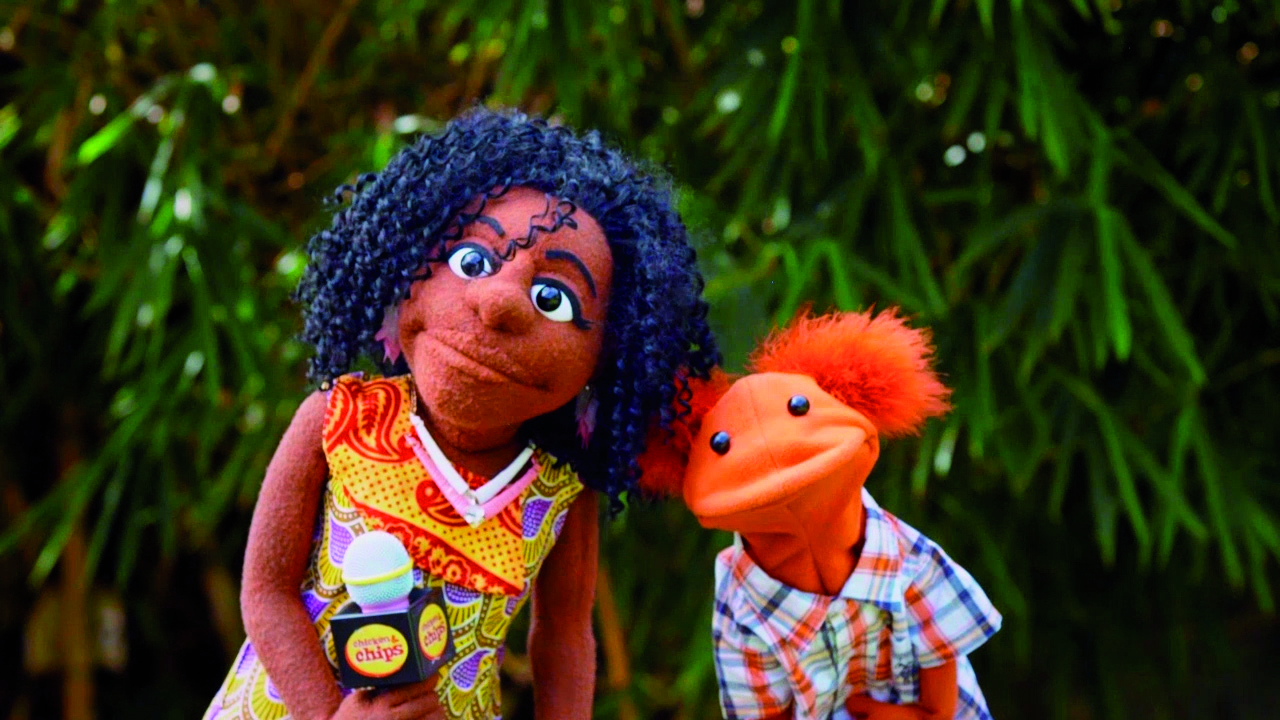
A novel TV puppet show, following in the footsteps of the globally famous Sesame Street and The Muppet Show, is now in its second, very popular season. The puppets use everyday conversation and humour to highlight many social issues that are considered taboo in normal discourse. Bamuturaki Musinguzi reports.
Season Two of Chicken and Chips, a novelty pop culture TV show broadcast on NTV Uganda, started up in February, consisting like season one of an unscripted series of conversations about real life issues using puppets. Airing every Sunday, and repeated every Friday, the show has a huge following.
Produced at Media Innovation Lab (MIL) in Kampala by the international NGO, Peripheral Vision International (PVI), the popular youth series focuses on relationships and combines music and journalism to create a fresh blend of purely Ugandan edutainment, all served up on one plate.
While made in Uganda, some segments are shot in Tanzania. The puppets themselves have been created by the veteran Muppet Show puppeteers in New York. It is a blend of humour and food for thought, aimed at young Ugandans to reflect, engage and enjoy.
Season Two is comprised of 15 half-hour episodes that are, according to PVI, research-driven, and fine-tuned based on audience feedback.
Hosted by a charming puppet, Kiki Love (voiced by the Ugandan Fun Factory comedian and KFM radio presenter Veronica Tindichebwa, commonly known as Tindi), Chicken and Chips brings a new take on timeless topics affecting our daily lives, addresses stereotypes and breaks taboos. “Sometimes it takes a puppet to say what people won’t,” the producers say.
Kiki Love introduces the topics to each episode and the various segments. In doing so, she interacts with other puppets as well as humans – such as a nurse, a pharmacist and university students, among others. Her segments are funny but always carry a social message.
For example, dipping into the eternal battle of the sexes, we see two puppet friends, Tom and Peter, enjoying a meal of burger, roasted meat, chips and soda at the Katwe Corner restaurant while discussing the delicate subject of communication in relationships.
Tom says: “Yeah. They [women] need reassurance, isn’t it?
She will ask you ‘Do you love me?’ today and tomorrow she will ask you, ‘Do you love me?’ Even after you’ve bought her a Mercedes Benz [they will continue to ask the same question]”.
“They are good at sending signals but they don’t really know how to read signals,” Peter replies.
“Absolutely. They’re the worst people in reading signals although they use them so much!” Tom concurs.
“Haha, maybe we need to ask scientists to create some kind of decoder or something. Haha,” Peter adds.
Season One of Chicken and Chips was launched in Kampala on NTV in September 2016. It introduced a collection of compelling show segments, and even more have been added in Season Two. They include Katwe Corner, Popcorn Video, Talk of the Town and the new Social Experiment.
According to the producers, the Katwe Corner segment that features each week is based on audio recorded during real-life focus group discussions held in Kampala. The conversations are then brought to life by puppets in a thought-provoking short-form narrative, with the voices provided by artists from Nafasi Art Space in Dar es Salaam.
The discussions brought to life by the puppets cover topics including love, sex, relationship problems and everyday issues. Earlier pilot episodes focused on reproductive health, corruption, gender roles and diversity.
Katwe Corner was designed in response to the need for an effective vehicle to educate and inform broad audiences. “Although the show includes many uniquely Ugandan references, we hope it will appeal to young people across the East African region,” say the producers.
In the Popcorn Video segment, trivia, humour and useful factoids ‘pop up’ in Ugandan hit videos.
The new Social Experiment segment in Season Two employs hidden cameras to observe and comment on how ordinary people behave when they are confronted with dilemmas or unusual situations that require them to reveal their attitudes and make tough choices.
“As humans we are very sensitive to being watched. It makes us change our behaviour and choices without even realising we are doing so,” Gosia Lukomska, PVI’s Director of Integrated Media, told New African.
“Psychological experiments have shown that even an image, a photo of someone watching us can change the way we behave! And television, well, that is millions of eyes watching you. We wanted as little interference as possible, so that people act as their true selves in those difficult situations we present them with,” Lukomska adds.
“Social media has taught us how to carefully curate the information we present to the world, how to create our image. We wanted as much of the real character of the person to be revealed in the Social Experiment segment. So that we can all do some navel-gazing, reflect and learn from it,” he added.
Unscripted and unrehearsed
The producers do not write scripts or filter and rehearse for the show. PVI’s general manager for East Africa, Reagan R. Ocan, told New African: “This was our initial approach when prototyping and testing the show. But we weren’t getting the content we were looking for. The scripts felt artificial and polished. However, listening to young people freely discuss issues of love, relationships, gender, sex, among others, made us realise all the content is there! Listening to real people’s actual conversations is often much more interesting than listening to a script. That’s why reality TV is so popular these days.”
According to Ocan, Katwe Corner is the most popular segment. “Katwe Corner, the segment where audio from real conversations about love, relationships, sex and health is brought on screen via puppets, is definitely the one that gets the most responses.”
As to why PVI decided on a puppet reality show and not a political satire for example, Ocan said: “We knew we wanted to make a show with educational messages about reproductive health, because this is what is concerning our audience, young people, the most. Everybody at some point will fall in love and face some hard questions or decisions.
“And because Uganda is still a very conservative country, there are many taboos around reproductive health and you cannot just discuss certain matters openly on camera. That made us decide on the puppet format. A puppet can say more than a human (actor or not) would,” Ocan added.
Lukomska notes that Chicken and Chips is a variety show with a puppet component. “We have learned that seeing a puppet next to a real person in one show increases people’s perception of the ‘reality’ aspect of the show. But we’re not the only ones to use puppets in Uganda or Africa. The Simimi show, which is a political satire show based on the popular XYZ Show in Kenya, was another puppet show Ugandan viewers were able to enjoy. The style of puppetry, the subject matter and the overall format were quite different from what we are doing though.”
As to whether there are any similar production prospects in Uganda, Lukomska, said: “I’m not aware of any television productions involving puppets being developed at the moment. It is a very resource- heavy type of production, and it’s difficult to execute in a country where TV stations have very small budgets for shows. But our dream is to see the format replicated more often in Uganda – be it for adults or kids – and in other countries in the region and on the continent. We don’t need to be involved, we’ll be thrilled to be the inspiration.”
Rich history of puppets in Africa
Africa has a long and rich history of using puppets to tell stories. South Africa is host to the largest international puppetry and visual performance festival on the continent – Out of the Box.
Regarding the current state of the puppet television industry in Africa, Lukomska told New African: “TV puppetry, like the one we’re exercising in the show, is just an evolution of a visual performance that has been used in Africa in the traditional cultural context since way back. Ritual masks and figurines are used in religious festivals and community interactions, for instance. So, we like to think of it not as something totally new but going back to the tradition, and giving it a relevant contemporary spin.”
She added: “Aside from in Uganda, the costs of TV puppetry are one of the reasons it’s not utilised so much on the continent in general, with TV stations having limited budgets. But the talent is there, and so is the excitement about the format. We have realised this since following the puppetry workshop we conducted in Tanzania [led by Sesame Street veteran puppeteers], two participants developed and produced puppet shows of their own! One of them, Ubandani, depicts a fictional country in Africa, where citizens are challenged by poor governance, corruption and undemocratic practices.”
These puppets, it seems, are pulling the social strings rather than the other way round. NA