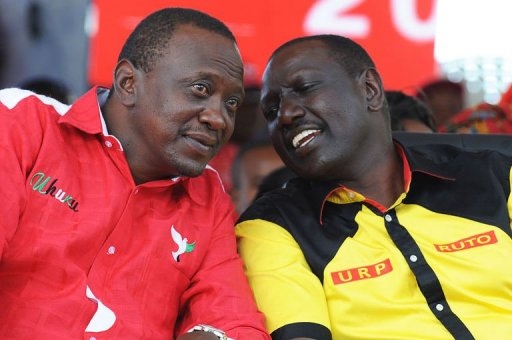
What message are the people of Kenya sending to the world, especially the West, with the election of Uhuru Kenyatta and William Ruto even though they face ICC charges?
The Kenyan presidential election won by the International Criminal Court-bound Jubilee Alliance team of Uhuru Kenyatta and William Ruto, as president and vice president respectively, is pregnant with meaning. It is one of those events that come along once in a decade, defining (and sometimes redefining) the landscape. Let us consider some of the implications. First, the Kenyan people have spoken. What is the message that they are giving the world with this election? Is it that they do not believe that either of the Jubilee Alliance team is guilty of the charges of crimes against humanity and so have not factored this into their deliberations?
Is it that they believe that Kenya should be the place to resolve the issues of guilt and punishment? The way the country pulled itself back from the brink, and put in place a power-sharing arrangement, which then led to progress with the new constitution and the recent peaceful elections shows it has the capacity and maturity to deal with issues of right or wrong, and so, going forward it might mean that the best way of maintaining progress is to have “a truth and reconciliation” style process?
In the meantime, were Kenyans reacting to outside (Western) interference by deliberately choosing the opposite candidate to the one hinted as acceptable?
Whatever it is, choices have consequences, according to Johnnie Carson, the outgoing US assistant secretary of state for African affairs. Meaning that a perverse result remains a perverse result and if countries decide for their own complicated internal reasons to elect leaders accused of serious crimes, then other countries are not obliged to ignore their own values to deal with them. The consequences, however, are not solely for Kenyans.
The consequences in the short term for Western power and policy in Africa, especially American power, have been humiliating. Thinly veiled threats were made (about diplomatic isolation, and even the possibility of sanctions) and the Kenyan people simply ignored them. What will the response now be? Will Kenyatta be treated as the representative of the Kenyan people or will he be snubbed, thereby snubbing the Kenyan people themselves? As every parent knows, it is unwise to make threats/promises without following through. If they follow through, do they not damage their own anti-terrorism, economic and regional interests in the strategic hub that is Kenya?
Meanwhile, the other dilemma faced by the Western countries is deciding which on balance is more important – their “Uhuru” project for freedom and democratisation in Africa (which includes honouring the outcomes of the will of the people) or their project for the “rule of law” (which includes honouring the ICC process?).
Despite the fact that Kenyatta has promised to meet his international commitments to the court, one suspects that the project for democratisation will win out, and over the coming months we will see the ICC charges either collapse, quietly dropped, or significantly downgraded, given that who is charged or not has a tendency to be linked to the wider pragmatic political calculations of the major powers (just look at Syria and Bashar Al-Assad).
One wonders whether the ICC process, already under attack in Africa, could survive the conviction of the Jubilee pair. The most important meaning from the election result, however, is that an African electorate, understanding the consequences, has expressed its free will and is insisting that this be respected. Will the Kenyan and African human rights lobby listen to what Kenyans have to say, even though they may not like what they hear? Ditto, will the Western countries listen to what the Kenyans have to say, even though they may not like what they are hearing?