African immigrant workers marched across Europe to draw attention to the exploitation of their labour by unscrupulous European employers. They also want EU governments to regularise their stay. Santorri Chamley reports from Paris, where the march began in early June.
On a sunny morning in early June, a large group of mostly West African undocumented workers assembled at a square in central Paris to prepare for an unprecedented, month-long march for mass legalisation of undocumented workers across several European Union states.
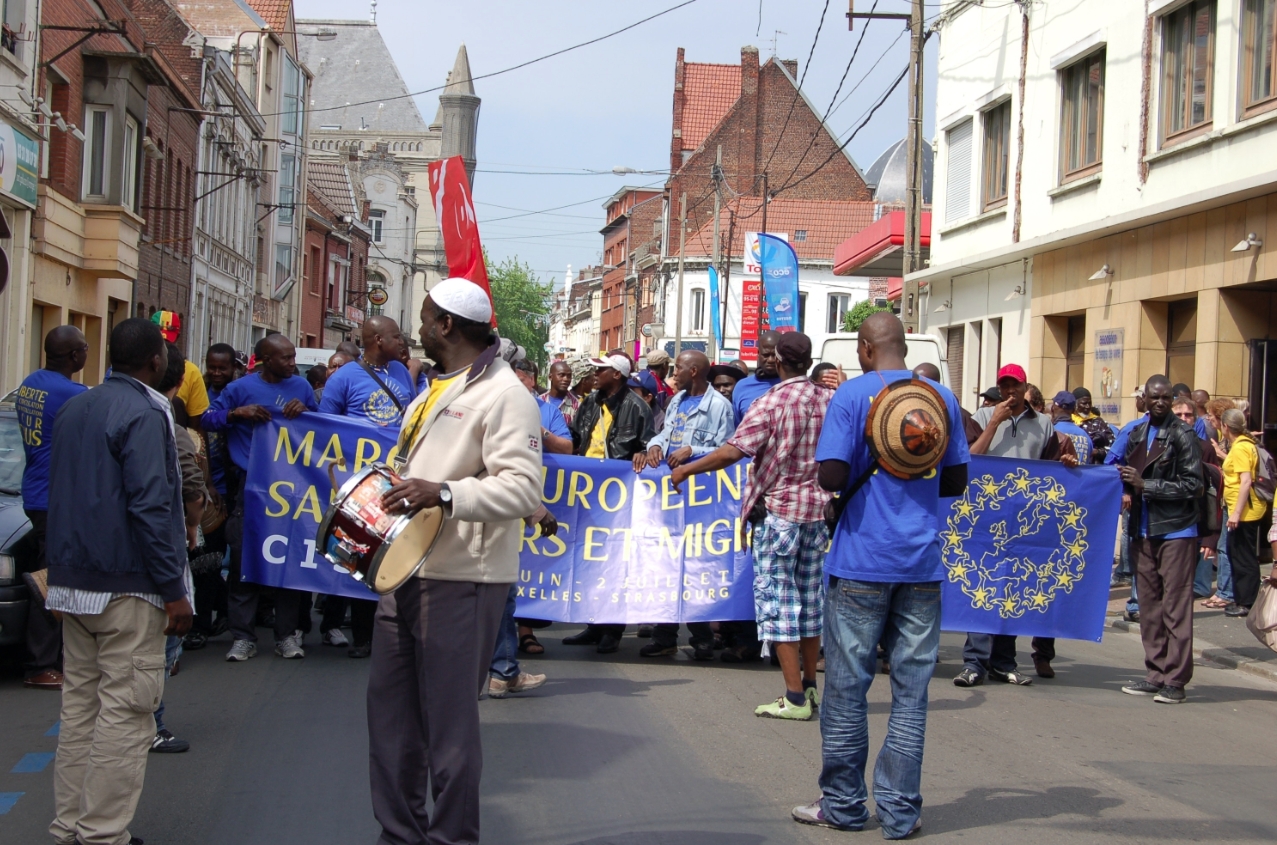
Wearing bright blue and yellow T-shirts emblazoned with the words “liberté de circulation et d’installation pour tous” (freedom of movement for all), the hundred-plus undocumented workers (men and women) boarded two large coaches and headed for Henin-Beaumont in Northern France, the first port of call in their marathon European march for legal status. They were members of Coordination des Sans-Papiers 75 (CSP75), an independent coalition of Parisian undocumented worker collectives with several thousand members. The march was organised by CSP75 in collaboration with several human rights organisations, including MRAP in France, Bleiberecht in Switzerland and Italy, all of which come under the umbrella Coalition Internatio-nale des Sans Papiers et Migrants (CISPM).
The European march was an acceleration of the undocumented workers’ labour movement that began in France in 2006. The movement has given a voice to low-skilled undocumented workers who are mobilising for their rights as they become increasingly aware of the value of their cheap labour to Europe.
As well as France and Belgium, they plan to march through Netherlands, Luxembourg, Switzerland, Germany and Italy, particularly in the cities where key EU agreements have been signed, including Maastricht in the Netherlands, and Schengen in Germany. EU policies, including the Schengen Agreement, have made life tougher for undocumented workers as member state governments increasingly crack down on illegal migrants.
The CSP75 marchers arrived at the European Parliament in Strasbourg, France, on 2 July, where they lobbied European parliamentarians. Along the way to the other countries, the CSP75 marchers were joined by clandestine workers based in those EU countries. Also marching with them in solidarity were supporters, including human rights activists, left-leaning mayors, and representatives from Christian organisations.
The start
They symbolically kicked off their march in Henin-Beaumont, the home turf of Marine Le Pen, leader of France’s far-right, anti-immigrant Front National party (FN).
This was the first time that Malian construction workers, Senegalese chambermaids, Moroccan street cleaners, and Pakistani dishwashers and other low-skilled undocumented workers from across the EU had mobilised to fight for legal status. They were unified behind a clear message: no to the exploitation of undocumented workers and yes to fair and direct employment. In Henin-Beaumont, the workers attracted looks of disbelief from local residents as they marched through the main street beating drums and chanting “papers for all”. Anzoumane Sissoko, the energetic coordinator and spokesperson of CSP75, explained the main objectives of the European march.
“We are demanding the repeal of European immigration laws and regularisation of all undocumented workers as well as full implementation of the rights of migrants and asylum seekers. It’s partly thanks to low-skilled undocumented workers who pay taxes and other compulsory contributions that the French and other EU economies have grown to become some of the most powerful in the world.
“We want fairer immigration policies that will allow poor, low-skilled workers from developing countries to work legally in Europe. It suits European governments and bosses to keep undocumented workers in a clandestine status,” Sissoko said.
The 47-year-old, Paris-based Malian cleaner is the public face of the undocumented worker movement in France. He has first-hand experience of the day-to-day difficulties facing undocumented workers.
During the 13 years he worked without legal papers in Paris, he was arrested on numerous occasions. He was detained in an immigration detention centre on the outskirts of Paris for several months before his status was “regularised”. He is hoping to expand the undocumented workers’ struggle into a broader popular movement.
But he and his colleagues face an uphill task as EU governments are increasingly flexing their muscles against illegal immigration. They argue that amnesty will open the floodgates for more undocumented migrants. But Sissoko and his friends are hoping that the new French president, François Hollande (whose Socialist Party recently won 320 seats in the 577-seat National Assembly) will be more sympathetic to their cause. Estimates show that apart from over 300,000 undocumented workers in France, there are hundreds of thousands more elsewhere in Europe who are employed on a daily basis.
The demographic forecast is that they will increasingly be required to boost workforces and pension payments due to Europe’s ageing population and the low birth-rate. According to Eric Fassin, a respected sociology professor at the École Normale Supérieure in Paris who has researched immigration in Europe: “Although it is hard to tell exactly how much undocumented workers contribute in tax and other contributions, on the whole, economists say the net result is positive.”
Fassin continues: “If you add everything together, you realise that migrants who are supposed to be so costly are in fact beneficial. Not just in terms of what they bring to the economy but also in terms of what they contribute to balancing the budget in France.”
Despite their notable economic contributions, research by human rights organisations reveals that hundreds of thousands of undocumented men and women are working without the benefits and pay levels that French and EU employers are legally required to provide to salaried workers. Filling the so-called “3D” jobs (dirty, degrading, and dangerous) as construction workers, cleaners, security guards and nannies which Europeans are increasingly reluctant to do themselves, the immigrants are often forced to work in poor conditions without any employment security.
A socially-excluded labour underclass, they are systematically deprived of their basic social rights in democratic Europe. They also often work long hours, but their clandestine status makes it difficult for them to access institutions set up to monitor and protect employment rights and working conditions.
This writer re-joined the undocumented workers’ march in Schuman Square in Brussels (the district where major EU institutions are located). They were on the second leg of their European march.
After being escorted by Belgian police on a short tram ride to the northern Brussels suburb of Tervuren, they encountered one of their first hiccups. The organisation that had initially offered to host them for lunch before they set off on their three-hour march to the university town of Leuven – 27 km away – was unable to do so.
They were forced to seek shelter from a continuous downpour of rain on the platform of Tervuren’s tram station for several hours where they ate their lunch, and the religious faithful among them said their daily prayers. When lunch was over, the undocumented workers and their supporters set off for Leuven under police escort once again. They marched through the grandiose gardens of the Royal Africa Museum (a showcase of Belgian colonial power in DRCongo) where they had planned to hold a demonstration, but the museum itself was closed.
When I asked Deyoko Kiatou, one of the undocumented women workers who was trailing behind in the spirited march, if she had the morale and stamina to complete it, she was resolute in her answer. “I have no choice but to carry on. We are united in this. We live and work in very difficult conditions so we have no choice but to carry on with our fight for legal papers,” she said.
This project was made possible by a fellowship from the French-American Foundation-United States. The views expressed are solely those of the author and do not reflect the views of the French-American Foundation or its Directors, employees or representatives.