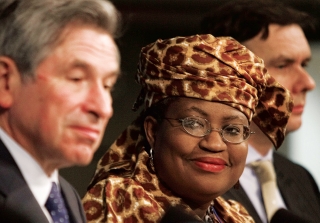
Ngozi Okonjo-Iweala is arguably one of Africa’s most influential women. Her role as Nigeria’s minister of finance and head of the Economic Team that coordinates the country’s development strategy is, to say the least, challenging. But with down-to-earth practicality and pragmatism, she has earned considerable admiration, serving under two administrations. Stephen Williams profiles “the lady who turned an economy”.
In April 2012, the hunt was on for a new president of the World Bank. Many thought that Ngozi Okonjo-Iweala was the ideal candidate, and that it was high time someone from the South, or the majority world, took the helm of the Bank (after decades of US presidents). Her interpersonal skills, first-hand experience, and no-nonsense approach to finance and development would serve the institution admirably, it was argued.
But there were many others who dreaded her departing Nigeria for Washington. Yes, she would have made a fine leader of the World Bank, they agreed, but Nigeria would have had to lose a key government figure in the battle to turn the country’s economy around.
In the end, the post of World Bank president went to the US choice, Jim Yong Kim, who was born in South Korea but emigrated to the US as a five-year-old. It was a close call, but Ngozi (as she is affectionately known by her many admirers) remained in President Goodluck Jonathan’s cabinet to continue her work.
A recently published book, Reforming the Unreformable, authored by Ngozi, provides an intimate insight into the problems she faced after being appointed economic adviser to former President Olusegun Obasanjo a dozen years ago.
She was tasked with making some sort of sense of Nigeria’s chaotic debt profile and establishing a national Debt Management Office. She succeeded in doing just that. It is interesting to note that, according to Ngozi, this book has been written with the clear intent of offering her experiences to other countries facing the same problems as Nigeria – certainly for low-income oilproducers and also those that have other fiscal problems, including “volatility, large macroeconomic imbalances, and over-borrowing”. Today, that would mean most countries, as the global economy continues to experience a serious crisis. As Ngozi points out, her book is a story of “development economics in action, drawn from the front lines of economic reform in Africa”.
But anyone looking to draw inspiration from more current events in Nigeria might be disappointed. This book simply deals with her experiences up to her resignation in August 2006, when she joined the Brookings Institute as a “distinguished fellow” before rejoining the World Bank as a managing director around a year later.
Achieving debt relief
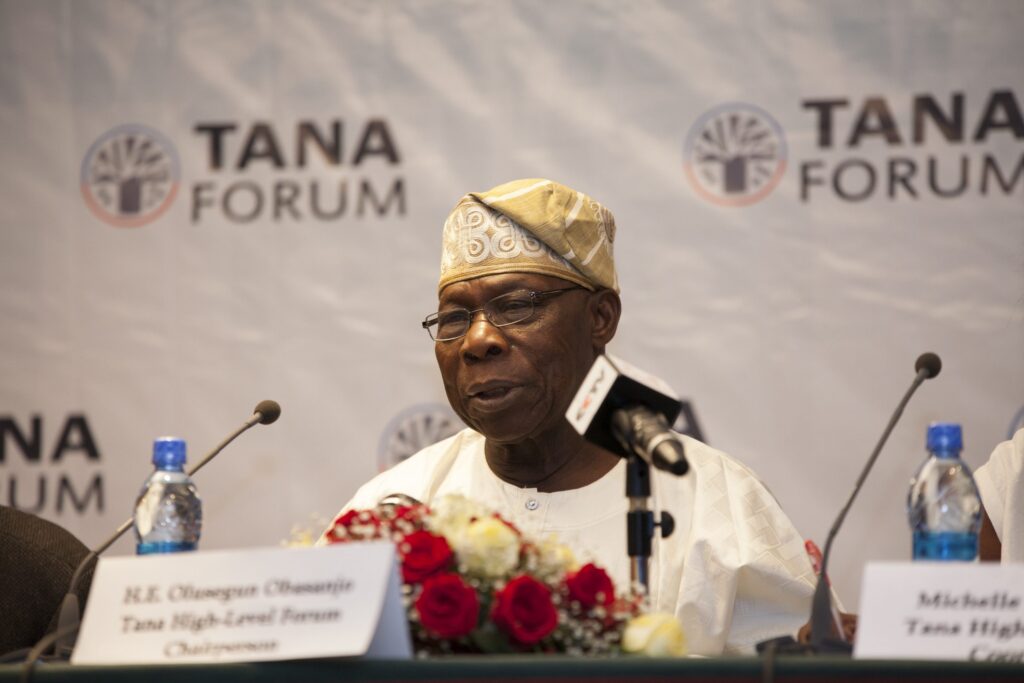
However, her recollections of this earlier period do place later developments in a much clearer context. Take, for example, what must be considered her most noteworthy accomplishment – negotiating Nigeria’s debt relief with the Paris Club. Ngozi is typically modest when describing this achievement, giving her president, Olusegun Obasanjo, a great deal of the credit for his determination that Nigeria should clear its debts with the international community in order to finance a major push for the country’s development and the implementation of difficult economic reforms. Her description of the events that surrounded the negotiations with the Paris Club is particularly revealing. It should not be forgotten that Nigeria’s Paris Club debt relief was negotiated when the oil price was very buoyant, and many observers questioned just why Nigeria should require debt relief when its principal resource, oil, was commanding such a high price on global markets.
The country’s oil and gas sector, according to OPEC, accounts for 20% of GDP, 95% of foreign exchange earnings and about 65% of budgetary revenues.
In fact, this was exactly the point put to Obasanjo by the then US-president, George W. Bush, at a White House meeting at which Ngozi was present.
“I broke protocol by jumping in and asking my president’s permission to explain the issue further to President Bush. He gave his permission and I knew I only had only a few seconds to make our case,” Ngozi recalls. “I made two points. First, although the oil price was high, Nigeria was still a poor, large country, with a population of about 150m. As such, given that we earned $25bn net a year in 2004, this amounted to just 46c per Nigerian a day.
“Secondly, Nigeria’s economy would have to depend largely on private sector investment for growth. Yet such investment would be severely limited if we did not invest in infrastructure. We would need $67bn, in our estimates, each year over the next five years for this purpose. That was why we would need debt relief – to free up resources for this.”
President Bush seemed to be persuaded by this argument, and Ngozi goes on to describe the negotiations, tortuous at times, that she had with the finance ministers of the Paris Club, essentially the world’s wealthy countries, in order to reach agreement. Here she pays particular regard to the support that she received from Gordon Brown, the then UK finance minister, later to become prime minister, whom she first met in September 2003 at a World Bank-IMF meeting in Dubai. At that Dubai meeting, rather than make the pitch for debt relief, she briefed Brown on Nigeria’s ambitious economic reform programme, telling him that only if this programme was implemented successfully for a year would she ask for his support for debt relief.
This approach worked, and her former close colleague during her days at the World Bank, Sir Nicholas Stern (the Bank’s former chief economist) who had subsequently joined the UK Treasury as one of Brown’s senior officials, underpinned her argument. As well as domestic support from Nigeria’s legislature, she was also to receive backing from her one-time boss at the World Bank, Caio Koch-Weiser, who had since become Germany’s deputy finance minister; another former colleague, Kiyoshi Kodera, who was now the senior deputy director general at Japan’s Ministry of Finance; and Emmanuel Moulin, a former alternate executive director for France at the World Bank, who had become the secretary general of the Paris Club. All of these former colleagues helped a great deal in the negotiations.
“This situation generated an invaluable measure of trust,” Ngozi recounts. “If I said that we would deliver on our commitments, important people believed we would do so.” Nevertheless, others were less than keen to provide the debt relief that Nigeria was asking for, but Ngozi lobbied hard to make her case, and Gordon Brown presented her arguments at the G8 meetings leading up to the Gleneagles G8 summit. Then Ngozi set to work to convince the non-G8 members of the Paris Club.
In fact, in a typically arcane arrangement that seems to be the hallmark of international financial agreements, Nigeria was required to “buy-back” its debt at a discount, i.e. repay a portion of the outstanding debt – but the net effect was the same: $18bn was cleared from the books. The main thrust of Ngozi’s economic policies since that momentous achievement has been to transform an expansionary Nigerian national budget into one of fiscal consolidation in order to stimulate growth. “We recognise that we must manage our macro-economy wisely,” she told delegates at a conference in August 2012. One of the ways that Nigeria’s prudent economic management has been affected was the insertion of a benchmark oil price within the national budget. This measure was actually first initiated while she served as finance minister in Obasanjo’s administration, so it is dealt with in some detail in her book.
She says that the oil benchmark has, since its introduction, had the effect of bearing down on Nigeria’s economic volatility. The oil price is generally below the actual spot oil price. For example, the 2012 budget’s benchmark oil price was set at $72 a barrel, down from $75 a barrel in 2011, and considerably below crude’s spot price. And Ngozi makes a crucial point in the book: that although de-linking government spending from current oil revenues is a big step forward, it is not enough. “The composition of spending also matters. Oil revenues are generated while a national asset, the country’s oil reserves, is being depleted. “That national asset,” she observes, “belongs not just to the current generation but also to future ones. Thus, all revenues should be spent on creating a springboard for stable long-term growth that will benefit future generations.”
In mid-2012, Ngozi presented the Medium Term Fiscal Framework of the 2013 Budget to the Federal Executive Council. She predicted Nigeria’s revenue for 2013 at $24.4bn while expenditure was set at $30bn. But she also pledged that the government would reduce its recurrent expenditure from 71.47% in 2012 to 68.66% in 2013, adding that capital expenditure would increase from 28.53% to 31.34%.
The budget was based on oil production of 2.53m barrels a day, with the benchmark price at $75/barrel – thereby allowing the government to make a practical impact on the areas that matter most to the Nigerian people – job creation, power supply, roads, rail, other infrastructure, and, of course, agriculture.
Significantly, the composition of the board and mandate of Nigeria’s sovereign wealth fund was also clarified. Known as the Nigerian Sovereign Investment Authority (NSIA), it actually consists of three sovereign wealth funds: a future generation fund, an infrastructure fund, and a stabilisation fund.
Already, $1bn has been earmarked for investment in the three arms of the fund, and transferred from the Excess Crude Account which was supposed to be replaced by the new NSIA. But this move has met strong resistance from what are colloquially known as “vested interests”.
Indeed, vested interests are dealt with in some detail throughout the book and are clearly a hindrance to Ngozi’s economic reforms, as is the scourge of corruption that Nigeria is so often associated with and that she has done so much to counter. Ngozi continues to press on to achieve her vision, and in a further development announced plans to issue a $1bn Eurobond which would be earmarked for investment in Nigeria’s oil and gas sector. It is a measure of the widespread international respect and domestic support that she has accrued that Nigeria could even contemplate such an issuance.
But, unlike many of her predecessors, her pledges that the country’s resources will be managed prudently and transparently, while ensuring that priority is given to the key growth sectors of the economy, have real weight and are taken on trust. That alone is a huge achievement.