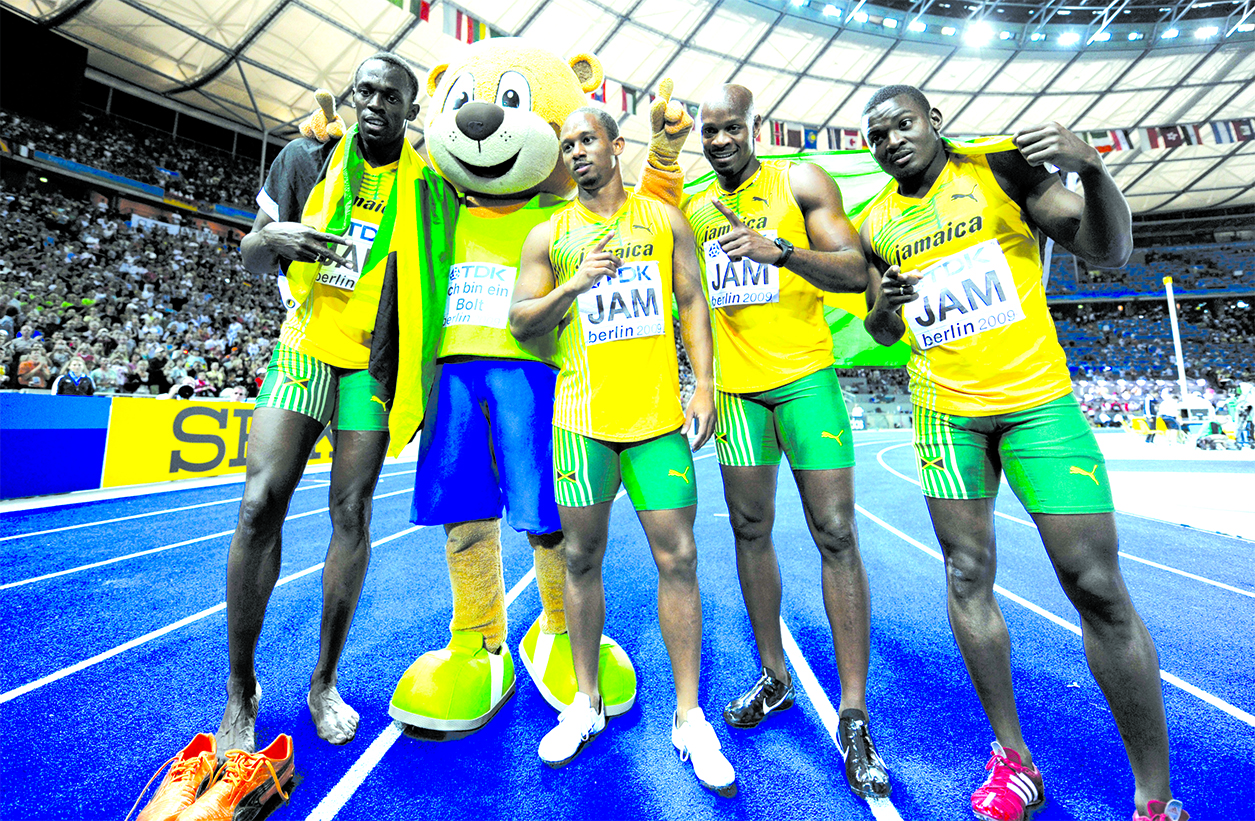
Usain Bolt hovers over the London 2012 Olympic Games as no other athlete has cast his shadow before. Nor is he alone among his compatriots, as there are also Asafa Powell, Yohan Blake and, in the women’s team, Veronica Campbell Brown. All of them are not just proven champions but outstanding champions of the track. So what makes the Jamaicans so special? For an answer, Clayton Goodwin goes back to the 1952 Olympics in Helsinki, Finland, in this instalment of our special countdown to the London 2012 Olympics.
Three years ago, the flags of Jamaica, which flooded the stadium, the streets, and the public transport system of Berlin for the World Athletics Championships, will again bath the very air of London in hues of black, green and gold.
Yet in 2012 there will be cause enough to remember the outstanding records of Jamaica’s sprinters and middle-distance runners, which would be the case even if there were no Usain Bolt and no Olympic Games. It is the 60th anniversary of the world record-breaking performance of the Jamaican men’s 4 x 400 metres relay team in the 1952 Helsinki Olympic Games. No single event – the historic triumph of the West Indies cricket team in England two years earlier notwithstanding – has stamped this small Caribbean island on the consciousness of the world to such effect.
Because his achievements in Berlin in 2009 so captured the public imagination, Bolt has been compared inevitably to the legendary Jesse Owens, who won four Olympic Games gold medals in Berlin in 1936.
While the American’s feat, quite rightly, will never be forgotten, it has overshadowed some outstanding track performances by other sportsmen and women in his team. Contrary to popular misconception, Jesse Owens was not the first African-American to win an Olympic Games medal – gold or otherwise.
Hurdler George Poage is regarded generally as being the first African-American to win medals, at the 1904 Games in St Louis. Nevertheless, our study here concerns short-distance running on the straight – that is, the 100 metres up to 400 metres.
The impetus over these distances was sparked by the 1932 Games, which were also held on the Americans’ own territory in Los Angeles. The Games coincided with the migration of a substantial number of the country’s black population from the South to the northern cities where whatever few opportunities that did exist were available.
Ralph Metcalfe and Eddie Tolan, both African-Americans, ran 10.38 sec in a memorable, almost dead-heat, finish to the 100 metres, when only an extended study of a photograph decided it in Tolan’s favour. For good measure, he also won the 200 metres.
Metcalfe was one of history’s “nearly” men. He added a bronze in the 200 metres to his silver in the 100 metres, and four years later again finished second in the 100 metres to new star Owens – while consoling himself with a team gold in the relay.
Built around Owens’ remarkable success, which has been reported extensively already over the years, 18 African-American athletes came to the fore in force at Berlin in 1936.
Cornelius Johnson, whose hand German dictator Adolf Hitler is said to have refused to shake (a perceived insult transferred subsequently to the better-known Owens), and Dave Albritton were first and second in the high-jump; John Woodruff and Archie Williams won gold in the 800 metres and 400 metres respectively; and Jimmy Luvalle took the 400 metres bronze.
By the London 1948 Games, at which high jumper Alice Coachman became the first African-American woman (and the first “woman of colour” anywhere, as they used to say at the time) to win an Olympic Games track and field gold medal, interest in the sprints was focused primarily on the clash between the Americans and the several talented Jamaicans who were then either studying in American universities and colleges or had just come out of the wartime armed services.
The Jamaicans dominated in the 400 metres. Herbert McKenley, 26 years old, who had risen to prominence while at the University of Illinois, was the advance favourite after he had broken the world record twice (bringing it down to 45.9 sec).
His main rival was his compatriot, the 28-year-old Arthur Wint, who was popular with the crowds in London, where he was a medical student at St Bartholo-mew’s Hospital, after having experienced active combat with the RAF in the Second World War.
McKenley set a cracking pace from the start – really too fast because the tactics which were designed to kill off the challenge of “Marvellous” Mal Whitfield of the USA, the winner of the 800 metres, caused him to fade in the finish as he was beaten to the line by Wint. Whitfield came third. Wint, by the way, had already won a silver medal in the 800 metres. Trying afterwards to explain his defeat – probably the upset of the competition – McKenley said that, unusually, he had felt bored in training and lacked competitive edge.
And so to the 4 x 400 metres relay which Jamaica had high hopes of winning – oh yes, the 4 x 400 metres relay – an event which would have “lived in infamy” in that country’s memory if it had not been erased by the exceptional achievement of the same quartet of runners four years later. There were some 80,000 spectators for one of the blue-ribbon events of the championships. It was USA v Jamaica.
George Rhoden, the 21-year-old Jamaican, held his American rival, Arthur Harnden, level on the first leg. On the second, the 23-year-old Leslie Laing, another Jamaican who had served in the Royal Air Force, was less experienced at this distance and fell some 15 metres behind Cliff Bourland.
The margin should not have been too great for the individual champion Wint to make up on Roy Cochran – but instead of starting slowly and increasing his pace, as was his normal practice, Wint went after the American straight away as quickly as he could.
Then it happened…
As McKenley waited for the handover to run the last leg which would have given him a share in the gold medal, he heard a groan from the crowd and saw that Wint had fallen on the track. He had gone down with a pulled muscle as if he had been shot from the stands – his arms went up, he staggered, and as he sprawled on the grass the baton slipped from his hand.
“Get up, get up,” screamed McKenley. Rhoden fell to his knees and wept. Laing blamed himself for setting his teammate too tough a target. With the Jamaicans out of contention, Whitfield completed the gold medal run for the USA.
The losers could only contemplate what might have happened … and what might happen again if they got to the next Olympic Games in Helsinki in 1952.
Well, they got there easily enough. The Jamaicans’ form held up so well in the intervening years that they still had only the Americans, and themselves, to fear.
McKenley, with two individual gold medals and one silver, and Rhoden, with one gold and one silver, performed well in the 1950 Central American & Caribbean Games in Guatemala City.
Competition in Helsinki, however, was generally tougher all-round than it had been in London because the powerful Soviet Union team, which had missed the 1948 Games because of the ravages of the Second World War, along with the defeated nations Germany and Japan, had now returned to the fold.
The hosts, Finland, had a strong athletics tradition going back to the achievements of their long-distance runners and national heroes Paavo Nurmi and Hannes Kolehmainen from 1912 to 1928.
Scandinavian fans had already taken the Jamaicans to their hearts – especially after McKenley’s outstanding performance in winning the 400 metres in 46.1 sec in pouring rain in Stockholm shortly after the 1948 Games, and with Rhoden setting a new world record for the same distance of 45.8 sec at Eskilstuna, Sweden two years later.
McKenley, though regarded as being the best athlete of the four, was destined never to win an Olympic Games individual gold medal. He came close here – very close – twice.
Although the joint world record-holder, Emmanuel McDonald Bailey, a colourful Trinidadian running for Great Britain, was favoured to win the 100 metres, McKenley fared so well in the heats of this shorter distance that he came into the final with a very good chance of winning.
The Jamaican started badly and then cut through the field. He outpaced McDonald Bailey and appeared to have crossed the finishing line a fraction ahead of Lindy Remigino, a comparatively little-known American: indeed, the first three runners finished almost together in a time of 10.4 seconds. Alas, it was not to be.
Intense study of the photograph (today’s sharp technology was not available then) showed that McKenley had been edged out by what was described as being “the skin of his right shoulder”.
Three Jamaicans were “in the running” for the gold medal in the 400 metres – McKenley, Rhoden and Wint – with Whitfield once more their chief challenger.
Wint, as if he had not learned from his experience in the relay in London, set out like a rocket but in the third 100 metres he lost ground to his team colleagues.
In the outside lane, Rhoden held the advantage. McKenley came back at him strongly, as he had against Remigino, and as in that race the first two competitors crossed the line in the same time (45.9 secs). Once again, too, he lost out on the gold medal – by the proverbial hair’s breadth. It was particularly disappointing because McKenley had finished ahead of Rhoden in the semi-finals. He was left with only the 4 x 400 metres relay to improve on his double silver.
On Sunday afternoon, 27 July 1952, the Jamaicans had a date with destiny or with further disappointment. Before the relay race began, the religious Rhoden led the team in a circle of prayer. The pressure seemed to be getting to Wint, who, incidentally, went on to become his country’s high commissioner in the UK (and ambassador to Sweden and Denmark) from 1974 to 1978. While warming up, he broke three nails in his boots and lost his vest. The team’s American coach, Joe Yancey, drove at breakneck speed back to the Olympic Games Village to pick up a spare set of boots, and Wint snatched a vest from Rhoden.
Even more extraordinary, it is reported that Hans Geister of Germany turned up without his shorts and had to turn to a colleague in the stands for a spare set. Surely that sort of thing could not happen in front of all the television cameras in London 2012 – could it?
McKenley, like Wint, who had won silver in the 800 metres, must have been near to exhaustion from his hard-run close finishes in the 100 metres and 400 metres (as well as the preceding heats). After a false start by the Germans, the race got underway and the Jamaicans were alone with the Americans, a few other athletes, and, above all, their own nerves.
The intensity of the occasion and the after-effect of his earlier efforts, took their toll on Wint. Running the first leg this time, he came in at 46.8 secs, a metre down on Ollie Matson of the USA.
Laing, more at home over the shorter distances, could not compete with Gene Cole, who stretched the Americans’ lead to a commanding 20 metres. Even so Laing kept going and at the end of the leg, which he ran in 47.0 secs, the distance separating the teams was down to a “manageable” 15 metres.
McKenley had to run the third leg against the 400 metres hurdles gold medalist, Charlie Moore, who had beaten him previously over 600 metres. It was a difficult, almost hopeless, task.
Herb was in the same position in which Wint had found himself in London – starting the third leg 15 metres behind the American. McKenley did not repeat his compatriot’s mistake of setting off too quickly. He remembered the words of his former coach, Leo Johnson: “When you are behind, Herb, eat it up a little at a time!” And that is just what he did.
Cheered on by the crowd, McKenley gained swiftly but surely on his rival. Moore, out in front, was at a disadvantage because he could not see where his adversary was and how quickly he was closing on him.
He found out only one stride from the handover as McKenley passed him after having run an outstanding 44.6 sec – that was over a second faster than the time in which Rhoden had won the individual event. It was Rhoden, too, who now took up the baton. The advantage had moved to the Jamaicans because Whitfield was suited better to the 800 metres, in which he had won the gold medal to repeat his victory in London.
On the final lap, neither man yielded an inch but with Rhoden coming home in 45.5 sec, it was enough to give Jamaica the gold medal in the world record-breaking time of 3:03.9 min (a bare tenth of a second ahead of the Americans with 3:04.0 min).
The islanders celebrated a triumph which, while admitting the subsequent performances years later of George Kerr, Lennox Miller, Don Quarrie and Merlene Ottey, was not approached until the success of Usain Bolt (twice in individual events), Shelly-Ann Fraser-Price, Brigitte Foster-Hylton, Melanie Walker and both the men’s and women’s 4 x 100 metres relay teams, caused the Jamaican victory anthem to be sung and their flag to be raised seven times over the stadium at Berlin in 2009 – a competition in which this small island finished second to only the mighty USA in the number of medals won.
The baton which Arthur Wint let slip on the grass with such anguish in 1948, and which was taken up by himself and his colleagues to win gold and break the world record four years later, has been passed to another generation.
The Jamaicans are back in town, in London, and it is also exactly 60 years after they set that world record. The wheel has turned full circle and there is again much to celebrate.