They called it an “Arab Spring” when President Hosni Mubarak’s government was overthrown in February 2011 after weeks of massive protests across Egypt. Mubarak’s successor, President Mohammed Morsi, is now gone, after only a year in power. How did things come to a head, once again, in Egypt?
What have been the political, social and economic implications of the North African revolutions for the rest of Africa? Why didn’t the much-anticipated “domino effect” from the “Arab Spring” engulf the rest of the continent? Is Egypt’s “spring” turning out to be a “summer” of discontent? In the lead cover story, our Associate Editor Osasu Obayiuwana examines what actually happened, or did not happen in Egypt. In subsequent pages, Adel Darwish and other New African correspondents discuss the broad range of issues surrounding democracy, elections and governance.
Just one year into Egypt’s new democratic experiment, it has all come unstuck. President Morsi has been kicked out of office, following massive street protests, involving millions of people, setting the stage for the military’s intervention, an action which General Abdul Fattah al-Sisi, the country’s top military commander (portrait held above), insisted was for the Egyptian people. Associate editor Osasu Obayiuwana examines the issues.
When Mohamm ed Morsi became Egypt’s first democratically elected president in June last year, Egypt’s 85 million people were looking forward to immediately reaping the benefits of having a government that is, at least in principle, directly accountable to them, as they started the long trek to entrenching a political system in which the rule of law secured their rights.
Why else would ordinary folk have risked life and limb to embark upon the bloody revolution that ended the 30-year rule of Hosni Mubarak, if not to open a desperately needed new chapter in the country’s history?
But now Morsi has been removed from office, in what is in allbut-name a military coup, and an interim president, Adly Mansour, the president of the country’s constitutional court, is now at the helm. The military insist they have no frontline role in the current dispensation, whilst they are clearly playing an extremely influential – if not the decisive – role from the shadows and the current political impasse in Egypt certainly raises crucial questions for the entire continent. For example, we must ask whether democracy, especially in a country emerging from a longstanding culture of iron-fisted rule, begins and ends with the toppling of a disgraced leader and the conclusion of an election?
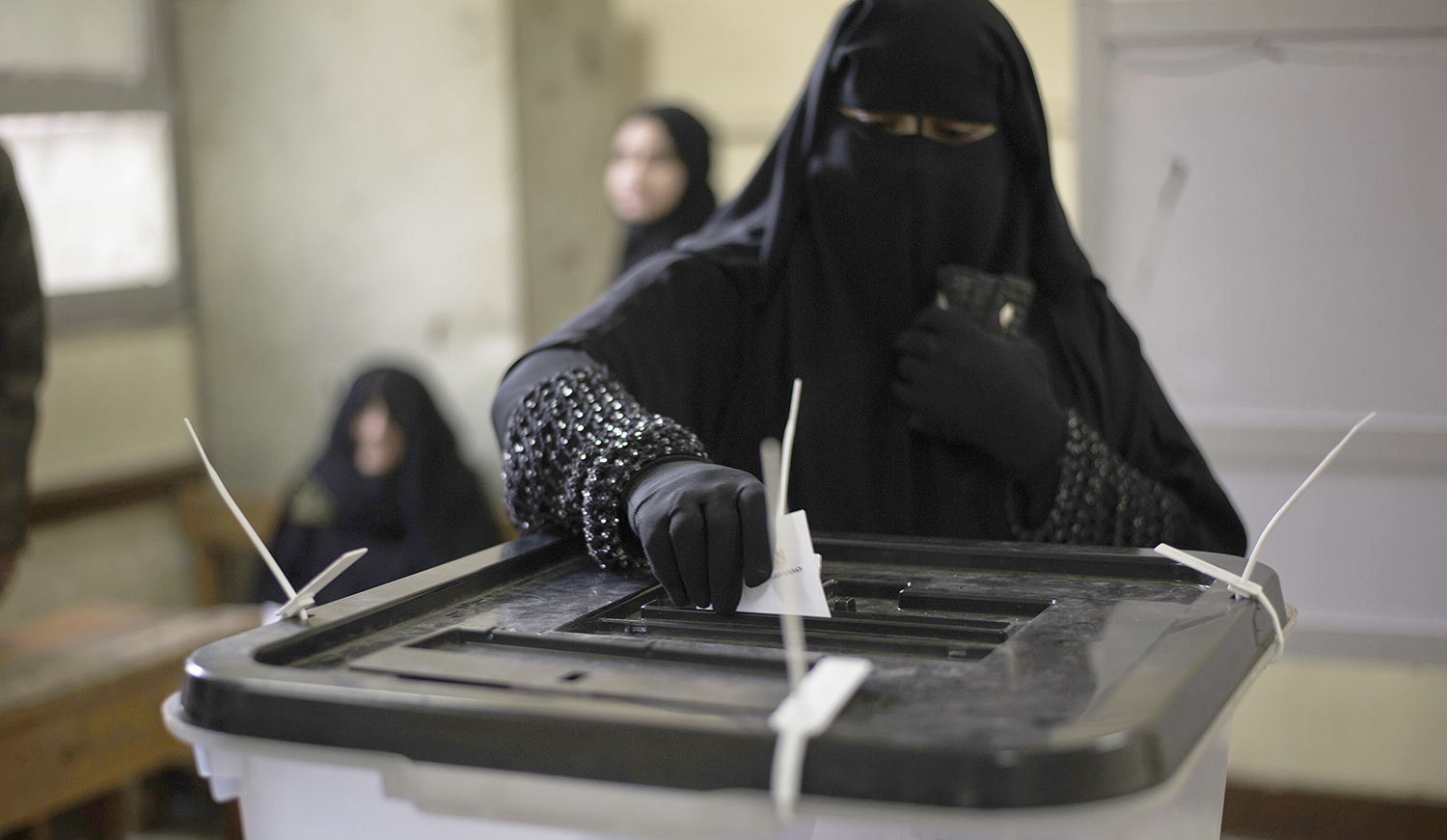
For members of the Muslim Brotherhood (MB), whose political arm, the Freedom and Justice Party (FJP), won 51.7% of the vote in the 2012 presidential election, giving Morsi the mandate to govern until 2016, the answer to this question would, most likely, be a resounding “yes”. “Egypt decides through the ballot-box…No one person, one elite group or military organisation will impose any decision on the people,” says Essam El-Erian, the FJP vice-chairman.
Despite being outlawed from the country’s political life over the last 40 years, by the governments of Gamal Abdel Nasser, Anwar Sadat and Mubarak, who saw the Islamist group as a threat to Egypt’s stability, the MB remained a formidable group, even whilst underground. It did not hesitate to take swift advantage of the political circumstances that presented themselves after the fall of the Mubarak government, a popular uprising in which they did not play a frontline role.
Meanwhile, the larger sections of Egyptian civil society, which did, were unable to form themselves into formidable groups with a decent chance of winning political power. The inevitable consequence was that they were absent from the corridors of power in a period when their presence and involvement, in shaping an Egypt that is evolving politically and socially, was most needed.
Whilst the FJP earned, in principle, the electoral right to fashion the country according to their Islamist ideology, the hard political realities in the post-Mubarak era dictated that they needed to govern in a way that acknowledged the revolutionary circumstances under which they were elected into office.
As the writer Ahdaf Soueif commented, in a recent piece for the UK’s Guardian newspaper: “The revolution will continue because neither the old regime [of Hosni Mubarak] nor the Islamist trend in its current form [Morsi and the FJP] are going to deliver ‘bread, freedom, social justice’. Neither of them are going to validate the sacrifices made by the 1,200 young people murdered by the regime, the 8,000 maimed, the 16,000 court-martialled…”
It is the disconnect between the deposed government and the larger society, outside the ambit of the FJP’s immediate political constituency, which felt completely ignored and disenfranchised from crafting a post-Mubarak political order in their country, that fanned the embers of deep division that created the circumstances which led to the unconstitutional removal of an elected government.
What does it mean for democracy?
In the book, Dispersed Democratic Leadership, edited by John Kane, Haig Patapan and Paul ‘t Hart, the never-ending conflict between the governed and their elected leaders was succinctly put: “Democracies empower elected representatives to rule on their behalf. Such leaders possess the extraordinary authority that comes from a grant of the popular will, and they rule by consent and ostensibly on behalf of the people. Yet, because democracies fear that their leaders will turn themselves into de facto sovereigns, they constantly challenge their authority and attempt to rein it in. The shadow of democratic illegitimacy haunts every leadership act and decision.”
Democracies with strong institutions, acting as a needed counterbalance to the excesses of executive power, have the robustness to confront problems and resolve crises, without a fundamental disruption to the system. But in the peculiar case of Egypt, which remains in a fragile political state, after a revolution that toppled its previous leader, any party, elected to begin the process of nurturing a nascent democracy, had a duty to govern with an acute awareness of the circumstances under which the country was transiting from one chapter of its history to another.
Thomas Jefferson, one of America’s founding fathers, tetchily described democracy as nothing more than “mob rule, where fiftyone per cent of the people may take away the rights of the other forty-nine.” Those with little sympathy for the removal of Morsi’s government would certainly support Jefferson’s view.
With Ahmed Shafik, the prime minister in the discredited Mubarak government, being a less desirable choice, in the 2012 presidential run-off election, Morsi’s margin of victory, which was less than 4%, ought to have been a clear warning that he had not been given a sweeping mandate to impose the Islamist agenda of the FJP on the rest of the country. A government that repeatedly ignores the voice of civil society, with numbers as large as the electoral majority that voted them into office – if not larger – is doing very little to nurture the growth of a young democracy.
Arthur Lewis, a Nobel Prize winner for his work on the economics of development, poignantly observed that: “The primary meaning of democracy is that all who are affected by a decision should have the right to participate in making that decision, either directly or through chosen representatives …to exclude the losing groups from participation in decision-making clearly violates the primary meaning of democracy.”
So what are the responsibilities of a leader with the arduous task of managing a country in an evolving political situation? Whilst presidents and prime ministers in established democracies often take advantage of electoral victories to radically pursue the agenda of their immediate political constituencies, sometimes to the exclusion – and chagrin – of the losing party, as well as other groups that are clearly in the electoral minority, the pursuit of what is clearly a divisive and selfish path, in a less mature system, will do severe damage.
South African example
Nelson Mandela, the former South Africa president, was acutel conscious of this fact in the early years of his presidency. His deliberatepolicy of “reaching out” to the white population, after the African National Congress took power, was one of his nuanced acts of statesmanship, in order to create an environment in which the various racial groups that made up South Africa had a sense of belonging. After 27 years of imprisonment, for taking up an armed struggle against a white minority government that saw black people as inferior, vengeance and retribution could have been the option of choice, which would have had the support of a significant number of people amongst the black majority, scarred by the long-lasting effects of racism and only too happy to pay their oppressors back in their own coin. But that would have hardly forged an inclusive democracy that would begin to heal its deep wounds.
Determined to reach out to the former oppressors, Mandela made an effort to appreciate the psyche and values of the Afrikaner community, which made up the majority of the minority white population. Embracing rugby, a sport followed with a religious passion by Afrikaners, and asking the country’s non-white population to support the Springboks, the national team, during the victorious 1995 World Cup – knowing that rugby was seen as a hated symbol of the Boers during the apartheid years – Mandela understood that getting South Africans to share values and likes, even sporting ones, was key in his plan for creating a new society that would escape the demons created by apartheid.
“I believe that that was a defining moment in the life of our country,” said Archbishop Desmond Tutu, the Nobel laureate. “They say some other head of state, if they had tried to do something like he (Mandela) did, they would fall flat on their face, as it were. But it was just the right thing.” Unfortunately, no leaf was taken from the South African situation when Egypt made their transition to a democracy in 2012. Morsi failed, quite badly, to understand and acknowledge that being a president, in an extremely young and fragile democracy, had thrust upon him a near-sacred duty to rise above partisanship and act in a similar spirit of statesmanship.
Whilst the country has an overwhelming Muslim majority, with a roughly 10% Coptic Christian population, there remain sharp differences on what the role and importance of religion within the affairs of the state should be, not to mention agreeing on a common definition of what democracy means to all Egyptians.
In the context of such a fluid atmosphere, in which it will take time for a national consensus to be reached, Morsi failed to address the needs, concerns and, above all, fears, of those who did not belong to the FJP or subscribe to his party’s Islamist agenda.
Adopting an Islamist-based constitution, late last year, against the wishes of several sections of Egyptian society, which boycotted the national poll that sanctioned its enactment, as well as Morsi’s ill-fated move of engineering a presidential decree forbidding the judiciary to question his executive decisions, did little to allay the widespread fears of those not subscribing to an Islamist agenda.
These grave miscalculations, as well as an economy in decline, created the cocktail of anger that saw millions of people swarm the streets in protest and give the military – which ought to stay out of political problems – the “legitimacy”, as they called it, to act on the “wishes of the Egyptian people” and force Morsi out of office.
Can the mandate of a democratically elected leader be arbitrarily truncated by its citizens, in whom sovereignty is ultimately vested? This is perhaps the most poignant question that has resulted from the tumultuous situation in Egypt. Many would not hesitate to argue, to the death, that leaders, even those who grossly misgovern, can only be removed by clear constitutional methods – such as a recall, before the end of his term or an election, at the end of a tenure, when the people have the right to vote him out.
But what if a president sworn to uphold democratic values is acting in a way that subverts the very principles he is supposed to uphold, in a manner that is seen as a fundamental threat to democracy? Would that give citizens the right to depose a president?
Thomas Jefferson had an interesting view on such a dilemma: “Whenever any form of government becomes destructive of these ends [securing inherent and inalienable rights, with powers derived from the consent of the governed], it is the right of the people to alter or abolish it, and to institute new government, laying its foundation on such principles, and organising its powers in such form, as to them shall seem most likely to effect their safety and happiness.”
However, “abolishing” an elected government, outside the boundaries of the ballot box, subjects a country to the laws of unintended consequences and unforeseen events, which Egypt is going through now, with a destination far from certain.
But if one thing is to be learnt, by the continent’s democratically elected leaders, from what befell Morsi, it is that a failure to govern a plural society with a sense of statesmanship and tact could earn them a similar fate.