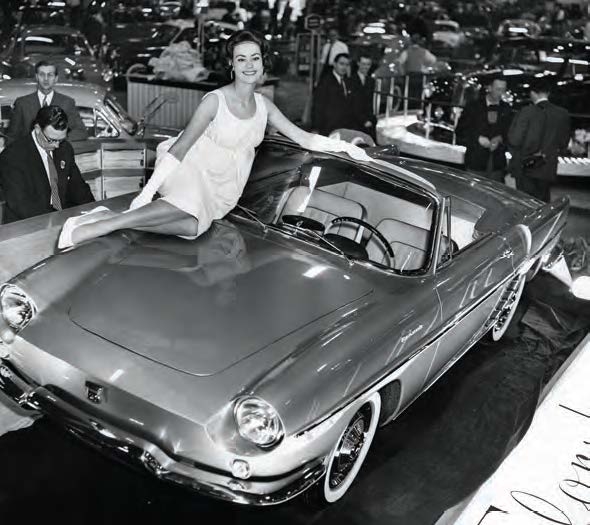
Still reminiscing on his love of cars, Mr Duodu writes: “One of my greatest regrets in life is not to have been able to go and present myself at Kukurantumi…driving my own sports car – a brand new, lily-white Renault Floride, with red leather seats.”
The Cocoa Rehabilitation (CR) scheme was evolved by the British colonial government of the Gold Coast circa 1950 to combat the “swollen shoot” disease that was threatening to wipe out Ghana’s cocoa industry. To make it effective, the CR Department was created as a separate organisation almost completely independent of the Department of Agriculture, and given its own fleet of vehicles, mainly Ford V8 Pilot pick-ups and Bedford one-and-a-half ton trucks.
As I have said before, it was the V8 Pilots that I fell in love with. Thanks to Kwame ’Toh, as you might remember, I had cut my driving teeth on his father’s one-and-a-half-ton Bedford truck, but now, Bedfords and I were like past lovers who looked beyond each other. The guy who first allowed me to take the wheel of a Pilot was called Mr Kwaku Robert. He came from Kukurantumi, a town some 10 or so miles from my hometown. Like most of the CR drivers, he was an ex-serviceman who had seen action in Burma during the Second World War. Most of the CR drivers were exservicemen, for the white officials who recruited the drivers were, almost without exception, all former military officers, and they trusted the drivers who had served with them in Burma.
Kwaku Robert’s whiteman, who was the “Agricultural Survey Officer” stationed at Asiakwa, was called Major George Watson. A special bungalow was constructed for him between Asiakwa and Bunso. In order to be able to travel around with the Pilot and occasionally cadge a drive from Kwaku Robert, I insinuated myself into the team run by Major Watson, as his “garden boy.”
My job was to walk down to a river at the bottom of the hill on which Watson’s bungalow was built, and bring a bucket of water for his “flowers”. I got my chance to drive when we were going to the bungalow, first thing in the morning, or coming back home, very late at night. Mr Robert was a very generous man, and he would stop the car, get into the passenger seat, and invite me: “Small” [for “Small Boy”] “come and take her!” I was too young at the time to know about the joys of sex, but I am sure that sitting behind the wheel of a Ford V8 Pilot, at age 13, and getting the best out of its steering gear and powerful “double engine” (two engines combined together in a V-formation to form one!) was as near-orgasmic as possible.
The car also had a metal ring on the steering wheel that served as a horn button. We loved all its unusual features, describing them, in our lingo, as “bluffing” stuff, and we put them to good use. It only had three forward gears, and it was fun to make the engine sing in first for a while, then go into second very quickly, make it whine a lot more, and then do a “Vroom! Vroom!” before changing into third. Actually, the drivers often put the car in “free riding” mode: either by putting the gear in neutral and switching the engine off, or planting a foot on the clutch, while the car was in gear, but with the engine cut. I discovered that the drivers liked to do this “free-wheeling” to preserve petrol, so that whenever they went to fill up at the CR transport station at Suhum they could siphon an extra 4 gallons into a jerry can, and flog it secretly to drivers with whom they had an “arrangement”.
As ex-servicemen, they knew all the foibles of their white “masters” and knew not to free the wheel in the manner described, when their master was on board, in case he asked what was going on! The whole CR operation, from my point of view, was a major fraud perpetrated with cocoa farmers’ money by the colonial government. The white ASOs had so much money they could afford to drink like fish. Their posts were given to them largely as a reward for their service to their nation in the WWII. But Ghanaian ex-servicemen were not given even the meagre pensions they had been promised while they were serving in Burma.
At Asiakwa reigned the white Major George Watson, the station of Major Charles Smith was Bunso (three miles away), at Kyebi was Major Charles Hill, and at Suhum, Major Barfield. They visited each other’s bungalows quite frequently. We would sit in the car and wait while they drank and drank and drank, laughing a lot. One night, our “master”, George Watson, got so drunk at Major Smith’s bungalow that at about 11pm, Smith staggered towards us and declared: “Your master is ill. You will leave the car here and come for it tomorrow morning.”
What? Watson was a kind-hearted man and would never have done that to us, had he been capable of making the decision. Or so we thought! Leaving the car at Smith’s bungalow meant we would have to walk three and a half miles in pitch darkness
(since we had no torches). We were also tired, sleepy and hungry. Hungry because when we were waiting for our “master”, we couldn’t go anywhere to look for food, in case he emerged from his colleague’s bungalow to find an empty car waiting for him.
Kwaku Robert, as an ex-serviceman, was used to this sort of casual cruelty, having served white “masters” in Burma. But Yaw Charles, the official car-boy and I were baffled that we were not told to go and find something to eat whilst our “master” was
boozing. Surely, he would know that he would be at the watering hole for an hour, or two, or three or four?
We could have gone to Asiakwa and back three times over, and looked after ourselves there. But we were supposed to be on hand for Mr Whiteman whenever he appeared. And so we were! Who cared if we were starving to death?
I must say we insulted the whites to our hearts’ delight. We didn’t know anything about homosexuality, but we all imagined that Smith was Watson’s domineering boyfriend! The only married man we knew among them was Charles Hill, who had a wife and several small children.
In fact, he didn’t drink as much as the rest, and we all liked him. He was a spectacularly handsome man, with hairy hands and arms. In contrast, Major Watson was distinguished only by a walrus-style moustache, stained brown with cigarette smoke, while Smith had no features to remember at all, except his cruel face. We suffered at their hands. But we also got something out of our association with them, Kwaku Robert got almost as much money each month from the petrol he filched in jerry-cans as his
official pay. Yaw Charles secured the love of a few young ladies, who realised that he would soon be obtaining his own driving licence, which would enable him to earn enough money to make him an eligible bachelor. And as for me – I would have done anything to get the chance to be at the wheel of a Ford Pilot V8, and be admired by all those who saw my tiny head popping up and down behind the steering wheel, as cool and skilful behind the wheel as someone twice my age.
I was particularly pleased that whenever Mr Robert got drunk after work, and we were going home, it was me, not his official assistant, my friend Yaw Charles, that he gave the wheel to. I think they both regarded me as some sort of a “mascot”, in whom they took unusual pride for tutoring. I often ran away from school to be with them. But they didn’t mind, for they knew I was always first in my class, despite my constant “truancy”. One of my greatest regrets in life is not to have been able to go and present myself at Kukurantumi to Mr Kwaku Robert, at the tender age of age 23, driving my own sports car: a brand new, lily-white Renault Floride, with red leather seats.
Even with my truancy from school, I was able to study privately to pass exams that paved the way for me to be employed at the Ghana Broadcasting System. From there, I became editor of Drum magazine, and I would have loved to hear Kwaku Robert recount his life-story to me, his participation in the war in Burma and all, and to have photographed him with his family, in the manner that had made Drum the most popular magazine in Ghana. But alas, he was gathered to his ancestors before I could elicit his views on WWII and his part in it; and wouldn’t I have loved to hear his views, as a cocoa farmer himself, on George Watson and the whole wasteful CR enterprise!
I had a front seat view of that enterprise, due to my love of motorcars. I saw how, in resentment at the fluctuations in the world cocoa price, cocoa farmers bribed Ghanaian officials employed by the CR department, to “cut out” perfectly healthy cocoa trees – sometimes whole farms in fact – in what they called “all-die” operations, so that they could collect “compensation” from the CR department. The cocoa price on the world market ROSE as a result of the farmers’ chicanery! The colonial government never cottoned on to this anomalous situation. But the CPP government, our first fully-Ghanaian government, detected the fraud and rectified things. But then, its efforts resulted in a massive cocoa harvest in 1965. But that only drastically reduced the world price of cocoa that year! The CPP government had unknowingly shot itself in the foot! It fell the next year – 1966. That is post-colonial economics for you.