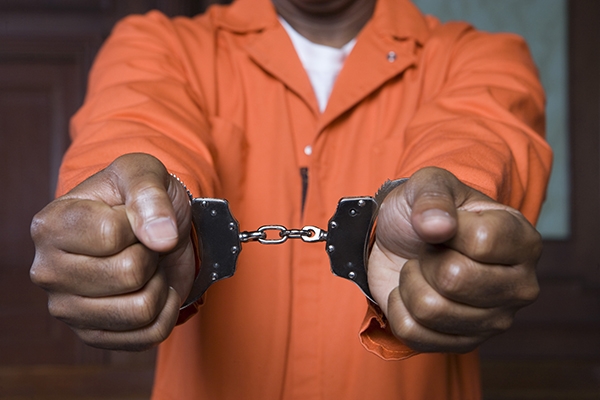
African-Americans constitute 13% of the US population but 40% of its prison inmates. Experts attribute this alarming situation to racial discrimination perpetrated by America’s criminal justice system against black people. In this piece, Ifa Kamau Cush looks at the effect America’s judicial perfidy has had on the African-American population.
On 20 February 2013, the US federal judge, Edith Hollan Jones, told a group of like-minded Americans that “African-Americans and Hispanics are predisposed to crime” and are “prone to commit acts of violence.” From 2006 to 2012, Judge Edith Jones served as the chief judge of the United States Court of Appeals for the Fifth Circuit. In an address at the University of Pennsylvania School of Law in February this year, Judge Jones referred to a death penalty case in which she rejected the intellectual disability defence of an African-American man, Elroy Chester, who was executed shortly after her ruling.
The views of Judge Jones expose a salient fact about American law and American racism – they are coeval. The date of birth of America’s “evil twins”, Law and Racism, is 10 April 1606. On that day, The First Charter of Virginia, an edict issued by King James I of England, was promulgated.
The Charter is a blueprint of American mendacity. It contained a self-serving promise of the colonists to “bring the infidels and savages, living in those parts, to human civility.” The “infidels” and “savages” to which the colonists referred were the indigenous people of the Americas. But there was nothing “civil” in the relationship between the European colonists and the indigenous people.
This 1606 “law” unleashed paroxysms of enslavement, mass murder and grand theft as the Europeans enforced their “law” to control “all the Lands, Woods, Soil, Grounds, Havens, Ports, Rivers, Mines, Minerals, Marshes, Waters, Fishings, Commodities, and Hereditaments”, “granted” them by King James I under the Charter.
The Charter led to the mass murder of the indigenous people and the enslavement of African people. Like a meme, it transmitted the idea of white supremacy from generation to generation (“for us, our heirs, and successors”, the Charter said) leading up to today where, according to the Republican congressman, Steve Cohen, racism is codified in US law enforcement – “from initial law enforcement contact with a suspect to the percentage of racial and ethnic minorities in prison”, as Cohen puts it.
For over 400 years, US law has been used to preserve white privilege. The American professor, Robert Perkinson, in his book, Texas Tough, explains how the State of Texas created “crimes” during the 1800s to target African-Americans specifically. Laws were enacted so that African-Americans (called Negroes at the time) could be arrested for “insulting” a white person.
Laws were also enacted prohibiting Africans from building houses of worship and hunting with a dog or gun. The Fourth Amendment of the US Constitution, which prohibits unreasonable search and seizure, did not apply to African-Americans, for their living quarters could be searched at any time. Castration of African-American men was a common punishment for any infraction.
In 1748 Virginia, African-Americans who read science books were killed or, as the statute read, suffered “death without benefit of clergy”. In 1770 Georgia, African-Americans were “forbidden to buy, sell, trade, traffic, deal or barter for any goods or commodities.” That was 164 years after the 1606 “law” which permitted Europeans to do the same and more.
In New York, after 1705, any African-American found travelling alone, 40 miles from Albany, was sentenced to death. In 1750 Rhode Island, no African could own a pig, cow or livestock.
All of the aforementioned laws enjoyed the imprimatur of America’s courts.
In 1857, the US Supreme Court ruled that “at the time of the Declaration of Independence, and when the Constitution of the United States was framed and adopted … blacks had no rights which the white man was bound to respect.” That ruling is known as the Dred Scott decision.
But it was not only the Supreme Court that was infected with racist judges. In 1847, a South Carolina judge ruled that an African “can invoke neither Magna Carta nor common law… In the very nature of things, he is subject to despotism.”
Joseph E. Brown, chief justice of Georgia’s Supreme Court from 1865 to 1870, used African-American men, convicted under America’s racist laws, to work in his coal mines. He amassed a fortune. To motivate workers where needed, Judge Brown employed a water torture method; “water was poured into the nostrils and lungs of the prisoners – because it allowed miners to ‘go to work right away’ after punishment.”
While the CIA perfected waterboarding under President George W. Bush to torture its prisoners at Guantanamo, Judge Brown created, then practised, that method on African-American men in his coal mines.
This leads some experts to say that the “law” in America is a sine qua non for a racist superstructure of values, and that explains why the constitutional rights and freedoms promised to Americans elude African-Americans. To fully understand the racist nature of American law one must separate the subjective deductions of American politicians and their shills from the objective realities under which African-Americans live daily.
American judges “use value to resolve cases”, explains Burt Neuborne, professor of constitutional law at New York University. When a judge looks at an African-American defendant in his courtroom, his judgment is informed by a panoply of political and social conditioning, compelling him to sentence black defendants to long terms in prison. Prof Neuborne is therefore correct when he observes that, for American judges “the line between politics and the US Constitution is an imaginary one”.
It is this “imaginary line” that makes the American media universe, academic universe and judicial universe locate crime in African-Americans. Black people are therefore perpetual victims of “constitutive” racist violence inscribed into the very institutional framework of American society. The result: Discriminatory treatment of African-Americans by US judges with its concomitant impact.
In his book, A History of American Law, Lawrence M. Friedman explains that American “criminal law is a vehicle for economic and social planning”. To underscore this fact, Texas’ Huntsville prison was built by African-Americans in 1848, and was then forged into an “instrument of Southern industrialisation”, according to Prof Perkinson. Judges such as Joseph Brown of Georgia abused black prisoners for precisely that purpose – advancing his, and his state’s, economic interest.
What is clear is that, historically, American law was formulated to advance a social, political and economic agenda. The high incarceration of African-Americans contributed to the industrialisation of America’s Southern states, as prisoners could be used as cheap labour.
Today, the African-American prison population helps inflate the local population in prison zones for the purpose of social spending. In other words, African-American men and women are extracted from their communities and transported to white communities as prisoners, where their presence attracts government funding to the white community, for infrastructure and other services. Because of this congenital racism, American judges routinely violate statutes and the US Constitution in their mulish fidelity to racist judicial precedents. This recalcitrance has resulted in the unequal impact of US law on the lives of African-Americans.
Consider the following: In 1985, Timothy Cole, an African-American student at Texas Tech University, was “convicted” and sentenced to 25 years in prison for rape. Ten years after his “conviction”, the real rapist, Jerry Johnson, confessed to the crime in letters to the prosecutors, who ignored them. In 1999, Timothy Cole died in prison from an asthmatic attack.
During Cole’s original trial, all exculpatory evidence was ignored by the prosecutors. The rape victim described her attacker as a chain-smoking, African-American man. Cole was asthmatic. Although the rapist drove the victim’s car, Cole’s fingerprints were not found in her vehicle. And Cole had a solid alibi. At the time of the rape, he was studying in his apartment. Several students testified at his trial that Cole was in his apartment with them all evening.
In 2007, prosecutors finally agreed to run DNA tests. When the results came back, it was Jerry Johnson’s DNA that was found on the swabs in the rape kit. Cole’s “conviction” was overturned in 2009 – ten years after he had died in prison for a crime he didn’t commit.
Similarly, Jamel Dossie, a low-level drug dealer, was sentenced to five years in prison in 2012 for selling $140 worth of drugs. His sentencing judge, John Gleeson, complained about the sentence: “The only reason for the five-year sentence imposed on Doddie is that the law invoked by the prosecutor required it. It was not a just sentence.”
Judge Gleeson’s sentencing decision confirms that African-Americans are not beneficiaries of the spirit of American law, they are, instead, victims of the letter of the law.
Compare Dossie’s case to that of Edward Christensen, a white attorney. Christensen stole $327,000 from his clients. He jumped bail and was a fugitive for three years. When captured, he was sentenced to one year in jail by Judge Meryl Berkowitz. Christensen benefited from the spirit of American law.
Such unequal treatment of African-Americans is routine in American courts as judges consistently display evident partiality to the ideology of white supremacy.
Cases of unequal impact were revealed in a recent study conducted by the University of Michigan Law School and Northwestern University. The study found that half of those falsely convicted for “crimes” in the USA are African-American, a group who comprise 12% of the US population.
To give some of the names to the numbers, Kenneth Adams was sentenced to 75 years in prison for rape, but was cleared after spending 17 years in prison. Philip Biven was freed after serving 30 years in prison for a murder he did not commit. Marvin Anderson and Bobby Ray Dixon were sentenced to 210 years in prison for rape. After spending 15 years in prison, they were exonerated.
All of those men are victims of American judicial perfidy. There are hundreds of African-Americans who have been exonerated and freed from America’s gulags. Thousands more are languishing in prison for crimes they did not commit, proving to the world that American democracy is a fiction constructed to obfuscate its racist superstructure.