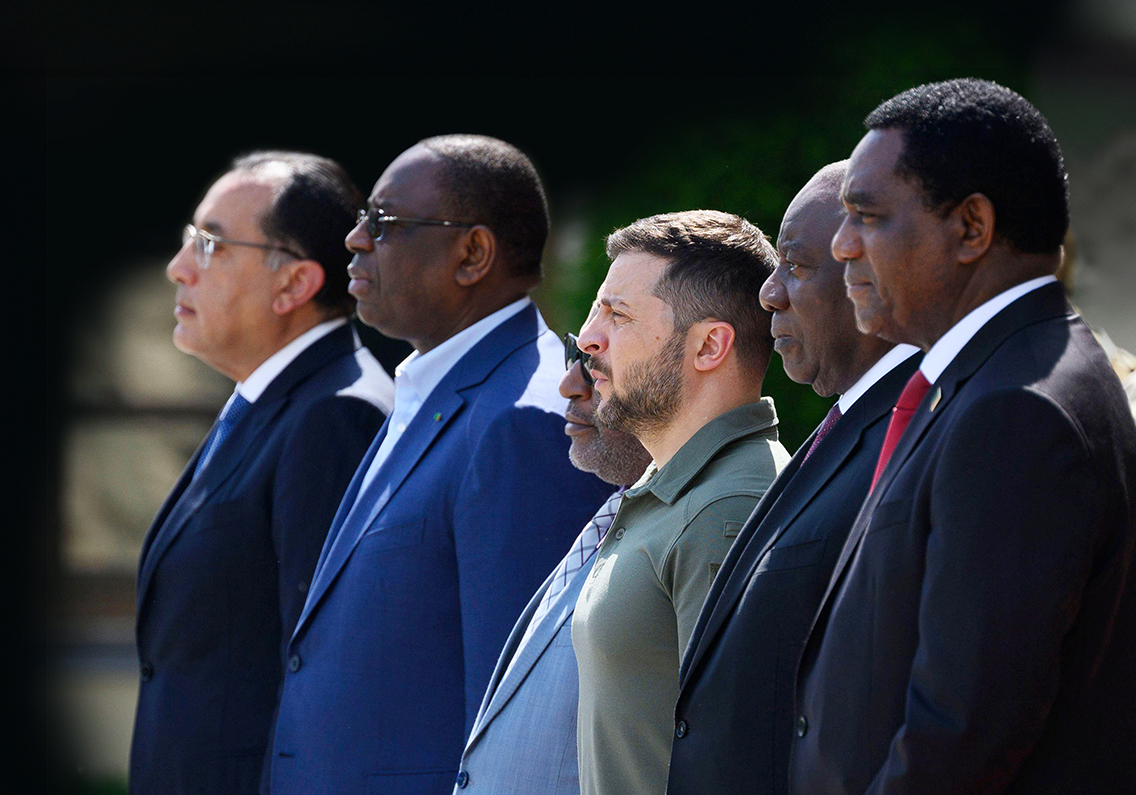
The largest collection of African Heads of State outside the annual AU summits gathered in China to attend the Beijing Summit of the Forum on China-Africa Cooperation (FOCAC) early in September. The 51 Heads of State were joined by Moussa Faki Mahamat, the Chairperson of the African Union Commission and António Guterres, Secretary-General of the United Nations.
This was a massive show of collective force and the continent’s powerful signal of its continuing confidence in the China-Africa relationship. The delegations were given the red-carpet treatment and the Summit was given pride of place in the Chinese national media.
China’s President Xi Jinping set the tone in his opening keynote address to the African delegation. He said that all African countries having diplomatic relations with China were now elevated to strategic relations level, that overall China-Africa relations were elevated to an “all-weather China-Africa community with a shared future for the new era”, and that China would work with Africa to take 10 partnership actions for modernisation.
He also announced $50bn over three years of financial aid to an Africa struggling under the weight of foreign debt and pulverising international interest rates.
In the hierarchy and status-obsessed Chinese diplomatic language, this meant that Africa as a whole would be considered a special partner, almost on equal terms with the world’s second-largest economy, and that China would work with the continent to help it overcome its colonial legacy and embark on a truly modern era.
African leaders, who have seen support from the West dwindling alarmingly and their interests marginalised, seemed to purr with pleasure as they listened to President Xi Jinping. This is what they had come for – an affirmation from the very highest levels of Chinese national leadership that despite its own economic slowdown and increasingly fractious relations with the West, it’s ‘win-win’ partnership with Africa remained undented.
Xi Jinping’s concrete 10-point programme on working with Africa to help accelerate its modernisation also hit exactly the right note. President Cyril Ramaphosa of South Africa, which is China’s largest trading partner in Africa, said that the continent “had not come to China with a begging bowl” in a pointed sideswipe to Western commentators who had suggested as much. He said he was looking forward to greater cooperation with the Asian giant in manufacturing and job-creation, Africa’s lodestar to its rapid industrialisation.
The Summit received saturation coverage in African media but was virtually totally ignored by the Western media. What little coverage of it emerged was characterised by speculation on China’s ‘suspicious’ motives in Africa which ranged from luring countries into a ‘deadly debt trap’, to bolstering China’s international clout in the UN and other forums. A few commentators acknowledged that the West has been losing ground and influence to China in Africa.
The full ramifications of the Beijing Summit and its impact on Africa will unfold gradually but it has arrived at a finely timed juncture in Africa’s relationships with the wider world. Can the continent maintain its non-aligned position when the pressure to join one or the other camp increases?
A darker mood
The international diplomatic mood has turned considerably darker since the optimism generated by the ending of the Cold War and the dissolution of the Soviet Union in 1992, celebrated by US political scientist Francis Fukuyama as the ‘universalisation of Western liberal democracy as the final form of human government’ in his book The End of History and the Last Man.
The acceleration of globalisation which followed in its wake opened up the global market to all comers and ushered in an era of unprecedented growth, particularly in the Global South, and the rise of the Tiger economies of Asia led by Japan and China. International trade multiplied in geometric progression as a cornucopia of goods and services flowed in a seemingly endless flow and were distributed to even the remotest corners of the globe. All boats rose on this economic swell and as the demand for materials and markets exploded, Africa found itself in a good place.
Citizens of virtually all countries enjoyed rising income levels and standards of living began to improve universally. International travel and tourism rocketed and with it came a deeper appreciation of the world’s cultures, customs and arts. The internet revolution, followed in quick succession by the digital one, was able to connect people from the furthest reaches of the globe with one another in split seconds. At long last, the dream of a unified, united world – hopefully living in peace and harmony.
But of course it was too good to last. The old human desire to dominate, to be number one, to outflank your competitor could not be suppressed infinitely and ancient and new fault-lines were discovered as fresh rivalries and deadly power struggles began to manifest themselves.
Even at the best of times, when youth from all continents were making music in unison and together raising awareness of famines and deprivation in parts of the world, bitter feuds were taking grim harvests of innocent lives in other parts.
The Middle East was aflame with the Iraq and Afghanistan wars, the Syrian civil war and the continuing persecution of the Palestinians in Israel; there were massacres and attempted genocides in the Balkans and Asian countries like Myanmar were locked in unending cycles of violence. Africa was not spared as Sierra Leone, Liberia, Sudan and Somalia descended into horrific bloodletting.
End of deadening effect
But at least the deadening effects of the Cold War – with its corralling of countries, including African ones into one camp or the other; as well as the actual proxy wars, especially in Southern Africa – were rapidly dissipating.
The superpowers, now including rising China, seemed to be working together on the basis of ‘competitive advantage’ – e.g. Western capital and innovation in tandem with low-cost production in Asia – to generate an unprecedented flow of goods at exceptionally affordable prices. This translated into a general spread of wealth across the world although, once again, Africa’s share remained the smallest of all the regions.
Nevertheless, freed finally from foreign ideological straitjackets, most African countries could concentrate on laying the framework for their own evolution to the proper industrialised stage. The focus was on infrastructure, the skeleton on which the muscle of enterprise, output and exchange could grow.
Pan-African financial institutions such as the AfDBD and the Africa Finance Corporation worked with national governments to raise sufficient funding for essential infrastructure such as power generation, ports, roads, etc. With demand for Africa’s resources at an all-time high and with a much more diversified market for their wares, African producers were able to strike favourable deals.
They had something valuable to offer the world market and in return, they wanted not only capital and consumer goods but technical support and expertise for their infrastructure. Enter China with its vast army of engineers, architects and construction workers and an insatiable hunger for African oil and minerals. It was, as it was said at the time, a marriage made in heaven – a win-win situation.
Africa could now realistically work to create its own continental market to absorb the expected increase in the output of processed goods and also accelerate its external trade. Institutions like Afreximbank came into their own and the long-wished-for unified African market emerged as the African Continental Free Trade Area (AfCFTA), the world’s biggest regional single market.
Real and manufactured tensions
But the era of general peace and goodwill had only a brief life before global tensions, whether real or manufactured, began to reassert their historical grip on human consciousness.
Once again the big powers began to distance themselves from each other and disparate groupings began coalescing. The flexing of military muscle increased, mutual suspicion intensified, and propaganda was ratcheted up. The language of ‘East versus West’, ‘Them and Us’, ‘Friend and Foe’ was dusted down, burnished and quickly became a staple for the mass media.
There was a brief period of global cooperation during the Covid pandemic when the whole world faced what developed into a catastrophic and seemingly unstoppable viral attrition. But even then, fingers of blame were pointed by one camp against the other.
The real heroes were the doctors and nurses, the researchers and virologists who eventually managed to tame the Covid monster and render it more or less harmless. But they, like the UN, the WHO and other global organisations found themselves working from the sidelines, increasingly being squeezed out by nationalistic stances.
What happened to the peace dividend that had generated so much prosperity and human goodwill – and had given the world’s poor a real opportunity to change their condition? Analysts, political scientists and historians are still working out how the cessation of hostilities has morphed into a new Cold War over such a short span of time.
Several theories have been advanced, including that many industrialised nations depend on their military-industrial complexes to keep their economies consistently growing and for this to remain a high priority in national budgets, there have to be enemies ‘posing threats’. These threats are usually unspecified and can change but as long as ‘a threat’ exists, vast resources can be allocated to combat it.
Ironically, economic theory seems to support this argument. In an economy that has reached optimum supply-demand, the only way to grow is to produce ‘more butter’ (luxury) or guns (war). But the demand for ‘butter’ is finite as one reaches saturation beyond a certain point, while the demand for guns is infinite as arms are destroyed as part of consumption, and so there is always a supply deficit.
Others have blamed it on a particularly weak set of global leaders who have relied on populist short-term policies to remain in power and have used the prop of external threats to maintain national unity.
Set into motion the divide
Whatever the cause, the tensions were rising and came to a head when Russia invaded Ukraine, immediately setting into motion the current divide between the US-led West and the smaller Russia axis. A third grouping led by China, Iran, Syria, India and Brazil, has sought to remain non-aligned but some members have shown a tendency to lean away from the West.
Into this configuration we have the ongoing conflict in Israel where an attack on Israeli civilians by the militant arm of the Palestinian organisation Hamas last year has led to the destruction of most infrastructure in the closed area of Gaza and the deaths of over 40,000 mostly civilians, including women and children. Israel has been accused of using starvation as a weapon of war and the Israeli Prime Minister Benjamin Netanyahu is being investigated by the International Criminal Court for alleged Crimes Against Humanity.
This conflict, with its terrible, nightmarish images on television screens and social media around the world, has also deeply divided the world between those that support Israel and those who think its response has been disproportionate and could possibly amount to attempted genocide. South Africa, with its own history of Apartheid and mass deaths, was the first to bring charges against Israel over attempting genocide at the International Court of Justice.
With the current global polarisation, Africa once again finds itself in the invidious position of having to choose sides when most leaders have always said they wish to remain non-aligned.
Africa’s wriggle room
How much wriggle room has Africa got? It seems it has sufficient to be able to plough its own furrow. The concerted gathering in Beijing, against the wishes of the West, was also a gesture that Africa will decide for itself who its friends and foes are, rather than be led by the nose by either grouping.
There is little doubt that the West’s virtual monopoly of influence in Africa has been waning fairly rapidly over the past decade. France’s hold in West Africa and control over the uranium production it needs for its advanced nuclear industry has been badly shaken and is tenuous at best.
Russia has established a firm foothold in some West African countries like Burkina Faso, Mali and Niger. The Wagner Group was seen as a much more effective force against jihadists than the Western forces led by France. Influential journalists have been on trips to Russia as well as Russian-controlled areas of Ukraine. Turkey and UAE have become important players in the region, both economically and politically, especially in countries like Sudan.
Anti-American sentiment, especially on its support and arming of Israel, has been growing not only in African Muslim states but generally among Africans, who can relate to the plight of the Palestinians. They say the rules-based international order is a myth as some countries can get away with mass murder, whereas others, especially Africans, are quickly condemned and prosecuted.
They saw Netanyahu’s public rebuffal of US President Joe Biden’s attempts to persuade him to tone down civilian deaths as proof of the US’s impotence to effect change.
On the economic front, aid from the West has contracted considerably but its legacy of debt has remained as a burden on many African countries. The West has warned Africa about being lured into ‘debt traps’ by China but the continent counters by saying that the Chinese debt is only 12% of the total, while debt to private Western lenders is 35% and to multilaterals such as the World Bank and the IMF, it is 39%. Interest rates, they say, average 5% to Western lenders but only 2.7% to Chinese ones.
Kenyan delegates to China pointed out that the riots that rocked the country recently were over the raising of taxes to service international debt of $180bn, while only $6bn of this was owed to China and the conditionalities imposed by the IMF had sparked the riots.
China’s pledge of $50bn over three years has been welcomed. There was also support for its decision to scale down the size of its projects and concentrate on green industries. Africans believe the smaller projects give them greater control and that they will be able to fund and run them independently fairly quickly.
The question is, will Africa find the right balance to stay clear of any alignment as the big powers increasingly square up to each other, and continue its own evolution towards true industrialisation?