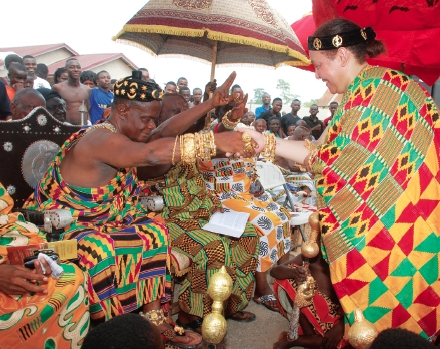
Pan-Africanism was taken a step higher on 21 March at Agona Ashanti in Ghana when the Tanzanian, Dr Frannie Léautier, the executive secretary of the African Capacity Building Foundation, was enstooled as the new Queen of Development (Nkosuohemaa) of the Agona Traditional Area. The colourful ceremony was held in appreciation of the immense work she has done for the cause of Africa, reports Stephen Gyasi Jnr.
The Tanzanian-born Dr Frannie Léautier, executive secretary of the Harare-Zimbabwe-based African Capacity Building Foundation (ACBF), decked in a colourful Kente cloth and gold jewellery, beamed and danced the traditional Adowa dance to the admiration of the large crowd that attended her enstoolment ceremony at Agona Ashanti.
Her enstoolment as Nkosuohemaa – Queen of Development – of the Agona Traditional Area in the Ashanti Region of Ghana was in appreciation of the work she has done in the past in uplifting societies across Africa. At her enstoolment ceremony, on 21 March, Dr Léautier stressed the importance of continued community development, particularly that of capacity development. She takes the traditional name, Nana Akosua Peprah Asiase.
The well-attended ceremony served as the ideal platform for Dr Léautier to announce the formation of the Léautier Family Foundation, a non-profit organisation, aimed at empowering and preparing girls for the future as invaluable agents of positive change and national development.
Festooned in rich Kente and precious jewels, the new Nkosuohemaa emphasised the value of combined energies, such as that of the Agona Traditional Council and the Léautier Family Foundation, in order to harness the capabilities of communities to raise standards of living as well as dispel poverty and ignorance from the community.
In many respects, the combined significance of Dr Leautier’s enstoolment, the formation of the Léautier Family Foundation, and her role at the ACBF, which over the last 20 years has greatly helped in the building of human capacity across Africa, highlights the unwavering dedication that she has demonstrated towards the upliftment of fellow Africans.
She told the cheering crowd at the ceremony: “While it may be that I am seen as one of the strategic leaders driving capacity development in Africa, I am hoping that this honour combined with the formation of the Léautier Family Foundation sends a signal that we, who impact development in our official capacity, should also contribute to Africa’s development in a more personal and individual manner, and not just from the positions we hold.
“My hope is that the formation of the Léautier Family Foundation sets the stage for others to identify areas where they can make such a personal contribution, whether with their time or income, especially those of African descent or heritage,” she added.
It is this very spirit of Africanism that Dr Léautier understands deeply. Growing up as a young girl in her home town of Kilimanjaro, she witnessed the struggles of families to survive, especially the burden of women who toiled endlessly at multiple tasks to ensure family survival, some within single-family households.
She came to understand the impact of development and science in managing the risks associated with the African cultural dependence on nature for survival, through agriculture and sustenance, and she marvelled at the strength of people and communities working together to motivate change. To her, applying the thinking that the nucleus of change lies with women, is an important aspect of life that underpins the essence of the Léautier Family Foundation. Its two main objectives are to improve the girl child’s access to quality education and to enhance their learning capabilities. These will be achieved by: the provision of scholarships or bursaries; the advocacy and sensitisation of parents, guardians, teachers and school management committees; and networking with similar organisations. The pilot phase of this project will be rolled out in June this year in the Sekyere South District of the Ashanti Region in Ghana, benefiting school girls between the ages of 13 and 27 years and facilitated by the Peer Education Programme (PEP) Ghana. After a comprehensive impact assessment of the pilot project, it will be introduced in other districts across Ghana before travelling the frontiers to the broader African communities.
Dr Léautier said: “This may be a small contribution but I, along with my family, am very keen and excited to see what the support of even just a few young women can effect in helping them through the challenges on a journey towards leadership.
“The Foundation’s success will be achieved by ensuring that contributions satisfy the right priorities so that we can measure the trajectories of those that benefit.
“I believe the birth of this collaboration, climaxed by today’s enstoolment, marks a new relationship between myself, my family, and the good people of Agona Traditional Area.
“I am deeply touched that the Agona Traditional Council, although far from where I was born, would bestow such an honour on me, to recognise that not only is development deeply important for Africa but that I could actually be a representative for that view.
“To know that the things I have been doing and saying over many years, that there were people listening and that they would find something worthy in it, makes me extremely proud, and I hope I live up to the expectation of what has been bestowed upon me by the Agona Traditional Council today.”
The paramount chief of the Agona Traditional Area, Nana Frimpong Anokye II, noted that “the selection and enstoolment of Dr Frannie Léautier as Nkosuohemaa will enhance the promotion of girl child education in our area. Already, the Stool has put initiatives in place to promote girl child education, including the conversion of an uncompleted S.I.F. project into a full scale Technical and Vocational School for girls.
“This project is intended to be developed into a tertiary institution in the near future. We are therefore open to ideas and suggestions on how to nurture this dream as a means of promoting skills training and a broader empowerment of girls and young women in our area,” said Nana Frimpong Anokye, himself a PhD holder.
He expressed the hope that engaging and working closely with the new Nkosuohemmaa and other stakeholders in the years ahead would improve the livelihood and wellbeing of the people in the paramountcy, especially women, children and the vulnerable.
“I pledge on behalf of my people to cooperate and work closely with you in this mutual endeavour to bring positive change and progress into the lives of our people,” Nana Frimpong Anokye said.
The Nkosuo Stool of the Ashanti kingdom was introduced by the late Asantehene, Otumfuo Opoku Ware II, the 15th occupant of the legendary Golden Stool. The purpose for the creation of the Stool was to recognise persons who have contributed or can contribute to the progress and development of society.
Profile
Dr Frannie Léautier is the executive secretary of the African Capacity Building Foundation (ACBF). She has a rich career in the private sector and in international development. She served as the vice president of the World Bank and head of the World Bank Institute from December 2001 to March 2007. She also served as Chief of Staff to the former President of the World Bank from 2000 to 2001. From 2007 to 2009, she took over as Managing Partner at the Fezembat Group, a company focused on risk management and leadership development Dr Léautier has published a number of articles in top-tier economic journals as well as opinion pieces in influential magazines and newspapers. She is currently the founding editor of the Journal for Infrastructure System, advisory board member of MIT Open CourseWare, and a former secretary to the board of the Nelson Mandela Institute of Science and Technology in Africa.
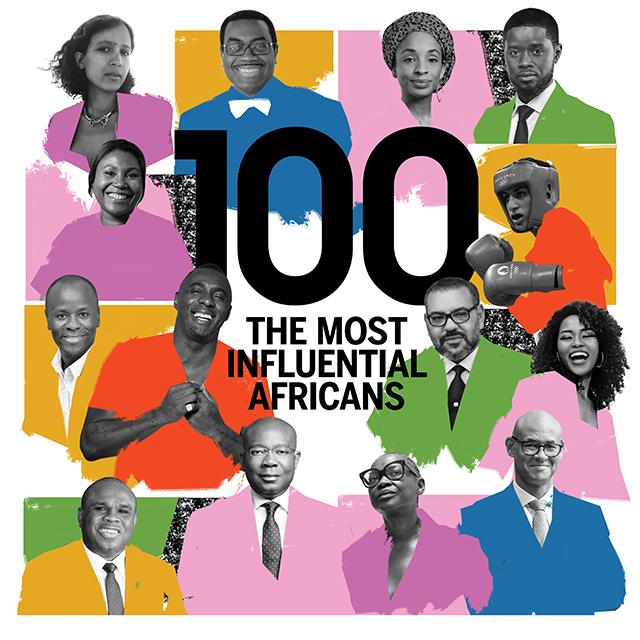
Dr Léautier is also a chartered member of the advisory board for EuroEFE, founding board member of the Africa Institute for Governing with Integrity, a member of the task force for Haiti set up by the World Innovation Summit for Education (WISE) initiative funded by Qatar, and has recently been named among the top 100 most influential people in Africa.
Dr Léautier holds a Bachelor of Science degree in Civil Engineering from the University of Dar es Salaam (1984), a Master of Science in Transportation from MIT, USA (1986), and a PhD in Infrastructure Systems from MIT (1990). She is also a graduate of the Harvard University Executive Development Programme.