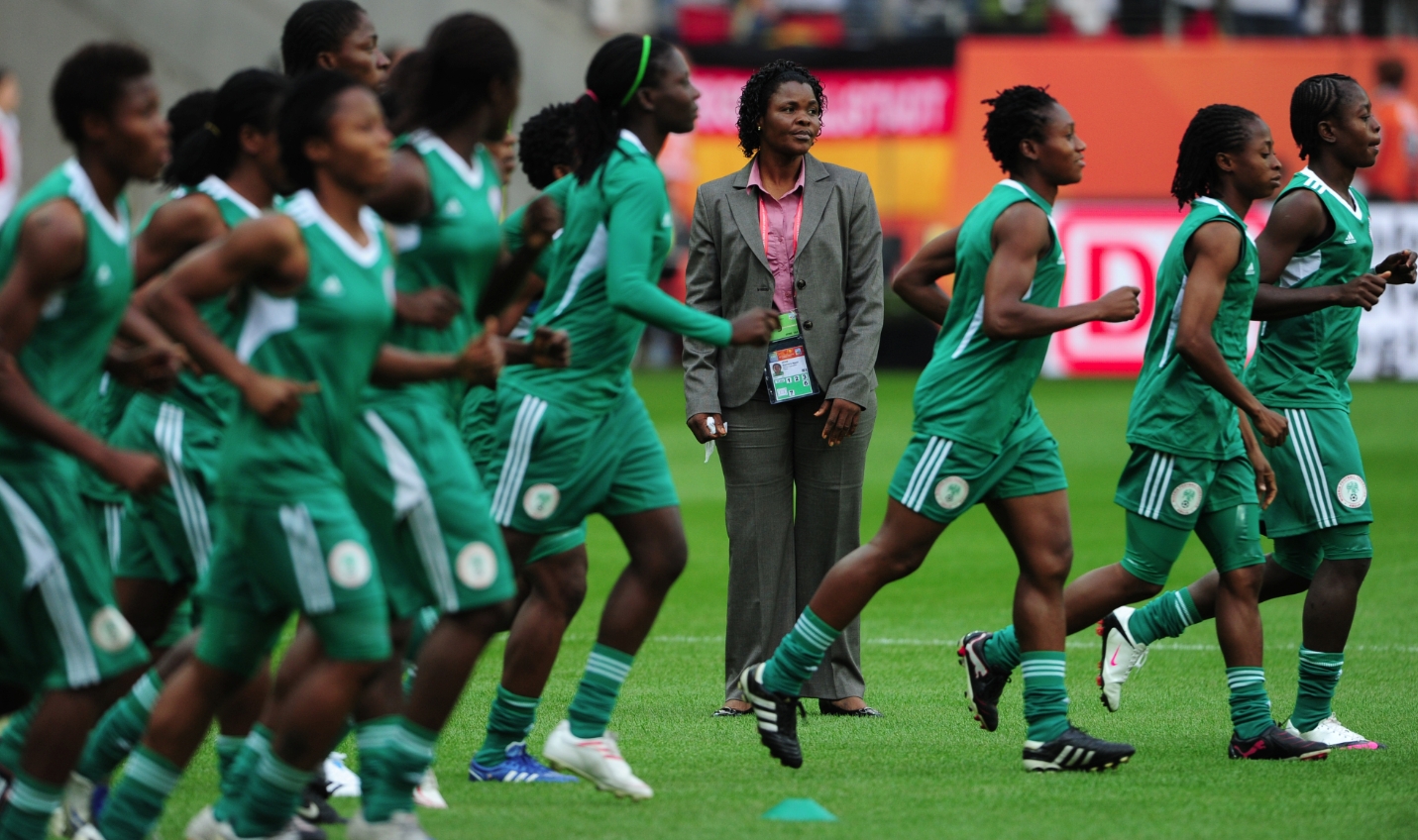
The Burundian, Lydia Nsekera, is the first woman in the history of football to join FIFA’s Executive Committee, which essentially remains a male club. “I think I am very much ‘one of the boys’ when I am talking about the game… When you show that you care for the game and you actually understand the game, the fact that one is a woman matters less,” she tells our football editor, Osasu Obayiuwana.
When the world football’s governing body, FIFA, ended the 108-year men’s club that its Executive Committee had unfairly and unrealistically been, it was a historic moment of pride for the African continent. Burundi’s Lydia Nsekera, a member of the International Olympic Committee (IOC) and member and president of Burundi’s Football Federation, became the first woman in the sport’s history to be made a member of FIFA’s Executive Committee. She is the only female FA boss amongst FIFA’s 209 national associations.
Spending an hour talking to the former basketball player, at the top floor of London’s Hilton Hotel in Park Lane, Nsekera comes across as being warm, intelligent, polite but quite firm, not flustered by being the lone woman in the midst of men.
Credible sources within the game speak about her honesty and integrity – qualities that seem to be in very short supply amongst the game’s chieftains these days.
“I don’t feel lonely, because my male colleagues and I speak the same language – football… I entered football in 2000, because I love the sport,” the 45-year-old says.
“I think I am very much ‘one of the boys’ when I am talking about the game… When you show that you care for the game and you actually understand the game, the fact that one is a woman matters less.”
But her ascension to FIFA’s Executive Committee, at the 2012 congress in Budapest, Hungary, did not come without its opponents. Several influential members of FIFA’s “Club of 24”, including UEFA president and French football legend, Michel Platini, were stoutly opposed to Nsekera’s arrival. It was for this reason that rather than hand her a four-year term, like her colleagues, Nsekera was only given 12 months, with her status to be reviewed at the 2013 congress. FIFA president, Sepp Blatter, tacitly acknowledged the stumbling blocks unfairly put in Nsekera’s way, by some of his uncooperative colleagues on the committee. Promising to fight for the retention of Nsekera on the Executive Committee, Blatter hinted he would resort to other measures to ensure she remained the Committee’s 25th member. “I tell you, it will be easier for me to get the support of the congress for this [to get her a four-year tenure], than the Executive Committee,” Blatter admitted. “I will fight for that and I will put it before the congress… This means that she will stay on the Executive Committee. She must remain there. When we have put the first woman in the history of FIFA onto the Executive Committee, we must fight for her.”
Nsekera appears to be quite at ease with the undulating political situation in the corridors of FIFA. “The current situation was decided by the congress long before, so the fact that I am only serving one year, with a proper election following to give a woman a four-year term is not personal. We are simply following procedure.”
While Blatter seems prepared to bat strongly for Nsekera, her status in the executive corridors of the Confederation of African Football (CAF) remains foggy. It is the established tradition that every member of FIFA’s Executive Committee, with the exception of Blatter, for obvious reasons, doubles as a member of the Executive Committee of their continental confederation. Joining CAF’s Executive Committee, where Nsekera would also make history as the first woman to become one of its members, ought to be a settled affair. But, as she told African Football, CAF president Issa Hayatou has not broached the matter. “He has not said anything about my joining the CAF Executive Committee,” she said, smiling.
The relevant CAF statute, on qualification for membership of the Executive Committee, gives its mandarins a legally sound excuse not to invite her in. Article 22(3) of its laws state that “African representatives (emphasis mine) on the FIFA Executive Committee shall attend all meetings of the CAF Executive Committee without a right to vote.”
Based on this provision, Nsekera has no firm legal ground to stand on. But – and it is a big but – the CAF president has the power to exercise his discretion and invoke powers under Article 22 (1), which allow the “Executive Committee” – which, in practical reality, is him – to co-opt her onto the Executive Committee, as one of the two members that can be appointed in that way. Whilst an African, Nsekera was clearly not elected onto the FIFA Executive Committee to represent the continent’s interests but that of women around the world.
However, the reality is that she is expected, alongside Egypt’s Hany Abou Rida, Algeria’s Mohamed Raouroua, Côte d’Ivoire’s Jacques Anouma and CAF boss Hayatou, to defend the continent’s interests during Executive Committee meetings. Molefi Oliphant, the former president of the South African Football Association (SAFA), got one of the co-opted positions at the 2011 CAF congress in Khartoum and he certainly cannot be made to give way. But while Tunisia’s Slim Aloulou was banned from all football activities, for his involvement in the “votes for cash” scandal that tainted the award of the 2018 and 2022 World Cup hosting rights, there was an opening. That firmly shut when he was allowed to return to the CAF Executive Committee at the expiration of his ban.
A CAF Executive Committee member talking to African Football “off the record”, claimed that Hayatou’s personal dislike for Nsekera would ensure that she would never be invited to join the CAF Executive Committee.
That does not discourage the 45-year-old, who has been the president of her country’s football federation since 2004, from being positive about breaking boundaries and seeking new frontiers.
“I think things will change in the ensuing years… It’s all a question of politics. There are women presidents and prime ministers, so I am sure that there will be a lot more women elected to football positions than there are now.
“I remember when I was approached in 2003 to be a candidate for the presidency of my country’s football federation, I initially said no (in fact I asked for three days to think about it, I thought they were crazy). But when they came back, I saw that they were serious. And I set certain conditions, in order to protect myself… The truth is that women in Africa are not given the same level of respect as men. It is a question of mentality.”
The disparity in financial treatment and attention between the male and female game, is one that upsets Nsekera greatly. Since the Women’s World Cup began in 1991, in China, Nigeria is the only African country that has reached the quarter-finals of the competition. The continent’s other representatives have never gotten past the group stages.
“There is little or no funding for female football in Africa, compared to what the male teams get,” Nsekera said ruefully. “In Africa, there are people who even question the rationale for funding female football. But I am confident that with the right encouragement, women’s football will evolve and reach the level of the men.”
She continued: “Most African female footballers cannot concentrate on the game full-time and have other commitments, so they are unable to give the sport the attention it needs. We need to change that.
“It is clear that without regular league competition for our women, throughout the continent, there is just no way our national teams will be able to effectively compete at tournaments like the Olympics.
“They do not have the level of competition that can bring them up to the needed level of performance. And they hardly have good friendly games, against top-quality opponents, with which to prepare for international tournaments.”
Whilst Rwanda, Burundi’s next door neighbour, made their Nations Cup debut at the 2004 edition in Tunisia, Burundi are yet to earn passage to the continent’s top event. Earning passage to their debut is a matter of great priority for Nsekera.
“That is true and we want to change that. But we do realise that many of the players that featured for Rwanda at that tournament came from Burundi. You know that we are quite intertwined, as a result of the family relationships between the two countries. We are working hard to realise this objective.”
Whilst trying to establish Burundi’s credentials on the continental stage, African football has struggled to make sustained progress over the last few years.
And with the rather disappointing performance of five out of the continent’s six teams at the last World Cup finals in South Africa being a major point of reference, Nsekera admits that levels of professionalism, among the players, as well as officials, must improve. But leaving her indelible mark on the Executive Committee, in the hope of securing a permanent four-year term, when elections take place in 2013, is Nsekera’s main focus.
“Football is for everyone, and my interest is in aiding the development of the game in general. Obviously I represent women’s football and I think it’s important to have a woman sitting on an executive body. But more than anything else though, I represent the football family as a whole. Football is a universal sport. It’s as simple as that.”