The Katumbi Football Academy is central to the long-term plans of TP Mazembe to control their own destiny. Few clubs in African football rely on developing their own talent, preferring to rely on poaching ‘finished products’ from others, for their title and other short-term ambitions.
The prohibitive cost of discovering and nurturing young, budding talent, which adds up over several years, has been a major disincentive for the continent’s clubs, for whom just meeting daily needs can be extremely challenging. Poaching was a script Mazembe also followed, until its president realised they had to lay a much stronger, dependable foundation for the development of players, who would be painstakingly instilled with the football culture and personal ethos Mazembe’s keen to promote.
“Congo has been producing good talent for a long time but there has been no sustainable investment in them,” Katumbi observes.
“Before the political troubles in Congo, the school system did a lot to discover and nurture talent. But our problems ensured that this system was completely destroyed, until recently.”
“For Mazembe, we know that if we are to remain a strong team, we must build our future with the youth. That is why we are making a significant investment into the academy.”
“We have acquired 500 hectares for the construction of the academy’s physical infrastructure, which when completed, would be on the same level with any top academy in Europe,” Katumbi insists.
Frenchman Regis Laguesse is the man that has been entrusted with enforcing the vision for the academy.
Laguesse worked with Jean-Marc Guillou at the very successful ASEC Mimosas academy in Côte D’Ivoire, which produced the Touré brothers, Kolo and Yaya, Emmanuel Eboué and other well-nurtured products that went on to successful careers in European club football.
This Academy, set up in 1994, has reportedly produced 48 professional players so far. Laguesse is keen to transfer the success in Abidjan to Lubumbashi.
“I met with Moîse [Katumbi] for the first time in November last year. This meeting was organised by Roland Scheubel, a very senior adviser to the president,” Laguesse tells African Football. Scheubel, who designed the grand vision for the academy, handpicked Laguesse for the project. “Before coming here, I was running my own academy in Kinshasa,” Laguesse said.
“After talking with Katumbi, and seeing that he had a very serious vision for Mazembe, I decided that I wanted to be a part of this plan and we started on the 16th of January, this year.”
“I arrived from Kinshasa with 16 boys, who were between 12-14 years old. Most are between 13 and 15 now.”
“Just last September, we added four players from Lubumbashi, selected from the scouting missions that we did during the past months.”
“So, we have a total of 20 players in the very first intake that we have at the academy.”
“Since September this year, we admitted our second generation of players in the academy, picking 12 players from the 5,572 children that we scouted throughout Lubumbashi and its environs.”
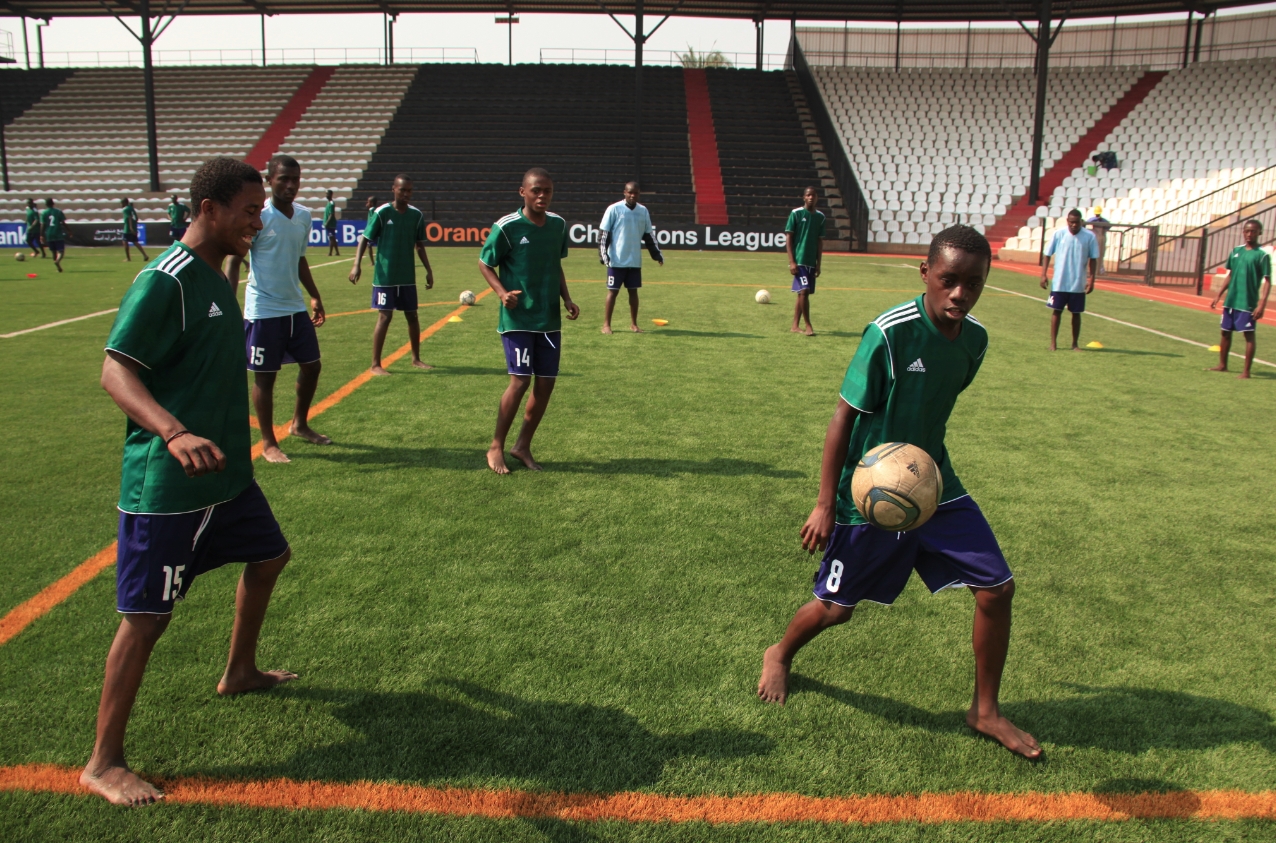
One of the unique training methods for players at the academy is that they must play barefoot until they have passed the academy’s stringent technical tests. In addition to playing without shoes, 18 players – divided into nine-a-side teams – play daily matches on only half a pitch, without goalkeepers.
It is only in January next year, while the rest of the continent will be paying attention to the Africa Cup of Nations finals in South Africa, that the academy’s first generation will make the transition to football boots and 11-a-side games, on a full pitch.
“I know the methods that we use in Mazembe will be frowned at by some of my colleagues in Europe, who think that their ways are superior,” Laguesse laughs.
“But I know, and this is something that we tested at ASEC Mimosas, that this method produces a better quality of footballer. It is far harder to control the ball with your bare foot than it is with a boot.”
“Once a young player is able to play very good football doing this, they will have a distinct advantage when they wear boots, because they will have much better control of the ball, developed from a sense of not wearing boots, even when they do wear them,” Laguesse argues.
“The principles we promote are technical dominance of the ball, intelligence in the collective game, speed in the moves – without the ball – and good final execution.”
“We are also keen to develop respect for the game, and for the opponent, in our players. This is very important.”
Whilst Katumbi has a reputation for a very hands-on approach with Mazembe’s first team, he claims he has little day-to-day involvement with the academy.
“I do not involve myself in the technical side of the academy. I leave that to the experts.” But Katumbi insists ensuring the youngsters are developed into responsible young adults, even if they do not have a career in football, is a matter of primary concern to him.
“The children have their school lessons. Some of them, some as old as 12, are very talented young players. But they never had the opportunity to go to school until they came to the academy.” Jerome Champagne, FIFA’s former deputy general secretary and director for international affairs, who is an adviser on international affairs for the club, is confident Mazembe’s template will keep them firmly on the path of prosperity.
“TP Mazembe is a flagship for the continent…. Africa is moving with new [football] leaders, efficient persons who are dedicated, honest and hardworking.”
“Katumbi has a vision to make the club stronger and more sustainable. He wants the club to have agreements with other clubs in Europe and South America, in order to benefit from the experience of these clubs.”
“What he is trying to do is to send a message to the world that we may have problems but with good methods and techniques, we can be a success.”
But Katumbi says making a success of Mazembe, without a complete transformation of the way club football is managed in other parts of the continent, would be far from satisfactory.
“Africa has so much football talent. I am appealing to governments in the continent to provide the enabling environment for football to grow… Football brings so much joy and happiness to us, it can create better lives and a better world.”
Only very few people can disagree with that thought.