Rashidi Yekini, one of the greatest strikers to emerge from Africa, died inexplicably on 4 May, leaving more questions than answers as to what really happened to the former African Footballer of the Year, writes our football editor, Osasu Obayiuwana, who knew him.
WITH HIS INTIMIDATING frame, gazelle-like speed and deadly accuracy in front of goal, Rashidi Yekini deservedly etched his name into the pantheon of African football legends. He was the first Nigerian to earn the prestigious CAF African Footballer of the Year award, one of the all-time top scorers at the Africa Cup of Nations finals (scoring 13 goals in the 1984, 1988, 1990, 1992 and 1994 editions – only Ivorian Laurent Pokou and Cameroon’s Samuel Eto’o were better), and was the first from his country to score a goal at the World Cup finals (in 1994).
He was also the country’s leading goalscorer and one of the few marksmen from the continent to emerge as a top scorer in a major European league – with Vitoria Setubal in Portugal. The fear of Yekini’s prowess was the beginning of wisdom for opposing defenders.
Dying in mysterious circumstances on 4 May in south-western Nigeria – the exact cause of death remains unknown – the demise of the 1993 winner of African football’s top individual award has thrown the entire fraternity into shock and grief.
He was buried the following day, in his hometown of Iffa, Kwara State, according to Muslim rites. He was survived by a mother, siblings, a wife and two children.
A mere 48 years old when he passed away, Yekini was, interestingly, a shy, reserved person off the pitch, who unashamedly revelled in his own company, which led many to question, with good reason, his state of mental health, in the months and years leading to his death.
Largely keeping his own counsel since retiring from international football in 1998 and club football in 2006, the “Goals father”, as he was popularly known, was never found on the game’s social circuit and shunned several lucrative commercial offers from blue-chip companies, keen to leverage on his fame and huge fan base throughout Africa.
Even for me, who developed a rapport with Yekini, pinning him down for an interview was an impossible task.
Ahead of the 2010 World Cup in South Africa, a television company in England, producing a series on the greatest goals ever scored at the World Cup finals, was desperate to profile him and asked me to arrange an interview in Ibadan, where he lived. I made a deluge of phone calls to coax him into doing so.
But Yekini politely – but bluntly – refused. “So many come to me with offers. But I am not interested,” he told me in a very revealing interview I had with him, almost seven years ago in Abeokuta, south-western Nigeria.
“God has made me into what I am, and I don’t need any further things in life. I am happy with what I have,” he said.
This untypical answer flies in the face of the usual attitude of retired players, frightened of fading into the sunset, and keen to remain in the memories of adoring fans.
Having lost his father at a rather early age, Yekini – who barely managed to have a primary school education – told me about the hardships he experienced as a youngster, whilst growing up in Kaduna, northern Nigeria.
“I was sleeping in all kinds of places and had no idea about how I was going to survive. It was a very hard life and it made it hard to really put my trust in anyone. It is hard to trust your mother or your father even,” he said. It was a rare glimpse into the inner recesses of Yekini’s mind.
Having been taken off the streets by a man called Baba Jibrin, whom he said saw his untapped potential, Yekini started his football career playing for UNTL, a club owned by a textile company based in Kaduna.
But Yekini did not get his big break in the Nigerian Championship until he moved to Ibadan, where he played for the former Africa Cup Winners’ Cup Champions, IICC Shooting Stars, now known as 3SC. Even though Yekini was Yoruba by birth and should have been comfortably returning to the region of his own ethnic group, moving to Ibadan was a huge culture shock. By upbringing, he was a Northerner in every other thing but name, speaking the Hausa language like a native and adopting their ways of life, so the transition down south was far from seamless.
He subsequently formed a unique on-field and personal relationship with another African legend, Segun “Mathematical” Odegbami, whose career was ending, as Yekini’s was beginning to blossom.
The duo’s telepathic understanding during the 1984 African Cup of Champions Clubs (now renamed the African Champions League) campaign earned them a ticket to the final, where they lost to the Egyptian side Zamalek in Lagos.
The former Nigeria captain, who was one of the last people to meet with Yekini before his untimely demise, describes him as an enigma. “Rashidi’s life was totally and completely wrapped around football,” recalls Odegbami, a lethal right winger in the Nigeria squad that won the 1980 Africa Cup of Nations on home soil.
“He did not understand player politics…The training ground was his world. On it, he came alive and shone like the midday sun. Outside it, he almost did not exist. He would retreat into his own world, a narrow impregnable world, shut to all.”
Yekini’s exploits at Shooting Stars, between 1982 and 1984, earned him a lucrative move to local rivals Abiola Babes, Nigeria’s richest club at the time. It was his last Nigerian foray before moving abroad, with Ivorian club Africa Sport. But Yekini remained an unpolished gem until his sojourn at Vitoria Setubal, the modest Portuguese club, where he evolved into the finished product, scoring an amazing 90 goals in 108 appearances.
Having emerged as the league’s top scorer in the 1993/1994 season, as well as winning the 1994 Nations Cup tournament with Nigeria – where he was also the tournament’s top scorer – it set the stage for Yekini’s – and his country’s – World Cup debut in the USA.
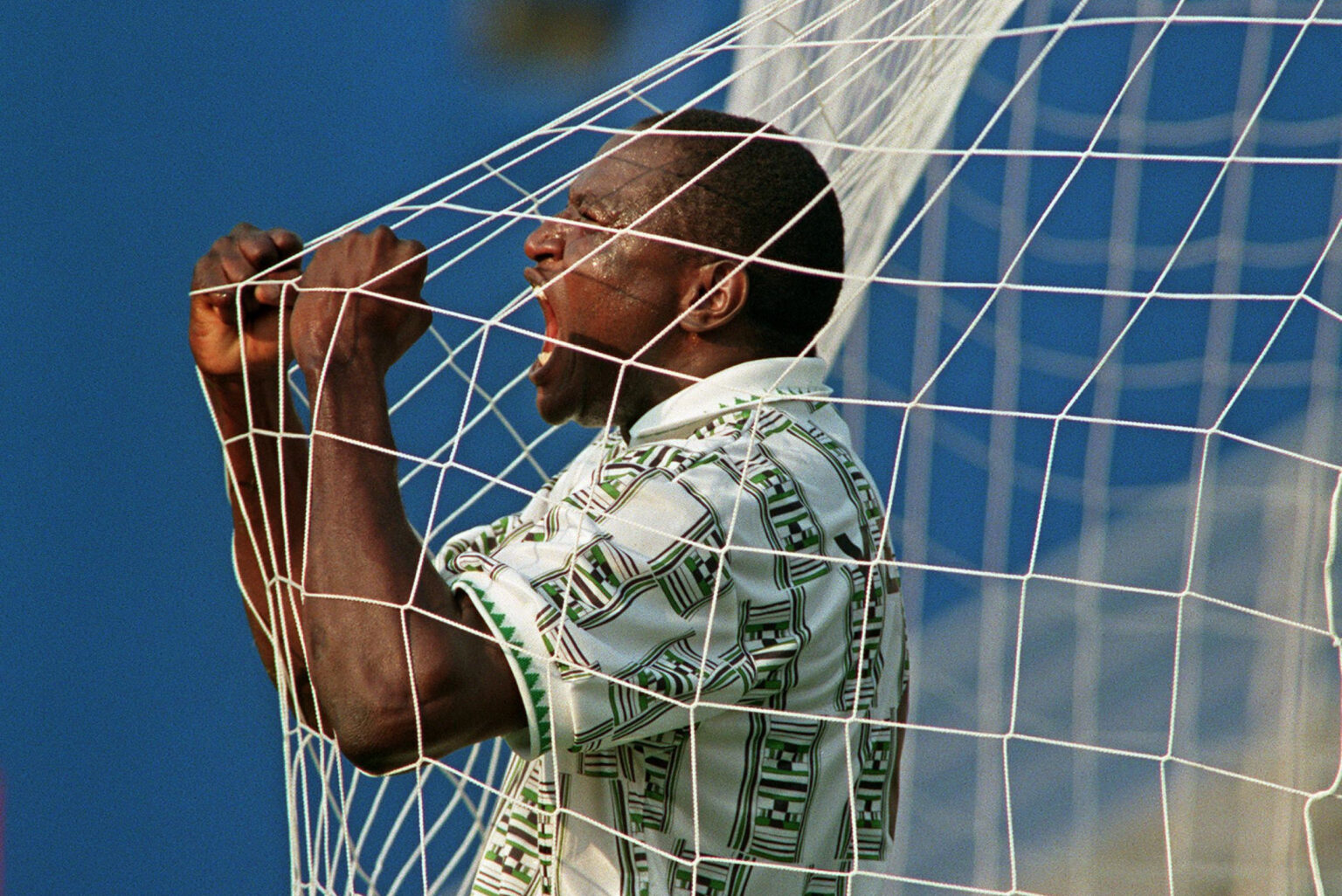
But after making history by scoring Nigeria’s opening goal, in that 3-0 win over Bulgaria in Dallas, Texas, which came with an unforgettable celebration – his shaking the net in a frenzy and, as he revealed to me in September 2005, uttering prayers of thanksgiving to God – it was, unbelievably, the last World Cup goal he ever scored.
Odegbami recalls: “When I became the team manager of the Super Eagles at the 1994 [Africa] Cup of Nations and [the] USA ’94 World Cup, I worked very closely with him, guiding him through the minefield of the power-play and player rivalry that… almost destroyed that great team. So, Rashidi trusted me.”
Returning to Nigeria, after playing in the Ivorian, Portuguese, Greek, Spanish, Swiss, Tunisian, and Saudi Arabian leagues, Yekini stunned everyone by making a return to the Nigerian league in 2005. He signed for Julius Berger and subsequently ended his career with Gateway FC of Abeokuta in 2006.
“Many people were shocked that after all my achievements in Europe, I would return to Nigerian league football. But I felt I had a duty to pass on my knowledge to the younger ones. And besides, I still enjoy playing. I was certainly not doing it for the money,” he laughed then.
Following the end of his club career, Yekini stayed alone in his Ibadan house, shunning the company of old team mates, friends and family. But his passion for the game was undimmed as he trained, unfailingly, at the Adamasingba Stadium every day.
Odegbami had to wait nearly six years before he met up with Yekini, in Ibadan, for a long chat in March 2012, in what perhaps was the latter’s last major conversation with anyone before his untimely death. “I had convinced him to return to the football community and involve himself in a number of activities. He was going to accept an endorsement from a bank, also. We were looking forward to so many other things, only for this to happen. I am so numb and angry, that it is very hard to talk about Rashidi’s passing,” Odegbami told me.
That Yekini is remembered for the explosive, exciting way he lived – on the football field – rather than the tragic way in which he died, is, perhaps, the greatest tribute the football fraternity can pay him. Adieu Rashidi, adieu…
Senegal’s hero
Another great African striker, Jules Bocande of Senegal, died from a terminal illness in Metz, France on 7 May. The 54-year-old, who scored 69 goals in 223 Ligue One matches, played for several French clubs, including Paris Saint-Germain, Nice and FC Metz. He was the top scorer in the league, with Metz, in the 1985/86 season. Bocande, who also captained and managed his country, was the father of FC Metz player Daniel Bocande. The elder Bocande had a 14-year international career with Senegal that ended in 1993, scoring 20 goals.