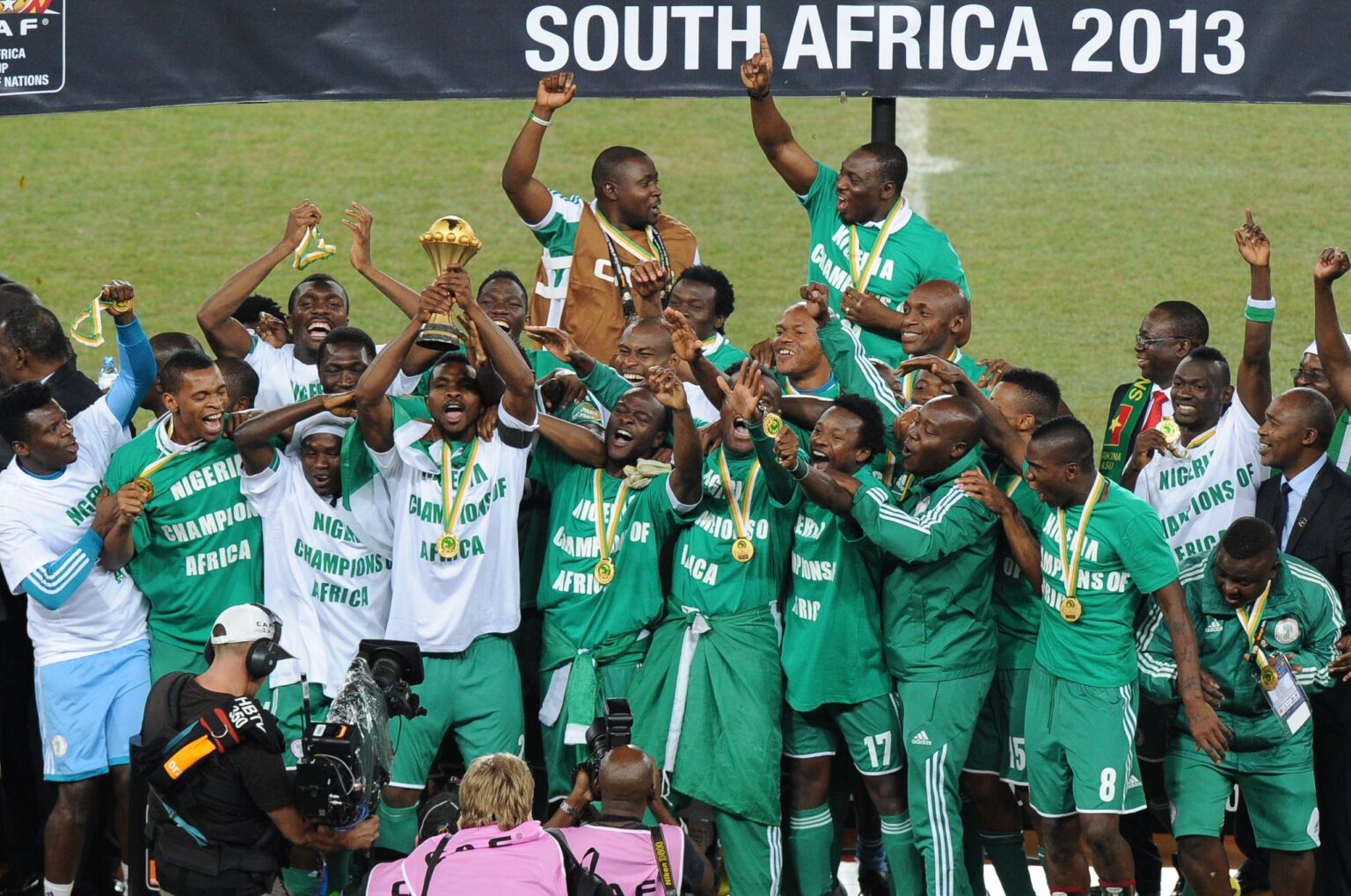
Leaving home unsung, Nigeria’s Super Eagles surprise their supporters and earn their third Nations Cup trophy. But the overall organisation of the tournament in South Africa leaves a lot to be desired, reports our editor, Osasu Obayiuwana, who covered the tournament.
Being the only living person in the continent, to have won the Cup of Nations as a player, team captain and head coach – and with an all-Nigerian coaching crew to boot – ought to have put Nigeria’s Stephen Okechukwu Keshi on the moon.
But the Super Eagles’ 1-0 win over Burkina Faso’s Les Etalons (The Stallions) in the final, at Johannesburg’s Soccer City, giving Africa’s most populous country its third title, after a near 20-year wait, only conjured a wee smile from his lips.
“I’m proud of what I have achieved… My goal, when I took over this team, was to make Nigerians happy and I am happy I have achieved that,” he said at the post-match press conference, where I sat less than three metres away from him.
Captain and central defender, Joseph Yobo, who largely sat on the bench during the tournament, as a result of a nagging injury, said having the trophy in his hands was “a dream come true”.
“This is my sixth Africa Cup of Nations and I wanted this to be my last. I’m short of words,” said the Fenerbahce player, who admitted that even he expressed his doubts to Keshi, about winning the trophy, before arriving in South Africa.
As the first black African coach to win a Nations Cup title in 21 years and only one of three to do so in 31 years (Ghana’s Charles Kumi Gyamfi and Côte D’Ivoire’s Yeo Martial being the others, at the 1982 and 1992 tournaments, in Libya and Senegal, respectively), Keshi used the bully pulpit of his second Nations Cup triumph to send a stern message to the continent’s football administrators.
“When local coaches take over a team, they are never given time to perform. Federations need to give them time, like they give the foreigners…” Keshi’s statement barely hid his deep anger, over the perceived lack of support from the Nigerian Football Federation (NFF), during the pressure-cooker moments of the tournament.
The kettle of discontent finally came to an overboil, in public, 24 hours after the Cup win.
Going on the popular Johannesburg radio show, 083Sports@6, on Metro FM, Keshi announced that he had resigned his position, immediately after winning the trophy, claiming the level of disrespect shown to him by his employers, the Nigerian Football Federation (NFF), left him with no option but to throw in the towel, whilst the ovation was loudest.
During the tournament, especially after the team’s chequered start in the group stages, against Burkina Faso, Zambia and Ethiopia, it was an open secret that a new coach for the team was being sought.
And had the Super Eagles failed to go past the group stages, it was a foregone conclusion that Keshi’s head was going to be on the chopping block.
“If back home, in my country, they don’t appreciate what I am doing with the team, so be it,” Keshi angrily said. “You can’t force somebody to love you. You can’t force somebody to accept you. It has to come from within.”
Extracting discord from victory’s jaws
The NFF’s apparent lack of confidence, in the team’s capacity to deliver results, was transparent, after it had booked air tickets for the team’s departure, following the Eagles’ 2-0 win against Ethiopia, in their final group match, with the quarter-final game against Côte D’Ivoire, the tournament favourites, yet to be played.
Even whilst he was training the team in Faro, Portugal, ahead of the tournament, Keshi complained to me, privately, about a key member of the NFF’s executive committee, whom he claimed had been making life particularly difficult for him.
Keshi’s politically deft act of ‘resigning’, taking a chapter out of the playbook of Clemens Westerhof, the flamboyant Dutch manager who won the 1994 Cup of Nations (Keshi was his captain) certainly set the proverbial cat amongst the pigeons.
The resignation took place with less than 24 hours before flying to Abuja, for a welcome reception with President Goodluck Jonathan. Now, in panic mode, Bolaji Abdullahi, the country’s Sports Minister and David Mark, the president of the Senate, pleaded with Keshi to reverse the decision, which he subsequently did.
Arriving home, with his players and assistant coaches – Daniel Amokachi, Sylvanus Okpala, Ike Shorounmu and Valere Houandinou – to a hero’s welcome, the entire team has been showered with cash and choice property from an appreciative country, through President Goodluck Jonathan and various state governors.
With football akin to a religion in Nigeria, an ethnically diverse and politically fractious country, the passionate desire of its 160 million people, for the Super Eagles to excel, has been a major instrument of forging national unity and identity. When Keshi took over the team at the end of 2011, he had the arduous task of restoring public confidence, after years of serial disappointment had left fans despondent and lacking belief in the Eagles’ ability to deliver.
In contrast to Samson SiaSia, his predecessor, who relied on the supposedly tried and tested Europe-based professionals, Keshi took the unconventional and extremely risky step of going with a team that largely had no Nations Cup experience and had several players from the much-maligned domestic league.
With Everton’s Victor Anichebe, Montpellier’s John Utaka and West Brom’s Osaze Odemwingie not making the final cut for the tournament, many felt Keshi had picked a team lacking the needed edge to compete in South Africa. But Nigeria Premier League players like Sunday Mba, scorer of the brilliant winner against Côte D’Ivoire in the quarter-finals and the lone goal in the final, against Burkina Faso, as well as central defender Godfrey Oboabona, vindicated Keshi’s choices.
“The players at home have the potential to do well but they just need to have the right work ethic and professionalism instilled in them… You can’t see [emerging talent] if you don’t give young players a chance,” Keshi told me, before the tournament.
“For the past eight years, it has been difficult for a home-based player to feature in the national team. So, if you don’t do that, how can you find the next Jay-Jay Okocha or Sunday Oliseh?”
Keshi’s tactical gambit hardly won him admirers in the tournament’s opening stages. Chequered 1-1 draws against Burkina Faso and Zambia, the 2012 Champions, in the group phase, stoked the furnace of criticism.
And with Nigeria needing two penalties to secure a 2-0 win over Ethiopia in the game that secured their passage to the knockout stages, few people (including this writer) gave the team a decent chance of beating Côte D’Ivoire in the quarter-finals.
But the Super Eagles metamorphosed, unexpectedly, into a well-oiled machine, which was more than a match for the Ivorians, tournament favourites, who were expecting an easy game against the Nigerians.
Drogba and Keita – a tale of two players
An emphatic strike from Emmanuel Emenike put Nigeria in the driving seat, against the inert and lacklustre Elephants. Didier Drogba, once the talismanic striker for the Elephants over the last eight years, was a shadow of himself at the tournament. His lack of fitness, having played no club football for four months, following the end of the season in China, with former club Shanghai Shenhua, was evident.
That Sabri Lamouchi, the Ivorian coach, lacked the courage to bench Drogba, in favour of fitter players, is perhaps indicative of the pervasive influence the former Chelsea player had on the management of the team. Drogba’s state was in stark contrast to Mali’s Seydou Keita, the former Barcelona midfielder, whose leadership was crucial to their bronze medal showing, equalling their performance at the 2012 tournament and continuing their best run of Nations Cup form in 42 years.
“Considering what has been going on at home (the civil war), doing well at the tournament was important for bringing joy and happiness to our people,” he told African Football.
Keita, like Drogba, played in the Chinese championship with Aerbin Dalian. But in contrast to Drogba, Keita went to his old Spanish club as soon as the competitive season was over, to ensure he would be match-fit for the tournament.
And his four “man of the match” performances – the highest for a single player in the tournament – ought to have earned him the tournament’s ‘Golden Ball’, which went to Burkina Faso’s Jonathan Pitroipa.
“Keita really showed that he was a leader for us,” said Patrice Carteron, Mali’s young French coach, who managed AS Cannes and Dijon, before taking a plunge into the African game.
Les Aiglons (The Eagles) began the tournament on a decent note, with a straight 1-0 win over Niger, in their opening group match. A subsequent 1-0 loss to Ghana, left them needing to secure a point against DR Congo, to earn passage to the knockout stages, which they did, when Mahamadou Samassa scored a 15th minute equaliser.
Set up for a grand quarter-final clash against hosts South Africa in Durban, the partisan 60,000 fans at the Moses Mabhida stadium were expectant. They thought Bafana-Bafana, who had beaten Angola and Morocco to a place in the knockout rounds, would keep their dreams of a second Nations Cup win on home soil alive.
That was not to be, as the Malians used their superior match experience to force the game into extra time and a dramatic penalty shoot-out, which they won 4-2. Mali’s resilience and calm gave the pundits the impetus to predict a pulsating semi-final against Nigeria. But the 4-1 thrashing from the Super Eagles, trailing 0-3, at the end of the first half, put paid to their dream of reaching their first Nations Cup final since Cameroon ’72.
Ghana flatters to deceive
A member of the all-West African quartet in the semi-finals, Ghana was supposed to have been a favourite for this year’s final. But the Black Stars’ form throughout the tournament hardly indicated they were championship material, as the team, managed by former captain Kwesi Appiah, huffed and puffed its way through the group stages.
Narrowly escaping a defeat in their 2-2 draw against DR Congo, in their opening group game, and securing a narrow 1-0 win over Mali, it was only their 3-0 victory over Niger, in their final group game, that was impressive.
A 2-0 win over Cape Verde, in the quarter-finals, flattered Ghana, as they really suffered against the courageous islanders, who threw everything at them, including the proverbial kitchen sink.
Winning the hearts of neutrals with their enterprising, exciting play, the tournament debutants, coached by Luis Antunes – an air traffic controller who took extended leave from his job to manage the national team – justified their presence at the Nations Cup. Ghana’s run of luck finally ran out against Burkina Faso, in what turned out to be perhaps the most scandalous and yet the most pulsating semi-final match in recent tournament history.
The disgusting refereeing by Tunisian Slim Jdidi, also at the centre of the equally controversial Nations Cup qualifier between Côte D’Ivoire and Senegal, was a terrible disservice to the African game.
Jdidi gave Ghana an undeserved penalty to convert, inexplicably disallowed a legitimate goal scored by Burkina Faso and subsequently sent off Jonathan Pitroipa, when he should have awarded Les Etalons a penalty.
Justice was certainly served, when they beat Ghana in the resultant penalty shoot-out. But the football fraternity awaits the severe sanctions that ought to be imposed on Jdidi, for poor officiating, which left his impartiality in serious doubt.
With Mali beating Ghana 3-1 in the third-place match, the Black Stars, with no medal to show for their tournament adventure, returned to Accra under a storm of criticism, with fans at home criticising the commitment of players to the national cause.
The decision of Appiah to drop players like Sulley Muntari and Andre Ayew, the son of the legendary Abedi ‘Pele’ Ayew from the Nations Cup team (the latter having a running spat with the coach), highlighted some of the troubles within. A top Ghana FA official, talking to African Football, insists Ayew will not return to the national team, unless he makes a public apology to the coach, for previous misconduct.
What happened to the Copper Bullets?
Zambia’s first-round exit, after winning the trophy a year ago, was certainly one of the shocks in South Africa. Lacking the tonic of what inspired them to triumph in Equatorial Guinea and Gabon – the 1993 air crash, off the coast of Gabon, that killed a generation of gifted players – the team struggled.
Scoring only two goals in three group matches, they were unable to secure a vital win in their opening game against Ethiopia, only managed, through a ‘soft’ penalty, an equaliser against Nigeria and lacked the needed bite to get a win over eventual finalists Burkina Faso. Herve Renard, the team’s despondent French coach, accused CAF, in a newspaper interview, of bias against his side. FAZ (The Football Association of Zambia) was handed a suspended $10,000 fine as a result.
“We have no apologies for winning the trophy 12 months ago. But we are disappointed with our performance, as I thought we could have gone farther in the competition,” Kalusha Bwalya, the 1988 African Player of the Year and current FAZ president told African Football.“We just have to focus on the World Cup qualifiers and make a serious effort to reach Brazil,” he said.
Moving to the Maghreb
With just 22 months to the organisation of the 2015 tournament in Morocco – the first Nations Cup to be organised in an odd numbered year since 1965 – there is little time for CAF to ensure that facilities are in place for a well-organised event.
The continuous quality assessment of tournament facilities, especially the playing pitches, is a must. There must not be a repeat of the severely embarrassing situation at the Mbombela stadium in Nelspruit, where the playing pitch resembled a potato patch, clearly unfit for high-level football. “People watching us on television will wonder whether we are playing Nations Cup matches in the desert. It is really a disgrace,” said the Tottenham Hotspur forward Sheyi Adebayor, who played for Togo.
But an improvement in the quality of tournament organisation (the 2013 event was a disappointing drop from the high levels at the 2010 World Cup finals), is certainly tied to a corresponding rise in the quality of continental governance. Unfortunately, the prevailing circumstances, in the corridors of African football politics, indicate that such improvements will be long in coming, as long as Issa Hayatou, in power for 25 years, continues to sit tightly in his CAF presidential seat.
With less than 500 days to the next World Cup finals, the continent has a lot of work to do, if it is to effectively compete against the world.
The risk that we may, for the first time since Espana ’82, not have a single team in the knockout stages of Brazil 2014, is a realistic and worrying one indeed. None of Africa’s teams has the pedigree to mount a serious global challenge. Yet.