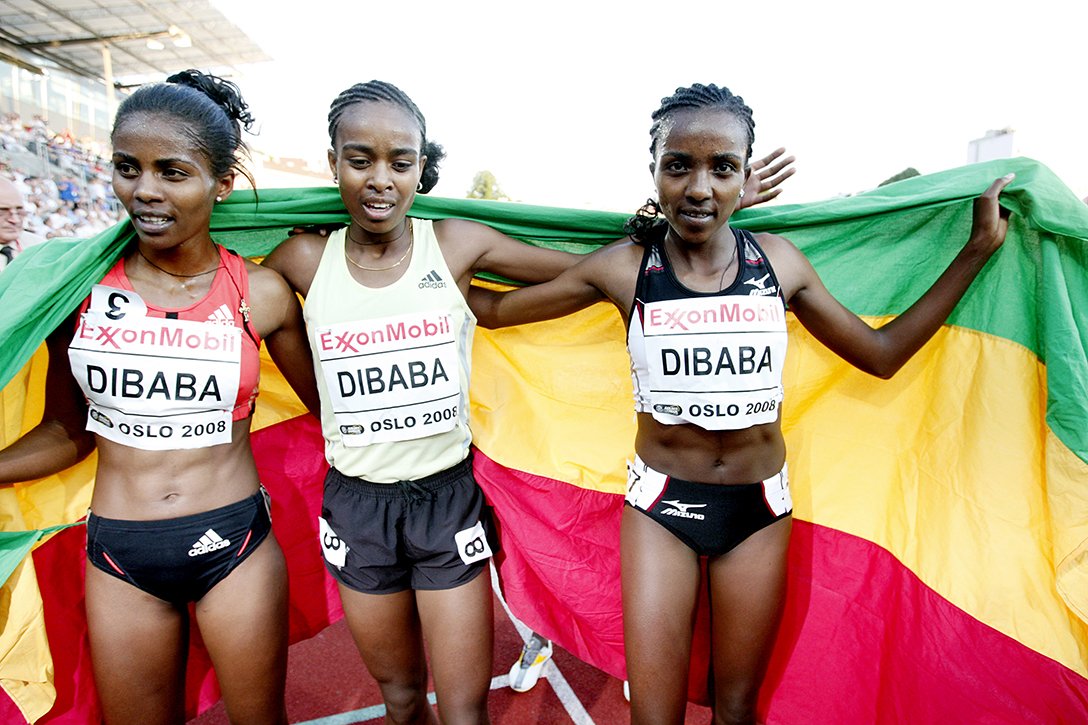
Clayton Goodwin continues our Olympics memory-lane series by focusing on the formidable women’s long-distance runners. As he reports, the ones to watch at the London 2012 Olympics are the Dibaba sisters.
Saturday, 18 February 2012. International athletics meeting at the Birmingham Indoor Arena. As we watched Genzebe Dibaba show the other competitors a clean pair of heels in the 1,500 metres, while winter rain and hail bombarded the streets outside, one of Britain’s most experienced and authoritative athletics journalists, a man who can well remember the last time the Olympic Games were held in London back in 1948, turned to me and said: “Aren’t they the most good-looking family in sport? I know that they are excellent athletes, but the Dibaba sisters are so very beautiful with it.”
His point of view has much to commend it. Only a few days earlier, I had shared the same hotel as the athletes in the English championships at Sheffield. Looking at one runner who was a former beauty contestant and model, I mused how she was much more attractive now and how the looks of the slim, well-exercised ladies of the track put to shame the over-painted models of the catwalk. The Dibaba sisters (Ejegayehu, Tirunesh and Genzebe) excel here, too, as they do in the arena … and it is their ability in the arena on which I want to concentrate here.
The East African dominance of women’s long-distance running in the Olympic Games of the 21st century is almost complete, and the Dibaba family from the Oromo ethnic group of the high altitude Arsi district in Ethiopia are to the fore. Indeed, the Ethiopians and Kenyans have inherited the track empire of the old Soviet Union. For three decades from the 1950s, the Russians and their allied nationalities had the advantage of being professional in what was still very much an amateur environment. They achieved that by giving their sportsmen/women state employment or work with the military which allowed them the time, the facilities and the security to develop their abilities to the full.
The nearest equivalent, I suppose, has been the American collegiate system. Then shortly after the 1988 Olympic Games in Seoul, South Korea, the Soviet Union fell apart, disintegrating into its component parts (which are now independent countries). As world athletics became professional from thence, up stepped the Ethiopians and the Kenyans, and, especially the Dibaba family.
Although excellence at world level has been no guarantee of success at the Olympic Games, as Berhane Adere and Edith Masai, to name just two, have found to their cost, the Dibabas, spearheaded by the formidable 26-year-old double gold-medallist Tirunesh, have not had that problem.
Now all three Dibaba sisters are in with a very good chance of winning medals in London, provided that – with the limitation placed on the number of representatives from one country allowed in any event – they do not eliminate each other from the Ethiopian team. As this piece is concerned with the Olympic Games, I have hardly referred to the numerous world records which the sisters and their compatriots and contemporaries have achieved.
Not that Tirunesh was the first of the family to strike gold. That honour went to their cousin Derartu Tulu, now 40 years old, the seventh of 10 children, who won the 10,000 metres in 31:06.22 at the 1992 Olympic Games in Barcelona, Spain.
The then 20-year-old Derartu sped past the South African Elana Meyer at the bell and stayed in front – afterwards inviting the South African to join her in a lap of honour, which was seen as being an appreciated gesture of African harmony in welcoming South Africa back to the Games after its apartheid-induced exclusion for a generation.
It was the first Olympic Games gold medal won by a female athlete from an African country. After that Derartu struggled with knee injuries which upset her form for several years so that she finished only fourth at the 1996 Olympics in Atlanta, USA. The birth of her daughter two years later, however, inspired a resurgence in her success.
Derartu went on to win the 10,000 metres again at the 2000 Olympic Games in Sydney, Australia, in 30:17.49 – with a last lap burst of 60.3 seconds which destroyed the challenge of her compatriot, Gete Wami. The latter was very much the bridesmaid as she had finished third in this event four years earlier and was third in Sydney also in the 5,000 metres.
The following year, Derartu won gold at the World Championships in Edmonton, Canada, as well as the marathons in London and Tokyo. Although she was coming up to the veteran stage for athletes, the Ethiopian retained sufficient form to win the bronze medal in 30:26.42 at the 2004 Olympics in Athens, Greece.
Now, however, it was time for a new generation to take over as Derartu’s cousin, Ejegayehu Dibaba, took silver in 30:24.98, both behind the winner Xing Huina in 30:24.36.
Ejegayehu, now 30 years old, may not have attained the fame and records of her younger sister but – including winning bronze in both the 5,000 and 10,000 metres at the World Championships in Helsinki, Finland, in 2007 – she has always been “there or thereabouts”.
Tirunesh, three years younger, is the complete long-distance athlete, and is tres by 15:41.40 to 15:42.74 and the 10,000 metres by 29:54.66, an Olympic Games record, to 29:56.34.
East Africans took the longer distance records by storm in the Chinese capital. Pamela Jelimo won the 800 metres, just ahead of Janeth Jepkosgei, while Nancy Jebet Lagat won the 1,500 metres, and Catherine Ndereba was second in the marathon (as she had been four years earlier in Athens). Yes – and Meseret Defar, another Ethiopian, was third in the 5,000 metres.
Now we come to Defar, the one runner who, until the advent of Vivian Cheruiyot, whose story I hope to be allowed to tell in a later article, has consistently threatened the supremacy of the Dibabas.
famed for her devastating sprint finish. She has won gold in four World Champioships between 2003 and 2007, although she pulled out with injury just before the same contest in Berlin in 2009. In addition, she has won five golds at all levels of the World Cross Country Championships.
After first making her name in the Olympic Games in Athens in 2004, where she was third in the 5,000 metres while still only 18 years old, Tirunesh dominated the next Olympics in Beijing by winning gold in both the 5,000 and 10,000 metres.
In each event, Tirunesh fought out an enthralling duel with Elvan Abeylegesse, another Ethiopian who has run latterly for Turkey. Tirunesh won the 5,000 me-tres by 15:41.40 to 15:42.74 and the 10,000 metres by 29:54.66, an Olympic Games record, to 29:56.34.
East Africans took the longer distance records by storm in the Chinese capital. Pamela Jelimo won the 800 metres, just ahead of Janeth Jepkosgei, while Nancy Jebet Lagat won the 1,500 metres, and Catherine Ndereba was second in the marathon (as she had been four years earlier in Athens). Yes – and Meseret Defar, another Ethiopian, was third in the 5,000 metres.
Now we come to Defar, the one runner who, until the advent of Vivian Cheruiyot, whose story I hope to be allowed to tell in a later article, has consistently threatened the supremacy of the Dibabas.
Her on-track rivalry with Tirunesh is well-known. At the meeting in Birmingham on 18 February 2012, in which I saw Genzebe Dibaba running away with the 1,500 metres, Defar cruised to a crushing victory in the 3,000 metres, killing off the opposition in the first few laps and then increasing the gap.
She won in 8:31.56 with such accomplished athletes as Hellen Obiri, Gelete Burka, and Meselech Melkamu trailing behind her. That was just how it had been also when I had seen her on a cold, overcast evening last summer in the Diamond League outdoor meeting in Paris, and at a good many other events.
Born in Addis Ababa, and now aged 28 years, Meseret won the gold medal in the 5,000 metres at the Athens Olympics in 2004 in 14:45.65, with Isabella Ochichi second in 14:48.19 (and, as we have seen, the then teenage Tirunesh Dibaba third).
Meseret has been regularly successful at 5,000 metres outdoors and at 3,000 metres indoors – in the latter of which she has won gold at the World Championships in Budapest (2004), Moscow (2006), Valencia (2008), and Doha (2010).
Such has been her success over a range of distances and in so many different types of competition that it is felt that Meseret Defar has still not given full justice to her talents in the Olympic Games and still has a very strong point to prove.
Meseret’s mastery of recent indoor competition has been so complete that her defeat in the World Indoor Championships in Istanbul this March was probably the shock result of the competition.
Going for her fifth gold medal, Meseret was well clear of the field but with victory apparently hers, she seemed to be caught “napping” by an exceptional burst of speed from Hellen Obiri who beat her to the line in 8:37.16. Was it mere complacency or the first hint of vulnerability?
Now with Meseret and Cheruiyot in full flow, Tirunesh putting in some impressive road performances on her return to competition, and Ejegayehu still there or thereabouts as she has always been, the youngest sister, 21-year-old Genzebe Dibaba, has entered the fray.
After impressive form in junior competition, she got her first big break at senior level in replacing her injured sister Tirunesh in the 5,000 metres in Berlin in 2009. Although she failed to make the most of her immediate opportunities, Genzebe came up to her previous expectations by winning the 5,000 metres in a championship record time at the 2010 World Junior Championships.
Nevertheless her ability has been in evidence for some time since she ran a personal best time of 15:02.41 for the 1,500 metres at the 2008 Bislett Games in Oslo, Norway, the same race in which Tirunesh set a new world record.
Perhaps by competing in several events from 1,500 metres to cross-country, Genzebe has not yet settled to her correct distance. In Birmingham on 18 February 2012, she started off like a rocket in running down the pace-maker and was not seriously challenged. She won in the stadium record time of 4:01.33, with the very good local favourite Hannah England, who, too, put in a strong performance, a long way behind on 4:09.79.
Three weeks after this success, the young Ethiopian crushed all opposition in winning the World Indoor Championships gold medal in Istanbul, Turkey, in 4:05.78, with Mariem Selsouli of Morocco, her only real challenger, a full two seconds behind her.
The success of the Ethiopian long-distance runners, both men and women, has often been attributed to their performing as a pack, with each helping the other. For some years they had more than the measure of the Kenyans, who tended to run as individuals – though that has changed now – and won the ire and jealousy of other nations.
It must help, therefore, if the runners come from the same district, from the same village and, even more so, from the same family. The Dibaba clan may indeed be the most good-looking family in sport – but they are also the most formidable.
Women’s long-distance running has a “loveliness” which goes beyond mere physical pulchritude. Male athletes dominate the sprints and shorter distances which depend on speed generated by muscle-power.
Everybody has heard of Usain Bolt – whereas his compatriots and female counterparts Shelly-Ann Fraser-Pryce and Veronica Campbell-Brown are unknown internationally outside the cognoscenti of the track. That may hardly be fair but it is understandable.
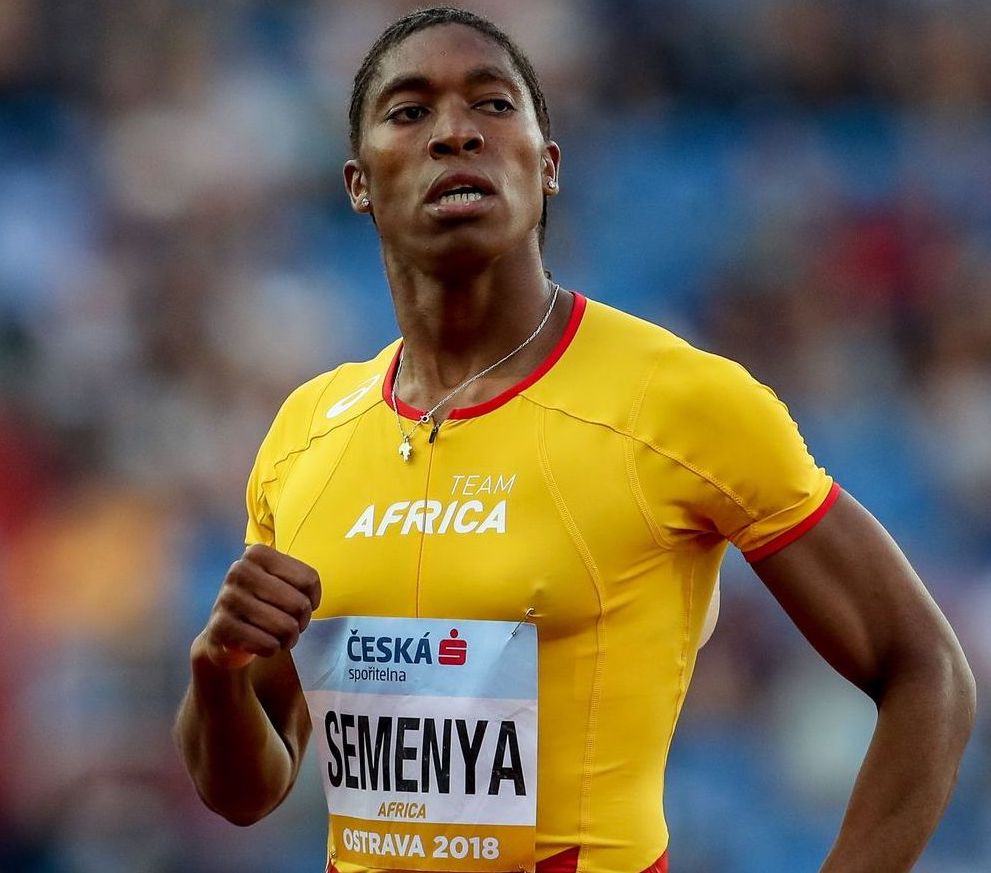
Power is the defining quality of the male runner. It was that surge of power into the finishing straight – whatever the private genetic concerns beforehand – that first threw doubt on Caster Semenya in the 2009 World Championships in Berlin. Yet it is a different matter when it comes to the long-distance races, in which other characteristics and tactics come into play to a much greater extent.
That is what makes women’s long-distance races the most aesthetically interesting in the programme. Those are the events that I always seek out on arriving at a venue. The interplay of changes of pace, the injections of speed and the saving of energy for the final sprint have their own poetic symmetry.
Yes, men, too, run tactically and long-distance women athletes have their own power, the power of endurance, but the concept and shaping of the race is different – and the tactics for the longer distances are not the same as for the middle distances in which nobody yielded anything in conventional power to Maria de Lurdes Mutola, the Mozambican.
Let yourself imagine – there is Meseret Defar well in the lead as they come to the bell, but Tirunesh Dubaba is noted for her blistering pace at the finish. Has Defar got far enough away to absorb her rival’s challenge and keep ahead, or will that lead be cut down and nullified?
And into the mix comes Vivian Cheruiyot, with perhaps another Dibaba, and Masai, and Obiri coming up very quickly, and a hitherto unknown Ethiopian or Kenyan who inevitably comes forward from nowhere on these occasions (and maybe a Russian) … then one stumbles … the finishing line is getting closer … who will win? I am so enthralled just thinking about that.