Rwanda’s road to sustained peace is grounded in its post-genocide return to the use of its indigenous language and culture, Kinyarwanda, to develop. Rwanda, unlike most African countries, has always had one majority language and culture, as Jacqueline Musiitwa explains.*
As a lawyer, I worked for years in Rwanda for both private and government clients. The use of language in law is important; not only can it can make the difference between winning and losing a case, it can help define much bigger things, such as the way a nation is governed over time or the way people interact with one another.
I have few memories as vivid as watching the news of the 1994 Rwanda genocide from my home in Zambia as a child. It was, and remains, difficult for me to comprehend how close to a million people could be systematically killed in 90 days. But it did make me realise the power of words, both for good and evil.
My interest in the peculiarities of language and the law sparked my curiosity about how language in Rwanda is helping to drive development. This was grounded in the greater question of how African countries can find solutions to their problems rooted in their own cultural and linguistic backgrounds rather than relying on foreign models.
The Belgians divided and conquered Rwanda by creating false divisions and competing power structures between the Tutsi and Hutu ethnicities. The result was years of animosity that resulted in genocide. After the genocide, to inspire a renewed national identity, Rwandans eliminated the use of ethnic identification and reintroduced a variety of traditional Kinyarwanda concepts into daily life. Rwanda is now using Kinyarwanda words to communicate a shared vision, and to mobilise action, inspire, and foster a common identity and agenda.
The word, kwibuka, (to remember), was very present in Rwanda as the mourning period of the 20th anniversary remembering the genocide played out. But Rwandans recognised that remembering the genocide is not enough; they have committed to the world’s promise of “never again” by invoking Kinyarwanda words and putting into practice the traditional Rwandan concepts they represent.
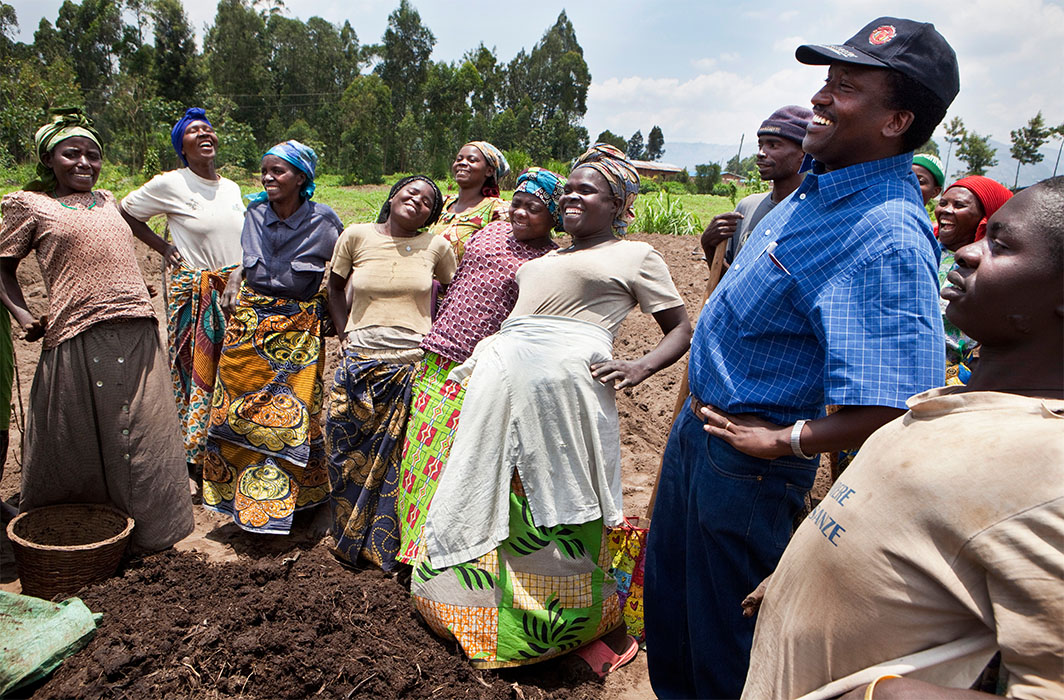
For example, Rwanda has brought back umuganda, which translates into “coming together in a common purpose to achieve an outcome.” In traditional culture, members of the community call on their family friends and neighbours to help them complete a difficult task.
The Rwandan government now has a monthly national community work-day called “Umuganda”. Close to 80% of Rwandans participate in this day, where communities come together to work on projects from environmental clean-up to construction ideas.
The value of Umuganda to the country’s development since 2007 has been estimated at more than $60m and has contributed to the country becoming one of the cleanest in Africa.
Some may argue that Rwanda’s turnaround has more to do with foreign aid than Rwanda’s own solutions. It is true that a large portion of Rwanda’s budget – 40% according to the World Bank –relies on foreign aid.
However, Rwanda’s own commitment to its people was reinforced following foreign aid cuts in 2012. At this time, Rwandans created the Agaciro Development Fund, which has financed over $30m in development projects. Agaciro, in Kinyarwanda loosely translates to “dignity” or “self-worth”, which many Rwanda’s felt they had lost during the colonial era.
Ensuring all citizens, regardless of class have dignity is also demonstrated through girinka, a programme set up by the Ministry of Agriculture and Animal Resources with the “aim of reducing child malnutrition rates and increasing household incomes of poor farmers” by giving cows to approximately 350,000 families by 2015. Cows are symbols of wealth in Rwandan culture. The word girinka translates as “may you have a cow,” and captures an old cultural practice where a cow was given as a sign of respect and gratitude.
In a country with limited land and a majority population of subsistence farmers, this practice simultaneously addressed issues of food and income security, while communicating reverence and appreciation.
Finally, the Rwandan government has created a modern day “itorero” – traditionally a cultural school – as an updated Rwandan civic education institution that teaches all Rwandese to keep their culture through values such as national unity, social solidarity, patriotism, integrity, bravery, and tolerance.
Despite laudable progress, Rwanda’s development model is under constant scrutiny, especially from strong democracy proponents. Though I believe that language has been used as a powerful tool for development, allegations of restrictions on freedom of speech are rife in Rwanda.
One of the powerful lessons from the grave abuse of free speech during the genocide – and the lengthy healing process – is that words have power. There is a very important conversation happening about limits to free speech.
In certain cases, it may be in the public interest to have certain restrictions to free speech, such as has been the case in post-World War II Germany, which continues to ban the praise of the Nazi ideology.
Rwanda inspires us to look for African solutions to African problems and examine where we came from in order to better frame where we are going. Like all development models, there is no one-size-fits-all solution. Language may or may not be a unifying tool in other places, but the lesson that Rwanda provides is clear: African countries should consider traditional solutions to their problems rather than relying only on foreign models – and describe them in their own terms.
* Jacqueline Musiitwa is the Founder and Managing Partner of Hoja Law Group, a boutique law firm in New York and Kigali, Rwanda, advising on investment and trade matters for companies doing business in Africa as well as African governments. She is a 2014 Aspen New Voices Fellow at the Aspen Institute.