Nine hundred and forty (940) African soldiers died at Camp Courneau during World War I. Santorri Chamley went to La Teste-de-Buch in France to find out who they were, what killed them and about the campaign to have them remembered.
The overlooked status of a World War I memorial for 940 African soldiers who died for France, and possibly medical science, has galvanised a remembrance campaign by Bordeaux’s Senegalese community and their French partners. The memorial, which stands beside the African soldiers’ tomb, is located in an isolated grove of trees off the “214” Forest Road near the Cazaux military base in La Teste-de-Buch, in the Gironde region of Southwest France. The African soldiers it commemorates were victims of a pneumonia epidemic that swept through the Courneau military camp in 1916-17.
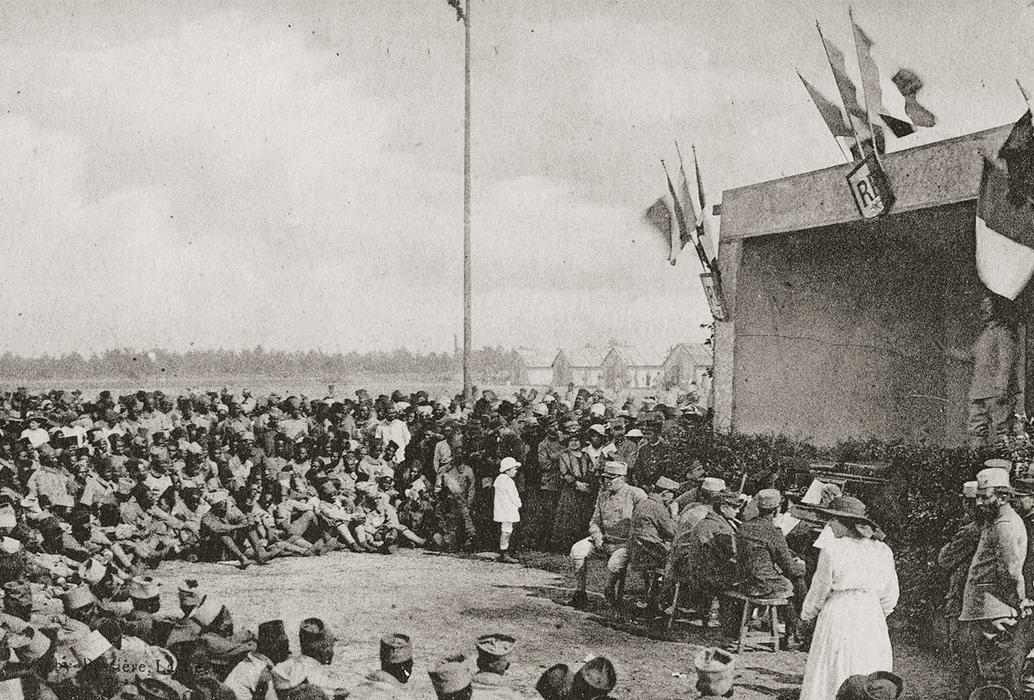
Between 15,000-18,000 African soldiers, generically known as “tirailleurs sénégalais” (Senegalese infantrymen) were based at the camp during this period as part of France’s large African colonial army in WW1.
The memorial, known as the Nécropole Nationale du Natus, recognises 940 African and 12 Russian soldiers who died in the camp. A Christian cross, Islamic crescent moon and star, and other religious symbols on five separate gravestones are the only symbols offering clues to their lives. The names of the deceased are not listed, though research by local historian Jean-Michel Mormone and his late colleague, Patrick Boyer, has helped identify most of the buried men. These soldiers would have been among those who fought in the critical Battle of Verdun and served in France’s 43rd Senegalese Battalion, which took the fort of Douaumont in October 1916.
Led by the Bordeaux-based Gironde chapter of the French Union of Senegalese Workers (L’Union des Travailleurs Sénégalais, UTSF), a remembrance campaign is being run for Camp Courneau which includes an attempt to get the names of the African and Russian soldiers inscribed on the memorial. Malick Ndaw, a key player in the action and president of UTSF from 1994-2014, explains:
“It’s crucial to progress the engraving of the names during the centenary of the First World War. It provides an opportunity for the French government to make amends for its regretful lack of recognition for the African soldiers.”
He adds that UTSF, which has around 1,000 members in the Bordeaux region, is continuing to push for the inscription. The union also organises two annual events at the site, on 23 August and 11 November. The August event was launched in 2006 to concur with the “Memorial Day for all Tirailleurs”, which was established in Senegal in 2004 by former president Abdoulaye Wade. The November ceremony is part of the international Armistice commemoration.
Around 150 people typically attend these events, including war veterans, African and French dignitaries, members of Bordeaux’s Senegalese and African community, and French supporters. In addition to honouring the Camp Courneau’s African and Russian soldiers, Bordeaux’s Senegalese community is also active in remembering other forgotten soldiers in the Gironde region. These include Algerian and Moroccan soldiers buried in a cemetery in northern Bordeaux and African soldiers in Lectoure, in Gers. The Gironde region is closely linked to the history of African soldiers in France, including the popular Atlantic coastal town of Arcachon, which also has a war memorial where African soldiers are named and buried.
Ndaw emphasises the importance of young people learning about their story and contributions to the freedom of France. “Children today are far away from war times,” he says. “Not just the African children here in France but also French ones. We’re doing this so that they know what their grandparents and France’s colonial soldiers did, which is not in the history books.”
The history
The first troops of African soldiers arrived at Camp Courneau in April 1916. They were part of France’s 600,000-strong African colonial army known as troupes indigènes (indigenous troops), which was mostly made up of North Africans alongside around 170,000 soldiers from France’s former colonies in sub-Saharan Africa.
Some would have ended up in the colonial army because they believed in the republican ideal that colonial subjects, like native French citizens, owed France a “blood tax”. Others would have been subject to coercive conscription.
A recruitment drive fronted by Blaise Diagne, the first African elected to the French National Assembly and mayor of Dakar, Senegal’s capital, is believed to have significantly boosted recruitment numbers. Diagne had been nominated as general governor for recruitment of soldiers from French West Africa by Georges Clemenceau, who led France during WW1. Diagne accepted the post after negotiating a number of guarantees and conditions for African soldiers.
Some would have ended up in the colonial army because they believed in the republican ideal that colonial subjects, like native French citizens, owed France a “blood tax”
“The popularity of Blaise Diagne meant the recruitment target of 50,000 men procured 70,000,” says local historian, Jean-Michel Mormone. “The men were promised money and assistance for their families. Some of the men were given by village chiefs.”
Many of these African troops spent the winter at Camp Courneau because the weather was warmer in the south of France than further north. Conditions were still chilly, however, and in addition to the wet and windy weather, sanitary conditions and overcrowding were appalling.
On 28 April, 1916, the first death from pneumococcal infections in the camp was recorded. Thirteen more followed in May, and in June, 40 more deaths were registered. By the end of the year, some 600 African soldiers had been hospitalised and by April 1917, the death toll had risen to 940.
Mormone believes the African troops in Camp Courneau were generally well-treated by the French army, and reasons that it was sharp differences in day and night-time temperatures, coupled with poor diet and vulnerability to pulmonary disease that were a big factor in the high number of deaths.
“It’s important to remember that out of the 8,095 patients admitted to the Camp Courneau hospital when the African soldiers were based there, 7,200 were cured of disease,” he says.
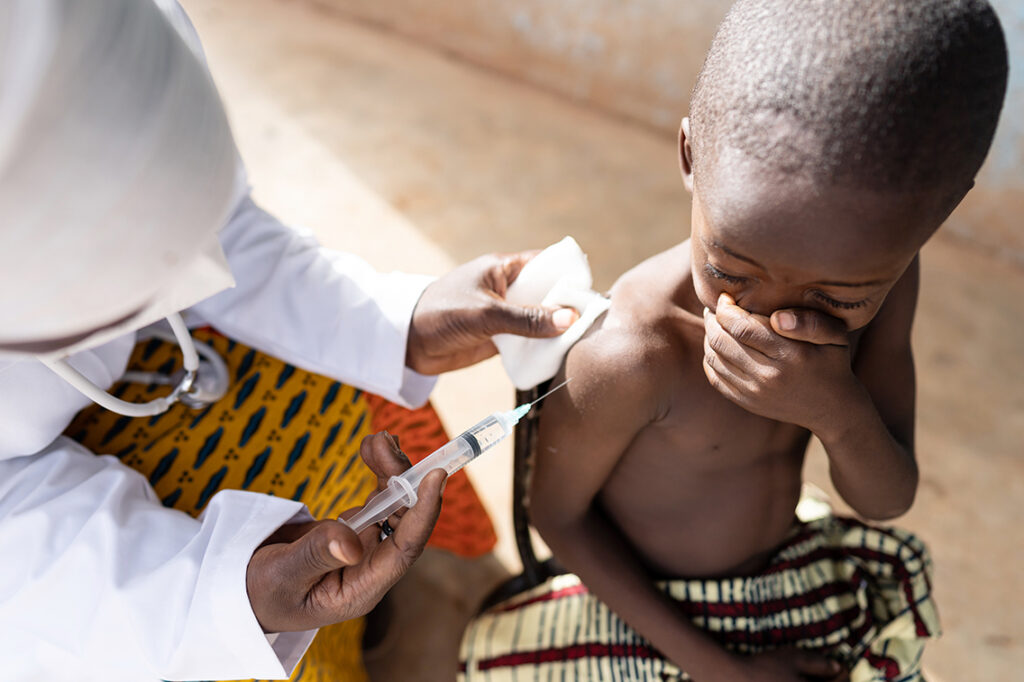
Nonetheless, research by Christian Bonah, Professor of History of Health and Life Sciences at the University of Strasbourg, suggests another reason for the level of deaths. His work has found that some of the African soldiers at the camp may have been used as human guinea pigs for experimental vaccines.
To prevent further losses of life following the pneumonia outbreak, he says, a French military inspector recommended sending the African troops to Algeria. But his advice was ignored. Instead, Justin Godart, the Ministry of War’s Secretary of State for military hygiene, pursued a controversial solution. He sought recommendation from the Consultative Commission for Military Hygiene and Epidemiology about using two new vaccines. The first was a new triple anti-typhoid vaccine developed by Fernand Widal, which combined protection against typhoid and paratyphoid fever. The other was a new pneumonia vaccine developed by Joseph Kerandel, an army physician.
The Consultative Commission for Military Hygiene and Epidemiology endorsed the vaccine trials. The majority of these were carried out on African troops stationed in Frejus, and Bonah says that evidence of these secret experiments includes clear archival notes and trial descriptions. He says that African soldiers would not have been made aware that they were being injected with experimental medicines.
“Informed consent was not standard at the time, even in non-military settings,” he says. “Legally, it was required in written form for operations, but not injections or drugs.”
However, Bonah says that it is difficult to discern the exact impact of the trials on the health of the soldiers. “The pneumonia experiments don’t seem to have had lethal outcomes according to archives,” he says, but adds, “It’s almost impossible to infer that no deaths occurred, but it’s just as difficult to conclude that they did.”
According to Bonah, a major issue may have been that African soldiers were more vulnerable to pneumonia than Europeans. “The best protection would have been to re-transfer the African troops to North Africa. But as that would have implied logistic challenges for the French army, the decision was taken to keep them in the military camp,” he says. “This caused increased mortality clearly, even if that was supposed to be prevented by the vaccine. The dramatic camp situation led to major mortality but that was not necessarily directly related to the vaccine experiments.”
After the 940 deaths by 1917, the remaining African troops were eventually moved from Camp Courneau following complaints from Blaise Diagne.
The fight for égalité
For Mbaye Lo Tall, the Senegalese Consul General in Bordeaux, ensuring that all the soldiers who fought for France’s freedom are recognised equally is vital as part of the healing process for the horrors of war.
“Our parents and many other people in Senegal and other former French colonies remember a relative who went to fight against Germany in both wars,” he says. “African soldiers fought and sacrificed their lives for the same French ideal of liberté, égalité and fraternité as their white counterparts. It’s important to honour them equally.”
This involves inscribing the names of the African soldiers on the Nécropole Nationale du Natus memorial, but it also includes parity in war pensions.
“African soldiers were recruited with many promises including citizenship and war pensions,” says Tall. “Although it’s too late for most who are now dead, it’s important to recognise their contributions and compensation for their families who are struggling to survive in Africa.”
Tall says he lobbies on war pensions for sub-Saharan African soldiers, an issue which stalled when, in 1959, the French government froze war pensions for colonial soldiers, arguably as a deterrent against decolonisation movements. Benjamin Gilles of the Library of Contemporary International Documentation at the University of Paris West Nanterre says the move was an economic and political one. He claims that by freezing war pensions, France failed to recognise the equality of soldiers, one of the founding principles of the modern French nation.
Indeed, in 2010, France’s Constitutional Council ruled that the suspension of military pensions contravened constitutional liberties and rights. In 2011, the French government repealed the 1959 act. These momentous events followed in the wake of a media campaign around the 2006 release of Indigenes, a film about African colonial soldiers who served France in WW2.
“African and white French soldiers fought in the same trenches as brothers in arms and should be equal in death.”
Gilles says that France’s then president Jacques Chirac was moved by the fate of the African soldiers depicted in the film and decided to re-establish equality of war pensions between veterans. However, although some North African soldiers have benefited from the development, Senegalese and other sub-Saharan African soldiers have reportedly not seen much change.
According to the UTSF’s Malick Ndaw, the military pension for sub-Saharan African soldiers who served in the French army for at least 15 years is a mere €132 ($165) paid every six months, a tiny fraction of the pension paid to native French soldiers.
Tall believes that it’s time to change this. “The duty of memory is very important,” he says. “African and white French soldiers fought in the same trenches as brothers in arms and should be equal in death.”
“Today we have peace and tolerate each other,” he continues. “We need to teach our children solidarity with everyone and give a sense of liberté, égalité and fraternité so that war doesn’t start again.”
There was no response from La Teste-de-Buch city hall when New African asked if the African soldiers’ names would be engraved on the Nécropole Nationale du Natus memorial as part of the WW1 centenary.