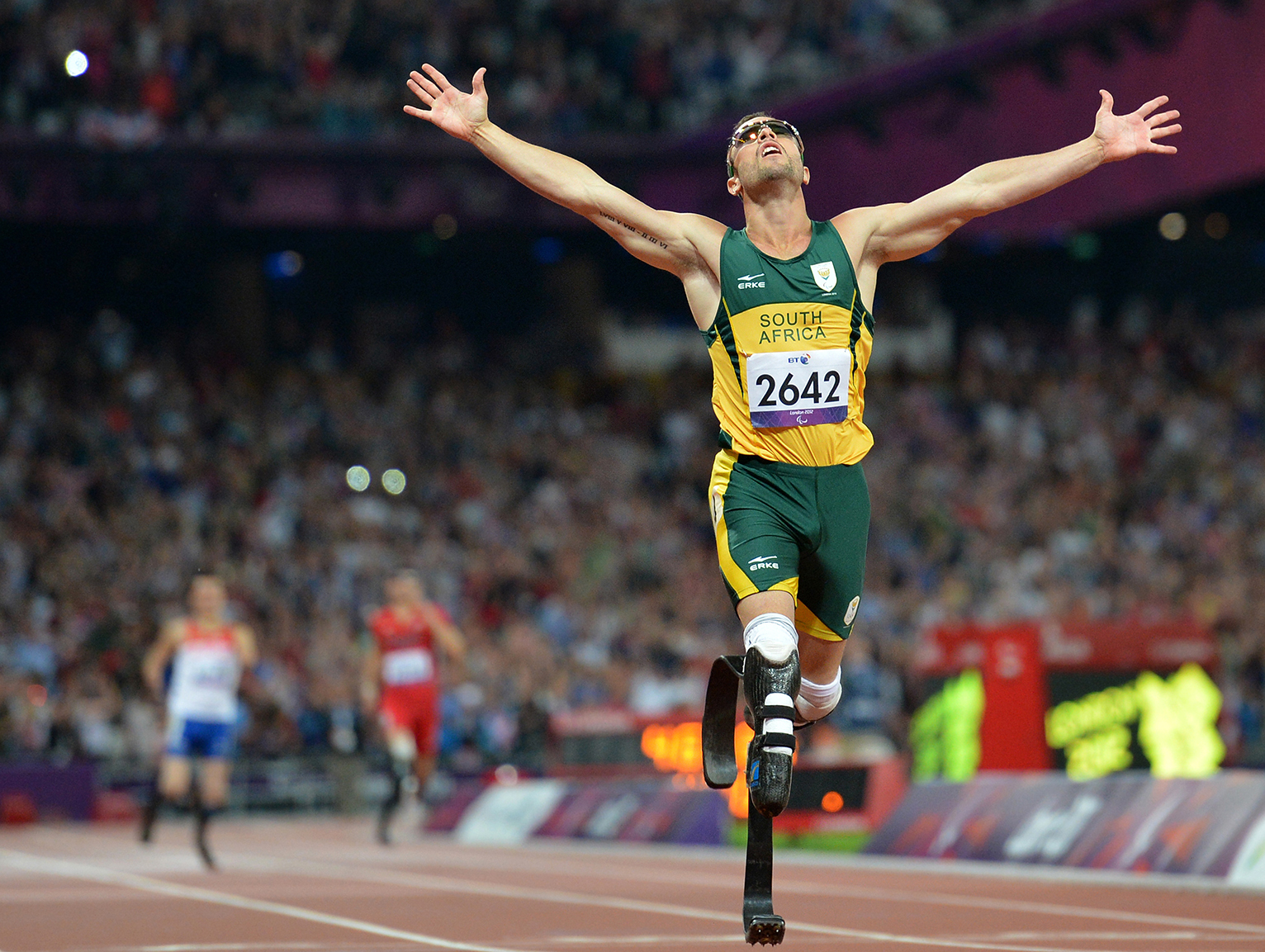
The plight of the South African Olympic star, Oscar Pistorius, who shot his girlfriend dead on Valentine’s Day, has also become the plight of a nation trying to find its way in the dark while standing in a blinding spotlight. The dilemma was supposed to have been bridged with Nelson Mandela and his reconciliation project. But South Africa has just discovered that Mandela drinking tea with the widow of Verwoerd, and sharing the Nobel prize with FW De Klerk, was no panacea for the fundamental problem of poverty and inequalities drawn along racial lines. The plight of Pistorius has accentuated the dilemma. Pusch Commey reports.
Oscar Pistorious, 26, has a compelling story. He was born without a fibula or calf bone, that piece of bone stretching from the knee to the foot without which one cannot walk. His legs were thus amputated at the knee at the age of 11 months. And yet he has run his way to fame and fortune. Defying his limitations, on carbon fibre prosthetics, he even competed against the able-bodied at the London 2012 Olympics and became an inspiration to many across the lines of race, class and nationality.
He was a genuine national and international hero who was undeterred by the cards dealt to him by fate, though also to the extent that he is white and has a wealthy family who could navigate his disabilities with money. Not so for many disabled blacks in South Africa. His endorsements around the world increased from year to year with his heroics. Nike’s alone was valued at $2m among many others. He even became the favourite son and darling of the small Italian town of Gemona. A five-year sponsorship deal netted the small change of $20,000 per annum, including accommodation and expenses. During 2011 and 2012, Pistorius trained in Gemona and attracted crowds and the media. Now the love affair has gone down the drain overnight.
It came as a big shock on Valentine’s Day, 14 February 2013, when the world woke up to an Oscar accused of the murder of his beautiful model girlfriend Reeva Steenkamp, 29. It would be a return of the OJ Simpson trial in the USA that riveted the world in the 1990s, except that the location had changed to the south of Africa. In one fell swoop, Oscar’s life would change forever. From a choice of five star hotels, he was negotiating for a better prison cell and small mercies in the first week of his bail application.
Prosecutors in search of fame are hot on his heels. At the bail application, the charge was “premeditated murder”, which carries a mandatory life sentence, unless there are substantial and compelling reasons. When he was finally granted bail on 22 February for one million rand ($120,000), the presiding magistrate had his own take on the facts of the case, expressing criticism of both the state and defence case. The bail was justified. Essentially the most significant factor would not be whether the accused is guilty or not guilty of the offence, but whether he is a “flight risk”. He is too well-known and recognisable to flee and hide anywhere in an increasingly smaller world.
The bail amount was petty cash for Oscar, who reported an annual income of about $700,000. His extended family has interests in mining, property, and several investments worth millions. They all rallied for prayers in front of the Pretoria Magistrates Court. When bail was announced, an audible sigh of relief, a loud “Yes!”, could be heard off camera. Small comfort for the Steenkamp family, who stayed away from the Oscar media circus and kept a dignified silence. On that day, the cremated ashes of Reeva were being interred at a church ceremony in Port Elizabeth, many kilometres away. The case has been postponed to 4 June for further investigation. From that date, there will be a few more postponements before the case is transferred to the High Court for trial, sometime in 2014. That is if it will come to that. Oscar may well enter into a plea bargain arrangement when investigations are complete.
What really happened is only known to Oscar. And whatever forensic and extraneous evidence that the state will adduce will likely be part fact, part speculation. Whether Oscar will tell the whole truth and nothing but the truth is another question. After all, as every lawyer knows, the truth is always somewhere in-between. Self-preservation comes first. In his affidavit for bail, Pistorius did state that while he was sleeping in his bedroom with his girlfriend at dawn, he woke up to bring in a fan from the balcony. It was pitch black. When he came back into the bedroom, he heard noises from the toilet, and without checking whether his girlfriend was in bed, he took his gun, went down a corridor, and fired shots into the bathroom door, thinking it was a burglar.
It later dawned on him that he might have shot his girlfriend who may have woken up to go to the bathroom while he was on the balcony. He then tried to break down the locked door with a cricket bat. Within the context of neighbours who reported hearing them quarrelling at dawn, the most likely explanation is that he had an altercation with Reeva, who ran to the bathroom and locked herself in. An enraged Oscar took out a cricket bat and tried to break down the door. When he failed, he went for his pistol and fired at the door, either in rage or in an attempt to force it open. It is just theory, and all will depend on the evidence, postulations and posturing that will feed a money-spinning story, for the media and the lawyers. What is almost certain is that, on Oscar’s own story, it will be hard to escape a conviction of murder of a less serious degree (not premeditated). In South African law, it is called Dolus Eventualis. It means that Oscar should have foreseen and did foresee that the person behind the bathroom door could be hit by the bullets he fired and would die as a result, burglar or no burglar. There would be no justification to shoot at any person, if there is no imminent threat to your life. It should be the only alternative. Heads, Oscar loses. Tails, he loses.
The question will be, how much jail time. Like all things in South Africa, there will be various filters. Race, class, inequalities, etc. Psychologists and pseudo-psychologists have joined the fray, including the minister of women and children, Lulu Xingwana, who went all the way to the Australian Broadcasting Corporation to make her views known: “Young Afrikaner men are brought up in the Calvinist religion believing that they own a woman, they own a child, they own everything, and therefore they can take that life because they own it.” She has since apologised for her outrageous statement.
The international media angle has been to use the indiscretions of one man to interpret or misinterpret a whole nation. The focus has been crime and violence in the new South Africa. All based on a perhaps self-serving statement of one famous man, to the effect that he concluded there was a burglar in the bathroom and consequently fired without much ado.
It has fed a certain industry that has been trying very hard to paint South Africa as a no-go area full of violent black criminals. It is far from the whole truth, though. No doubt violent crime in South Africa is not child’s play. It affects everyone, rich and poor. It affects blacks more than whites, the poor more than the rich. The rich have the means to install elaborate security measures to protect themselves against the poor, young, hungry, unemployed blacks who take to crime.
Unlicensed firearms abound and carry severe penalties, and are often used in crimes. The rich apply for licensed firearms and are granted that right. At the last count, Oscar had a licensed firearm and had applied for four others, including an assault rifle. Statistics rank South Africa as the 10th most violent country in the world. There is also lifestyle: massive electricfenced houses with security personnel, fast cars, guns, violence, money, sex, beautiful women, alcohol and drugs. A high life that is associated with White South Africa and their associates, often nouveau riche blacks with political influence.
The Pistorius story has had many interpretations, some attributed to ailments of a complex society: domestic violence, crime, inequalities, race, guns. Rape has become a scourge, highlighted when a 17-year-old, Anene Booysen, was raped by boys in her neighbourhood, and battered to death at a construction site.
It was soon followed by the rape and murder of an 8-year-old schoolgirl, on her way home after school. A violent police force under stress mowed down protesting miners at Marikana last year. A Mozambican taxi driver was dragged to death behind a police van over a traffic violation.
Death in police custody increases year by year, and so does the murder of police officers. Torture and assaults by the police are often reported, but many are swept under the carpet as the country goes to war with organised criminal gangs. It is noteworthy that South African society erupted with outrage at every of these crimes when they were reported in the media. Heaven knows what goes unreported, out of the glare of media and videos. The government, which is also under siege with accusations of white collar crime, essentially corruption, says reported crime is, according to statistics, on the decrease. The government has promised to name and shame corrupt officials who are convicted in a court of law.
But as Oscar Wilde cynically opined, there are only three kinds of lies: Lies, damned lies, and statistics. Critics have also pointed to the fact that bigger corruption happens in the white-controlled private sector, where racial capitalism and corruption runs rampant on golf courses. It is a creation of a historical past. The more bizarre postulation has been the view that Oscar Pistorius thought there was a burglar (read “black”) in his bathroom, so without much hesitation or verification, he fired four shots at the door, in a high security complex. Black lives are cheap. The ANC Youth League has also weighed in on the economics of race. They ranted about the extent of Pistorius’ wealth from endorsements that had netted him millions. He was kilometres ahead of other famous black athletes like Caster Semenya. The Youth League complained that while the black world-beaters struggled to find sponsorship, Corporate White South Africa and the white establishment showered white heroes with plenty.
Conversely, successful black companies, comparatively few as they may be in the new South Africa, have generally kept their money close to their chests, waiting on the government to do the necessary. At least one of them, billionaire Patrick Motsepe, has announced that he will give away half of his wealth to uplift the poor. It became headline news. Others have complained that Pistorius got bail because he was rich, saying that his battery of high-powered lawyers confirms that justice, like the five star Sandton Sun hotel, is open to the rich and the poor. Several blacks accused of similar crimes languish in jail without bail, awaiting trial. South Africa has the highest prison numbers on the continent compared to its population of 50 million.
There are deep psychological fault-lines when it comes to the interpretation of South Africa. The end of apartheid and the loss of white political power has meant that a portion of the white world has no goodwill towards a black government they would like to see fail, therefore justifying a belief that blacks cannot manage their own affairs and have to rely on whites to do so for them. It justifies the hated primitive apartheid system. It is also within this context that the world media spewed negative stories, more often with a racial construct, preceding the highly successful 2010 World Cup – stories about rampant crime and incompetence. Needless to say, the machete-wielding blacks waiting to hunt down whites in Johannesburg, were nowhere to be seen during the peaceful World Cup. It is within this context that every isolated report on crime in South Africa has been spun out of orbit in the international press.
The minister of justice, Jeff Radebe, has emphasised that crime levels have fallen over time. This is true. There was a time in the past when in the Johannesburg city centre, someone could not walk the streets talking on their cellphone for fear of being attacked and robbed of the phone. That is no longer the case. Murder rates have dropped, as well as other crimes. What is on the rise is drug offences, as South Africa becomes a more open society. And foreign visitors have played a significant role.Th en there is the small matter of love triangles and infidelities. From the grapevine, Pistorius’ act was not unlike that of the allegations against OJ Simpson. There is the theory that he shot his lover in rage when he discovered that she was having an affair. The beauty was linked to other celebrities, including a handsome rugby star. Apparently beautiful blonde models and sports stars go together.
In the age of Twitter and Facebook, such titbits are necessities that improve the bottom line of the mass media. So the feeding frenzy continues with journalists constantly on the prowl for an Oscar story. Where does this leave the families of both parties? Where does that leave a Steenkamp family struggling to come to terms with the death of a daughter, while the other side protests their innocence? The Steenkamps have sought comfort in the Bible and forgiveness. On the other hand, they have also hired high-powered lawyers to watch the trial, if and when it happens.
Oscar’s uncle, who acts as the family spokesperson, has been careful to stress that their hearts grieve with the Steenkamp family. He is also at pains to state that when the truth is out, it will be found that Pistorius did not intend to kill his girlfriend and that it was a tragic accident.
Reeva was on the programme Tropica Island (set in Jamaica), screened by the South African Broadcasting Corporation the very Saturday preceding her death. In it, she bid her farewell when she was eliminated from the show, shortly to be eliminated from the world stage by Oscar.
Now the plight of Oscar Pistorius has also become the plight of a nation trying to find its way in the dark while standing in a blinding spotlight. It is all within the context of a tribal contestation that has evolved over the centuries. It was supposed to have been bridged with Nelson Mandela and his reconciliation project. But South Africa has just discovered that Mandela drinking tea with the widow of Verwoerd, and sharing the Nobel prize with former President FW De Klerk was no panacea for a fundamental problem: poverty and inequalities, drawn along racial lines that perpetuate themselves. It is definitely not the whole picture, but events like Oscar Pistorius and what he does behind closed doors bring all of it back onto the kitchen table. And the world cannot have enough of a historically violent but bewildering beautiful South Africa.