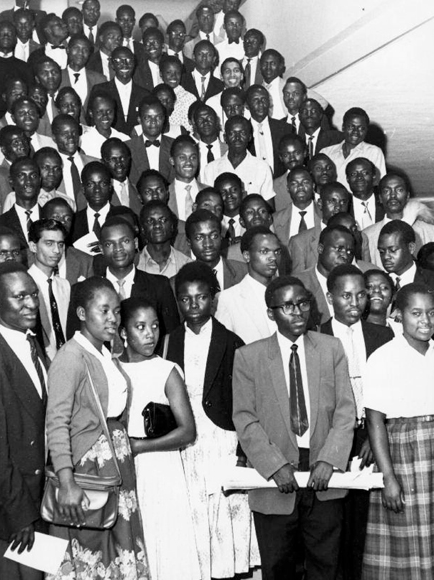
Between 1959 and 1963, Tom Mboya, the Kenyan politician and presidential aspirant, organised the airlifting of 770 young men and women from Kenya and nine other East, Central, and Southern countries to go and study in the USA and come back to shape the future of their countries. Fifty years on, the friends of Mboya pay homage to his patriotic work, reports Leslie Goffe from New York.
Kenya would have struggled to run itself in the early days, after the British lowered their Union Jack and left 50 years ago, had Tom Mboya, the Kenyan politician, not convinced US charities to give hundreds of young Africans – among them President Barack Obama’s father – scholarships to study at American universities as part of an educational initiative that became known as “Operation Airlift Africa”.
“These are men and women who will help build our nation,” Tom Mboya said of the students chosen to participate in the Airlift Africa initiative, which began in 1959 and ended as Kenya became independent in 1963. “My efforts to help African students to study overseas are based on my conviction that our people need higher education.”
Airlifted to America aboard specially chartered BOAC (British Overseas Airways Corporation) airplanes, the students were trained in the US to become everything from engineers and economists to agronomists and civil servants. They were really preparing, though, to become the future leaders of Kenya and fill positions in government and industry the British would soon vacate.
According to a University of Nairobi study, more than half of the parliamentarians, top civil servants, and leaders of industry in post-independence Kenya were Airlift Africa alumni.
Among the best-known was George Saitoti, who became the vice-president of Kenya and died on 10 June 2012; Florence Mwangi, the first African woman physician in Kenya; Joe Barrage ‘Joe B’ Wanjui, an industrialist and CEO of East African Industries (Unilever); and Wangari Maathai, the environmentalist and political activist who won the 2004 Nobel Peace Prize.
President Obama’s father, Barack Obama (Senior), also received funding from Tom Mboya’s Airlift Africa. But he was not among those airlifted to America. Obama Snr had applied to the programme but was rejected because his grades were too low.
He made his own way to the United States with funding from a wealthy American family. But once Obama Snr was at a university in Hawaii, where he met and married Stanley Ann Dunham and had the future President of the United States, Tom Mboya agreed to assist him with tuition money and living expenses.
President Obama is proud of the part his father played in Airlift Africa. In books and speeches, he has spoken of how grateful he was to the Kennedy family for contributing money to bring African students to America – otherwise his mother and father would not have met and he would not have become America’s first black president. “The Kennedys decided we’re going to do an airlift,” President Obama said in a 2008 speech. “We are going to go out to Africa and we are going to start bringing young Africans over to this country… And this young man named Barack Obama got one of those tickets and came over to this country.”
There is no doubting that Tom Mboya’s airlifts were an important initiative, both for the future of the USA and the future of Africa. Thanks to Mboya, Kenya did not have to depend entirely on white expatriates to run the country’s Civil Service when it became independent in 1963, as Ghana had to endure when it became independent in 1957.
Returning students
Kenya’s returning airlift students filled many of the key posts in the Civil Service and industry, thus giving the country a big head start at independence. Kenya’s founding president, Jomo Kenyatta, praised Mboya’s vision. “Kenya’s independence would have been seriously compromised, were it not for the courage and steadfastness of Tom Mboya,” Kenyatta said.
Most of the airlift students came from Kenya, but others came, too, from Uganda, and what would later become Tanzania, Malawi and Zimbabwe. The first airlift, with 79 Kenyans, one Ugandan and one Tanganyikan, arrived in New York from Nairobi on 9 September 1959.
Waiting to meet them at New York’s Idlewild Airport were members of a support organisation, the African-American Students Foundation. Also there was a key backer of the airlift initiative, Jackie Robinson, the African-American who had integrated the segregated world of American professional baseball. “I couldn’t help but feel that here was a whole group of potential Tom Mboyas, Kwame Nkrumahs, and Nnamdi Azikwes,” said Robinson as he shook hands with the young Africans.
Also waiting to meet the students at the airport were reporters from The New York Times and the African-American newspaper, New York Amsterdam News.
The students had been warned not to say anything about racial segregation in the US or about British colonial rule in Kenya. Saying the wrong thing, they were told, might lose them their scholarships or ruin the chances of other Africans coming to the United States to study.
But Fred Egambi Dalizu, an airlift student who would go on to become a professor at the University of Nairobi, ignored the warnings. He told the reporters he was eager for the day when Kenya would achieve independence and he could return home and join with other Kenyans in “watching the British sun set behind our beloved Mount Kilimanjaro”.
Intrigued by the young Africans, The New York Times reporter asked the 24-year-old Frank Nabutete, why on earth he had chosen to attend college in the segregated American South, in the notorious town of Little Rock, Arkansas, where armed soldiers had been sent two years previously to stop nine black teenagers from integrating their local high school.
Nabutete had a good answer to the question. He said in Kenya Africans were treated much the same way African-Americans were treated in the United States. Surviving American racism, he said, would teach him how to survive, and defeat, British racism and colonialism at home. “Troubles are not in Little Rock alone,” said Nabutete, assured and articulate. “The trouble in Little Rock might give me better experience for when I return to Kenya.”
Encouraging pan-African cooperation, the New York Amsterdam News began a campaign in its pages to get its readers to help the airlift students in whatever way they could. Tom Mboya was eager for American support for his initiative. He knew the British colonial authorities were against him and had done everything they could to see his plan fail.
The British colonial attaché in Washington DC, Douglas Williams, wrote a letter to The New York Times denying that education needed to be expanded in Kenya and claiming that Kenyans were happy with the way things were.
Mboya rejected this. In an article, he pointed out that only a tiny percentage of the Kenyan African population was receiving higher education and technical training at Makerere University in Uganda. In 1959, for example, only 23 Kenyans were selected to study in Britain compared with the 79 Kenyans who went on the airlift to America.
Mboya also pointed out that only £10 to £20 was allotted by the British authorities to educate Africans, while five times as much, £60 to £90, was allotted for the education of whites in Kenya. Naturally enough, Mboya turned to the Americans, who were eager to enhance their standing in Africa now the British were preparing to leave.
Fundraising tour
To drum up further support for Airlift-Africa, and cash in on promises made by many wealthy Americans, Mboya set off on a fundraising tour of the United States in April 1959. In the US, Mboya was greeted as an African hero by African-Americans. He met with Dr Martin Luther King Jnr, who invited him to speak at a civil rights rally in Washington.
“You and ourselves are all engaged in the same struggle that can aptly be summarised in terms of a struggle for political freedom, economic opportunity and human dignity,” Mboya told the crowd. Dr King agreed to raise funds for Operation Airlift Africa and said he would find families to sponsor some of the students.
Impressed by Mboya, Dr King sent him an interesting letter. “There is no basic difference between colonialism and segregation,” Dr King wrote. “They are both based on a contempt for life and a tragic doctrine of white supremacy. So, our struggles are not only similar, they are in a real sense one.”
Popular with African-Americans, Mboya was popular, too, with American politicians who viewed the Kenyan as a practical, pro-capitalist who would be a good friend to the US if he became the President of Kenya one day.
Mboya met Richard Nixon, the then US vice president, the billionaire David Rockefeller, and Senator John F. Kennedy, the then chairman of the Senate Foreign Relations Subcommittee on Africa, but none of them was ready, they said, to commit funds to the airlifts. It did not really matter though, as Mboya and his supporters managed to scrape together the money to fund the 1959 airlift. Mboya succeeded in convincing dozens of US colleges and universities and several wealthy philanthropists to bankroll the student scholarship scheme to the tune of $2m.
Indeed Mboya did not do it by himself. He had help from Bill Scheinman, a white businessman who was a member of the American Committee on Africa. Scheinman had made his money selling airplane parts, and even before he became involved in Mboya’s airlift scheme, he had helped several young Africans to attend university in the US and the UK.
It was Scheinman who convinced Mboya that they ought to charter planes to transport the students to the US as commercial airlines tickets were expensive and ate up much of the money intended for tuition.
Mboya also received help from the former African-American baseball player Jackie Robinson, who offered to pay the tuition and expenses of several of the students; and from the African-American singer, Harry Belafonte, who agreed to put on special concerts to raise money for the students.
When JFK went on board
A year after the first airlift, Mboya came to the US again to raise funds for Operation Airlift Africa. This time John Kennedy, who was running for president, invited him to his home, where he agreed to donate $100,000 of Kennedy Foundation money. The funds would be for the charter of four BOAC airplanes. In addition, Kennedy donated a further $100,000, to be used for whatever the 295 students coming on the 1960 airlift needed.
Kennedy was no fool. He knew his generosity would win him African-American votes in the presidential election and help to convince Kenya, when it became independent, to be pro-American and anti-Russian.
“Education, in truth, is the only key to genuine African independence and progress,” Kennedy said at a conference in the USA attended by Mboya. “If these new states and emerging peoples turn bitter in their taste of independence, the reason will be that the Western powers … have failed to see that it is their own future that is also at stake.”
But Vice President Nixon was furious when he heard that his rival for the presidency, Kennedy, had pledged money to Airlift Africa. Worried that he had been outflanked by Kennedy, Nixon pressed the US government to make money available to Mboya. But it was too late.
Kennedy’s airlift pledge, it appeared, won him the black vote and the election in 1960. In the following years, the US government made sure it was the chief funder of the Airlift Africa programme.
This led to charges from Mboya’s critics that he was a puppet of the US government and big business, and would assist the US in becoming the new colonial master in Africa. Mboya’s airlift programme, according to his detractors, was making Americans out of Africans.
Much of the criticism came from the camp of Mboya’s chief political rival, Oginga Odinga, who, like Mboya, hoped to one day become the president of Kenya. Odinga was as close to the Soviet Union as Mboya was to the United States. As a counter, Odinga arranged for the USSR to provide scholarships for thousands of Kenyans to study at the Patrice Lumumba University in Moscow or elsewhere in the Eastern Bloc.
For an African student on a very tight budget, the Soviet scholarships were very tempting, coming as they did with tuition and all expenses paid for by Moscow’s “Peoples’ Friendship University of Russia”.
Several well-known Kenyans attended Eastern Bloc universities on special scholarships. Among them are Joseph Kamotho, a former minister of education; Dr Odongo Omamo, a former minister of agriculture; and S.M. Otieno, who became a leading criminal attorney in Kenya.
Apart from the criticisms of being pro-American, Mboya was also criticised for filling the airlifts with Kikuyu and Luo students. Mboya himself was a Luo. Masinde Muliro, the deputy head of the Kenyan African Democratic Union, and a member of the Bukusu ethnic group, even claimed that the airlifts were a “political swindle” and that his party would send a delegation to the US to ensure that students from all Kenya’s ethnic groups received airlift scholarships.
Mboya was also accused of nepotism. His opponents claimed that he arranged scholarships for family members and friends who had not properly qualified for the airlifts. They pointed to his fiancée, the then Pamela Odede, who went on the 1959 airlift to study at the Western College for Women in Ohio as proof of nepotism.
“Asomi”, or “American elites”, is what some Kenyans dismissively called the Airlift Africa students, pricking their pretensions and acquired American accent. But life in America between 1959 and 1963, the height of the civil rights period, was not as easy as some thought. Many of the students who found themselves at colleges in the American South complained of being racially abused. Many transferred to schools in the North, fearing for their lives.
Cora Weiss, who worked for an organisation that provided support for the airlift students, confirmed that life was not easy for the young Africans. “The saddest moment for me was when a darling guy was getting off a bus one day and was run down by a car,” Weiss explained. “It was a racist murder and the local police refused to investigate.”
It was Weiss’ job to ship the student’s body back to Kenya. “We were attacked for bringing bunches of Africans from the bush to our country. It’s racism. It’s America. It’s the 50s and 60s.”
To protect themselves, many of the students would don traditional dress in the hope of convincing racists that they were not African-Americans. “Our hosts always told us: ‘Wear your national dress when you go out to restaurants and public places’”, revealed the Ugandan Mahmood Mamdani, who was on the final airlift in 1963.
Mamdani went home briefly to Uganda but returned to the US, where he works as a university professor in New York. “We realised that the national dress differentiated us from Americans of colour; [and] we came to realise that discrimination was less about colour than about the history of slavery and subordination.”
In all, 770 young men and women from Kenya and nine other East, Central, and Southern African countries were airlifted to the USA between 1959 and 1963 as part of Operation Airlift-America. Sadly, Mboya did not live long enough to witness how the returning students helped to shape Kenya and other countries. A contender for the Kenyan presidency, Mboya was assassinated in 1969, six years after the final airlift to America.
“Nothing constitutes a greater contribution to the struggle against poverty, disease and political subjection in Africa than that made towards our peoples’ educational advancement,” said Mboya, who was described, memorably, by a Kenyan newspaper as “the greatest president Kenya never had”.